Laser
Light Beams That Changed the World
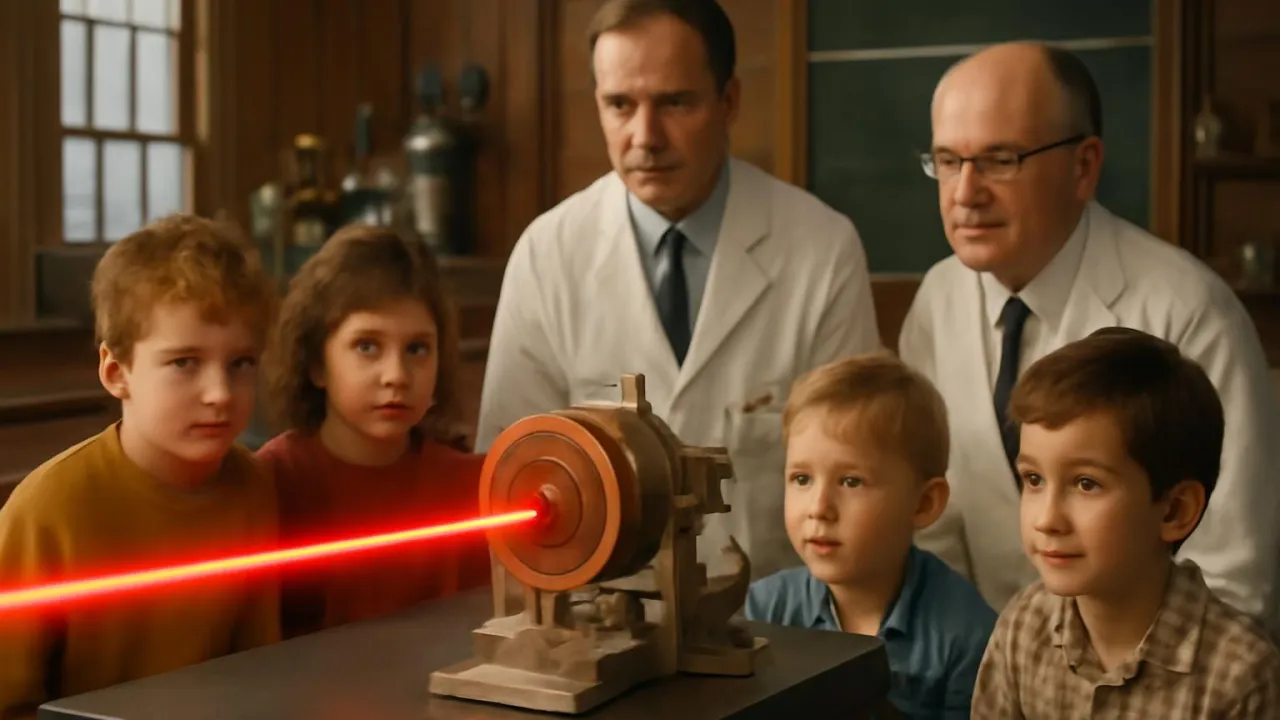
Scientists have used lasers to cool atoms to just billionths of a degree above absolute zero!
1 A Spark of Innovation: The Birth of the Laser
In 1960, physicist Theodore Maiman achieved a scientific breakthrough by constructing the first operational laser at Hughes Research Laboratories in California. He used a synthetic ruby crystal and a powerful flash lamp to create a beam of light that was not only intensely bright but also incredibly focused. This invention built upon earlier discoveries in quantum physics, particularly the concept of stimulated emission, which was first theorized by Albert Einstein in 1917. Maiman’s ruby laser produced a flash of coherent red light, launching the field of and revolutionizing technology across the globe.
2 The Science Behind the Beam
A laser, which stands for Light Amplification by Stimulated Emission of Radiation, operates by exciting atoms within a , such as a crystal, gas, or semiconductor. When these atoms are energized, they emit photons, which then trigger additional atoms to release even more photons in a chain reaction known as stimulated emission. The photons bounce between two mirrors—one fully reflective and one partially transparent—until a narrow, coherent beam escapes. This process results in light that is (single color), highly directional, and extremely intense, making lasers unique among light sources.
3 Engineering Marvels and Applications
Lasers come in many types, including solid-state, gas, dye, and semiconductor lasers, each engineered for specific tasks. Industrial lasers can cut through thick steel plates with millimeter precision, while medical lasers perform delicate eye surgeries by reshaping the cornea with micron-level accuracy. In telecommunications, fiber-optic cables use laser pulses to transmit data at nearly the speed of light, connecting continents and powering the internet. Scientific research relies on lasers for spectroscopy, holography, and even cooling atoms to near absolute zero temperatures.
4 From Moon Landings to Everyday Life
One of the most spectacular uses of lasers is lunar ranging, where scientists bounce laser beams off mirrors left on the Moon by Apollo astronauts to measure the Earth-Moon distance within centimeters. Lasers are also essential in barcode scanners, DVD players, 3D printers, and even in the alignment of skyscrapers during construction. Their ability to deliver energy with pinpoint accuracy has transformed manufacturing, medicine, communications, and entertainment, making lasers a cornerstone of modern society.
5 Safety, Ethics, and the Future
While lasers have unlocked countless possibilities, their power demands careful handling and ethical use. High-powered lasers can cause permanent eye or skin damage, so safety goggles and strict protocols are required in laboratories and factories. As laser technology advances, it raises questions about privacy, security, and responsible innovation, especially with the development of laser weapons and surveillance tools. Looking ahead, lasers are expected to play a key role in emerging fields like quantum computing, clean energy, and interplanetary communication, continuing to illuminate new frontiers for humanity.
1. Which scientist first theorized the process behind lasers?
2. Why are lasers crucial in fiber-optic communication?