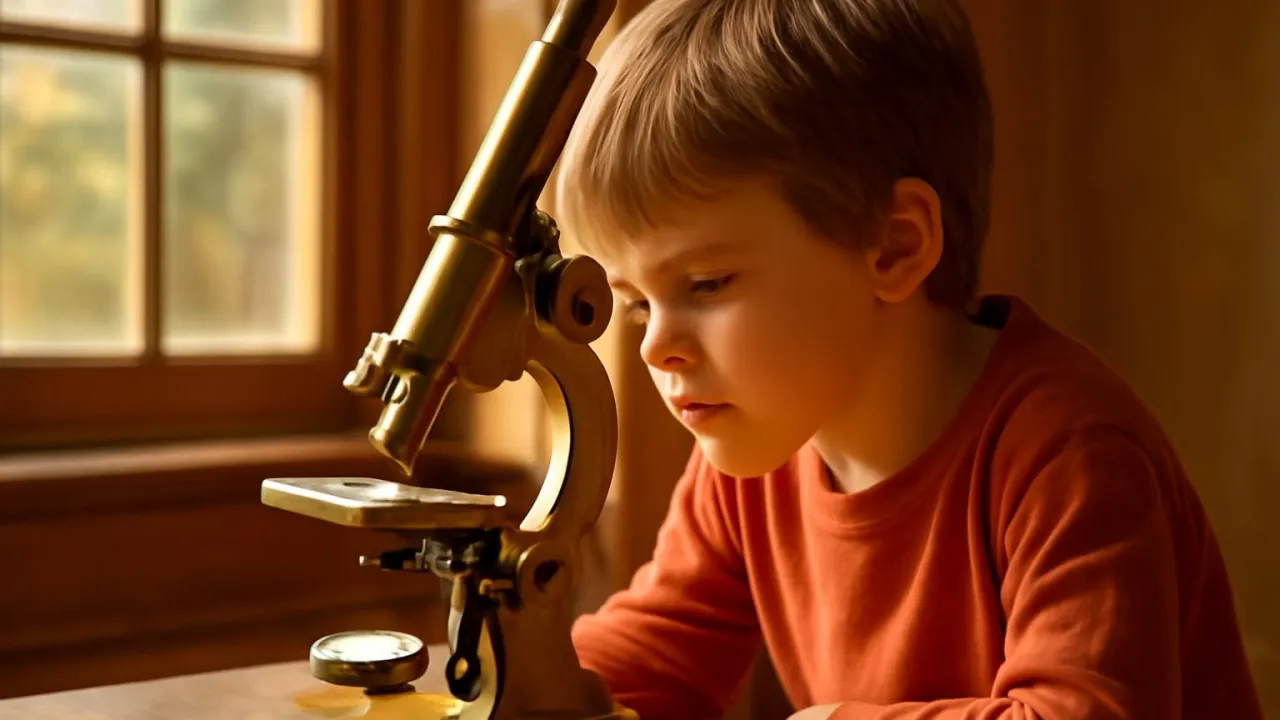
The first microscopes were made over 400 years ago in the Netherlands.
✨ Word Sparks (Grade 2 Glossary)
Tap 🔊 to hear
eyepiece
The part you look through
sample
A tiny piece you want to see
germ
A tiny living thing that can make you sick
🪝
Have you ever wondered what a drop of pond water looks like up close?
1
Seeing the Unseen
A microscope lets you see things your eyes cannot. You look through a lens and everything becomes bigger. Scientists use microscopes to study bugs, plants, and even . It is like having super-seeing powers!
2
How Does It Work?
A microscope uses glass lenses to bend light. This makes tiny things look much bigger and clearer. You place a on a slide and peek through the . Suddenly, a whole new world appears!
3
A Tool for Discovery
People have used microscopes for hundreds of years. They help us learn about cells, which are tiny parts of living things. With a microscope, you can explore amazing details all around you.
2. What does a microscope use to make things look bigger?
🤯 Mind-Blowing Fact • Grade 3
The strongest electron microscopes can magnify things over 10 million times!
✨ Word Sparks (Grade 3 Glossary)
Tap 🔊 to hear
specimen
A sample you look at closely
bacteria
Tiny living things too small to see
magnification
How much bigger something looks
🪝
Imagine peering into a drop of water and seeing creatures swimming inside—how is that possible?
1
A New Way to See
Microscopes let us explore worlds too small for our eyes to see. When you look through the eyepiece, the lens magnifies tiny objects like plant cells and . Early microscopes, invented in the 1590s, amazed people by revealing details never seen before. Today, scientists use them to study everything from leaves to pond water.
2
How Microscopes Work
A microscope uses curved glass lenses to bend and focus light. This process is called , and it makes small things look much larger and clearer. You place a on a glass slide, then adjust the focus knob to see sharp details. Some microscopes can magnify objects up to 1,000 times their real size!
3
Discoveries Under the Lens
With microscopes, scientists discovered cells, the building blocks of all living things. They also found tiny creatures called microbes, which can live in water or even on your skin. These discoveries changed how people understood health, disease, and the natural world. Every slide can reveal something surprising and new.
4
Microscopes Today
Modern microscopes are even more powerful, using light or electrons to see tiny details. Some can show viruses, which are smaller than . Microscopes are used in schools, hospitals, and research labs all around the world. They help us solve mysteries and make new inventions every day.
Without microscopes, scientists would never have discovered germs or learned how to fight diseases.
✨ Word Sparks (Grade 4 Glossary)
Tap 🔊 to hear
convex lens
A lens curved outward to bend light
nucleus
The center part of a cell
electron microscope
A super-strong microscope using electrons
🪝
What secrets would you uncover if you could see things smaller than a grain of salt?
1
Peering Into Hidden Worlds
Microscopes open up entire worlds that are invisible to the naked eye, revealing astonishing details in everyday objects. When you peer through the eyepiece, light passes through glass lenses that magnify the specimen on the slide. Early microscopes, invented by Dutch spectacle makers in the late 16th century, amazed people by showing them the intricate structures of insects and plants. Since then, microscopes have become essential tools for scientists, doctors, and students everywhere.
2
Engineering Marvels
A microscope works by using to bend and focus light, creating a magnified image of the specimen. The process of magnification allows us to see features as small as a cell’s or a single bacterium. By adjusting the focus knob, you can make the image sharp and clear, revealing details that are impossible to see otherwise. Some microscopes, like , use beams of electrons instead of light to achieve even greater magnification.
3
Changing Science Forever
The invention of the microscope sparked a revolution in biology and medicine, allowing scientists to discover cells, bacteria, and even viruses. These discoveries helped people understand how diseases spread and how living things grow and function. Microscopes also led to new inventions, such as vaccines and antibiotics, which have saved millions of lives. Today, microscopes continue to help researchers solve scientific mysteries and make new discoveries.
4
Microscopes Around the World
From classrooms to high-tech research labs, microscopes are used by people of all ages and backgrounds. They are vital tools in fields like medicine, forensics, and environmental science, helping us learn more about the world at the tiniest scale. Modern microscopes can even take digital pictures and videos of microscopic worlds, making science more exciting and accessible. The microscope’s impact on science and society continues to grow every year.
2. What do electron microscopes use to magnify objects?
🤯 Mind-Blowing Fact • Grade 5
Antonie van Leeuwenhoek’s handmade microscopes could magnify objects over 200 times—enough to see bacteria for the first time in history.
✨ Word Sparks (Grade 5 Glossary)
Tap 🔊 to hear
resolving power
How clearly a microscope shows tiny details
nanotechnology
Science of super-tiny things and machines
confocal
A microscope that uses lasers for sharp images
🪝
If you could shrink down to the size of a dust speck, what wonders might you witness through a microscope?
1
The Birth of a Scientific Revolution
In the late 16th century, Dutch spectacle makers Zacharias and Hans Janssen experimented with stacking glass lenses, creating an instrument that would forever change science. Their early microscope, a simple tube with two convex lenses, allowed people to see details far too small for the naked eye. Soon after, Antonie van Leeuwenhoek, using improved lenses, became the first person to observe single-celled organisms—what he called 'animalcules.' The microscope’s invention marked the dawn of microbiology and transformed our understanding of life’s complexity.
2
Optical Engineering: How Microscopes Magnify
A compound light microscope uses two or more convex glass lenses to bend, focus, and magnify light passing through a specimen. The objective lens, closest to the sample, creates an enlarged real image, which is further magnified by the eyepiece lens. By adjusting the focus and changing objective lenses, users can achieve magnifications from 40x up to 1,000x or more. The of a microscope—its ability to distinguish two close points as separate—depends on the quality of its lenses and the wavelength of light used.
3
Electron Microscopes: Seeing the Invisible
In the 1930s, scientists developed the electron microscope, which uses beams of electrons instead of light to achieve magnifications over 10 million times. Transmission electron microscopes (TEM) can reveal the internal structure of cells, while scanning electron microscopes (SEM) provide detailed 3D images of surfaces. These instruments have enabled researchers to visualize viruses, DNA strands, and even individual atoms, opening up entirely new fields in and molecular biology.
4
Microscopes in Medicine, Science, and Industry
Microscopes have revolutionized medicine by making it possible to identify bacteria, diagnose diseases, and develop life-saving vaccines and antibiotics. In environmental science, they help detect pollutants and study microorganisms in water and soil. Forensic scientists use microscopes to analyze evidence such as hair, fibers, and fingerprints, while engineers inspect the tiniest flaws in materials and electronics. The microscope’s impact stretches across nearly every scientific and technological field.
5
A Window to New Frontiers
Today, digital and microscopes allow scientists to capture high-resolution images and videos of living cells in real time. Advances in super-resolution microscopy have broken the limits of traditional optics, revealing structures smaller than the wavelength of light. As technology evolves, microscopes continue to unlock new mysteries of life, matter, and the universe, inspiring curiosity and discovery for generations to come.