Printing Press
The Machine That Multiplied Words
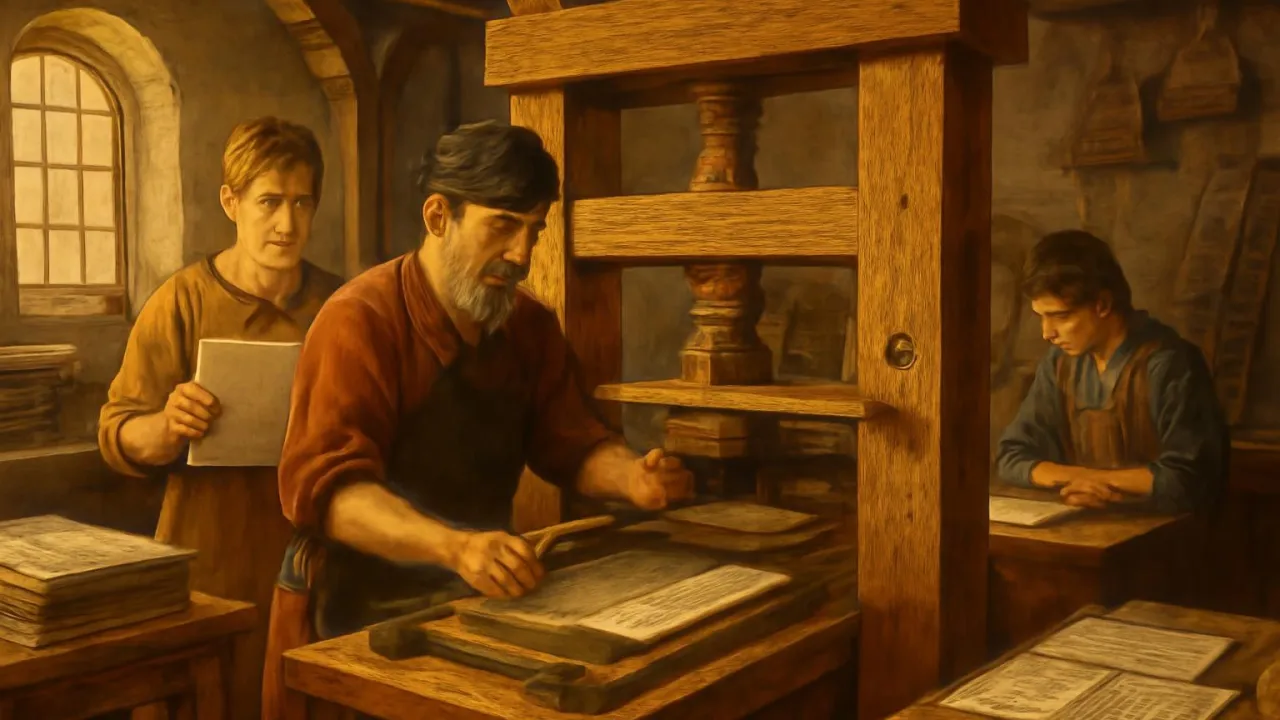
Gutenberg’s press could produce up to 240 pages per hour—over 200 times faster than hand-copying!
1 The Workshop That Changed the World
Step inside Johannes Gutenberg’s bustling 15th-century workshop, where the clatter of wooden gears and the rhythmic thump of the press fill the air. Instead of laboriously copying books by hand, skilled workers carefully arrange hundreds of tiny metal letter blocks—movable type—into sturdy iron frames. Thick, oil-based ink is rolled evenly across the raised surfaces, and a large screw press applies uniform pressure, transferring the letters’ shapes onto crisp sheets of paper. Each page emerges with lines of perfectly aligned, easily readable text, ready to be bound into books.
2 Engineering Marvels: How the Press Works
The Gutenberg press operates on the principles of mechanical and uniform force distribution, using a screw mechanism adapted from wine and olive presses. When the operator turns the handle, the screw drives a heavy down, pressing the inked type against the paper with consistent pressure. This process ensures high-quality impressions and allows for rapid, repeatable production. The use of movable metal type, cast from durable alloys, means printers can rearrange letters for every new page, maximizing efficiency and minimizing errors.
3 A Catalyst for Knowledge and Social Change
Before the printing press, books were rare, painstakingly hand-copied, and affordable only for the wealthy or religious leaders. Gutenberg’s invention revolutionized access to information by making books cheaper, faster, and more widely available. This of knowledge fueled the Renaissance, the Scientific Revolution, and the Reformation, as ideas could now spread rapidly across continents. Literacy rates soared, and people from many backgrounds could learn, debate, and innovate like never before.
4 Global Impact and Evolution of Printing
Within fifty years of Gutenberg’s press, thousands of print shops had opened across Europe, producing millions of books in dozens of languages. The spread of printed materials accelerated scientific discoveries, preserved ancient texts, and connected distant cultures through shared stories and news. Over centuries, printing technology evolved from hand-powered presses to steam-driven machines and, eventually, to digital printers capable of producing billions of pages annually. Yet, the core principle—using pressure to transfer inked type to paper—remains unchanged.
5 Legacy in the Modern World
Today’s world of instant communication and global publishing owes its roots to Gutenberg’s pioneering invention. The printing press not only transformed education, science, and literature but also empowered ordinary people to share their voices. Modern newspapers, books, and even websites are direct descendants of that first press in Mainz. By making information accessible to all, the printing press set humanity on a path toward greater understanding, creativity, and progress.
1. What key engineering principle made the Gutenberg press so efficient?
2. How did the printing press change society’s access to information?