Refracting Telescope
Peeking Far into Space with Glass and Light
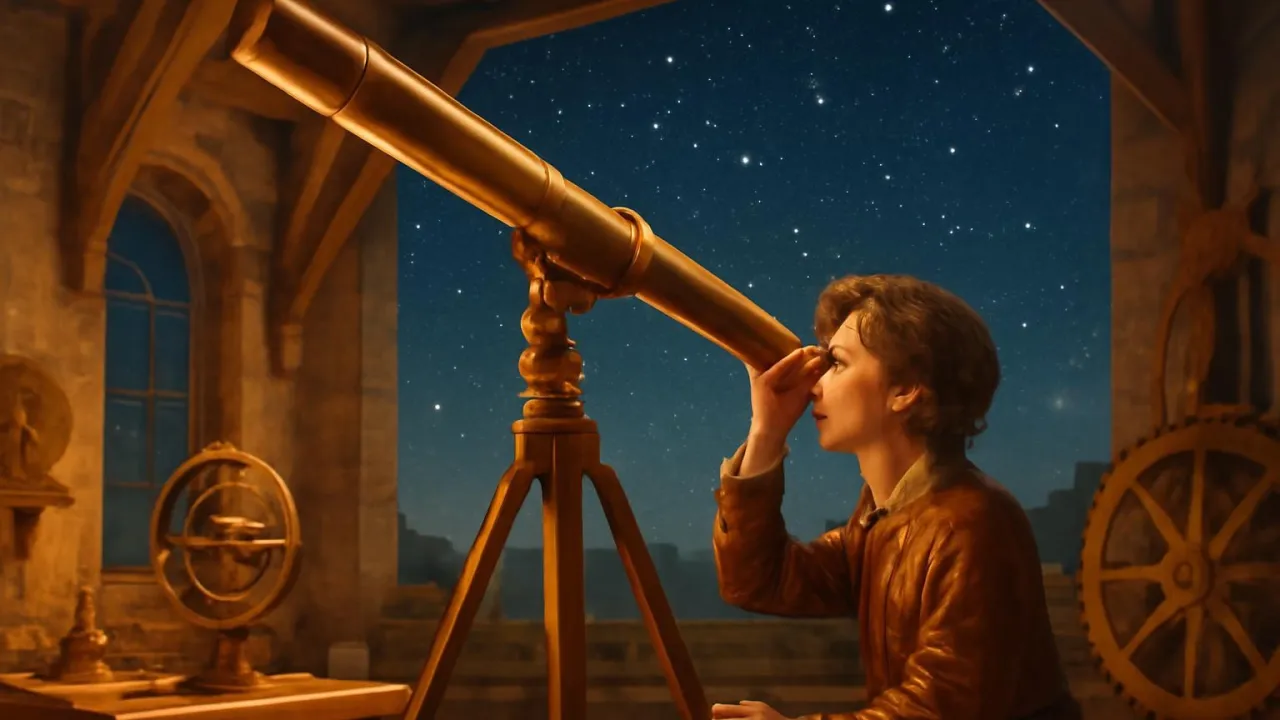
Galileo’s improved refracting telescope was only about 1.3 meters long but revealed mountains on the moon and Jupiter’s moons.
1 Inventing a New Way to See the Cosmos
In 1608, Hans Lippershey, a Dutch spectacle maker, assembled the first refracting telescope by aligning two glass lenses in a long tube. This device instantly fascinated scientists and explorers, as it allowed them to observe distant objects with unprecedented clarity. The refracting telescope soon reached Italy, where Galileo Galilei famously improved its design and pointed it skyward. Galileo’s observations using this instrument marked a turning point in astronomy and human understanding of space. The refracting telescope’s invention sparked a revolution that would echo through every observatory and classroom for centuries.
2 Optical Physics: How Refraction Magnifies the Universe
A refracting telescope works by using the principle of refraction, which is the bending of light as it passes through materials of different densities, such as glass and air. The objective lens, usually a large convex lens at the front, gathers light from a distant object and bends it to a inside the tube. The eyepiece lens, a smaller convex lens, then magnifies this focused image so the human eye can see fine details. The power of a refracting telescope depends on the curvature and diameter of its lenses, with some early models reaching up to 30x magnification. However, making large, perfect glass lenses was a major engineering challenge, often resulting in long, heavy telescopes to reduce image distortion known as .
3 Galileo’s Discoveries and the Scientific Revolution
Galileo Galilei’s use of the refracting telescope in 1609 led to discoveries that forever changed our view of the cosmos. He observed four moons orbiting Jupiter, proving that not everything revolves around the Earth, and saw the rugged surface of the moon, challenging the idea that heavenly bodies were perfect spheres. Galileo also documented the phases of Venus, providing evidence for the heliocentric model of the solar system. His findings, published in 'Sidereus Nuncius,' sparked debates and inspired future generations of astronomers. The refracting telescope became a symbol of scientific curiosity and the power of observation.
4 From Early Telescopes to Modern Instruments
Although early refracting telescopes were groundbreaking, their design had limitations due to and the difficulty of producing large, flawless lenses. In the 18th century, achromatic lenses were invented to correct color distortion, allowing for shorter and clearer telescopes. Today, refracting telescopes are still used for educational purposes and in some research observatories, but most large modern telescopes use mirrors instead of lenses. Reflecting telescopes, invented by Isaac Newton, can be built much larger and gather more light, making them better for deep space observation. However, the refracting telescope’s elegant design and historical significance remain celebrated in science museums worldwide.
5 The Lasting Impact on Science and Society
The refracting telescope not only transformed astronomy but also influenced navigation, timekeeping, and our philosophical understanding of the universe. By making the invisible visible, it encouraged scientific thinking and skepticism, leading to the development of new technologies and methods of inquiry. Today, refracting telescopes are accessible to students and amateur astronomers, inspiring curiosity and exploration. Their legacy endures in every lens that brings the distant universe closer to our eyes. The simple act of bending light with glass opened a window to the cosmos that will never close.
1. Why did early refracting telescopes sometimes produce blurry, colored edges around objects?
2. What major discovery did Galileo make with his refracting telescope?