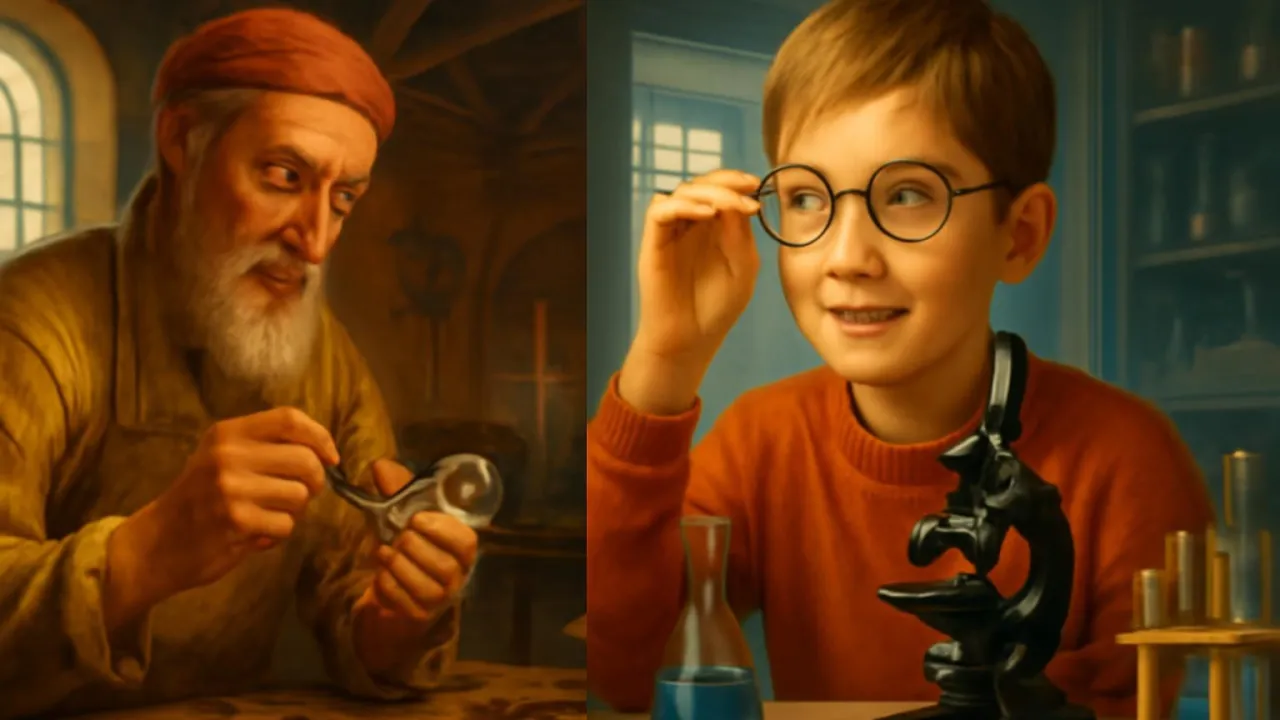
Some eyeglasses can turn dark in sunlight to protect your eyes!
✨ Word Sparks (Grade 2 Glossary)
Tap 🔊 to hear
lens
Clear piece that helps you see
invent
To make something new
focus
To see something clearly
🪝
Have you ever seen the world look fuzzy, then clear with glasses?
1
How Eyeglasses Work
Eyeglasses use special to bend light, making things look sharp. The lenses fit inside frames that rest on your nose and ears. People look through the lenses to read, draw, and see far away. Eyeglasses can help both kids and adults.
2
Choosing Cool Frames
Frames come in many shapes and colors, like circles, squares, blue, or red. Some people pick big , while others choose small ones. The frames hold the lenses right in front of your eyes. Picking glasses can be fun and show your style.
3
Eyeglasses in History
Eyeglasses were invented in Italy over 700 years ago. Back then, only a few people had them, but today millions wear glasses every day. Eyeglasses help people learn, read, and play. They make seeing the world easier for everyone.
Some scientists design special eyeglasses that help people who are colorblind see more colors!
✨ Word Sparks (Grade 3 Glossary)
Tap 🔊 to hear
refraction
Bending light to make things clear
lens
Curved glass that helps you see
frame
Part that holds the lenses
🪝
Imagine a world where words on a page turn from blurry to bright—how do eyeglasses make that happen?
1
Bending Light for Clear Sight
Eyeglasses use curved to bend light rays as they enter your eyes. This bending, called , helps images focus sharply on the back of your eye. When things look blurry, the lens shape corrects the problem. That way, people can see clearly both near and far.
2
Frames for Every Face
Eyeglass come in many shapes, like circles, ovals, or rectangles. Some frames are made from plastic, while others use metal or even wood. The frames hold the steady in front of your eyes. People choose frames that fit their style and feel comfortable.
3
A Long History of Helping Eyes
The first eyeglasses appeared in Italy around the year 1286. Early glasses had round, thick and were held by hand or balanced on the nose. Over time, inventors added arms to rest on the ears, making glasses easier to wear. Today, millions of people around the world use eyeglasses every day.
4
Eyeglasses Change Lives
Eyeglasses help children read books and see the board at school. Grown-ups use them to drive, work, and enjoy hobbies. Some glasses protect eyes from the sun or help people see in bright light. Thanks to eyeglasses, almost anyone can see the world in sharp detail.
2. How did early people keep eyeglasses on their face?
🤯 Mind-Blowing Fact • Grade 4
One pair of eyeglasses can bend light by up to 20 diopters, helping even very blurry eyes see clearly!
✨ Word Sparks (Grade 4 Glossary)
Tap 🔊 to hear
retina
The part of your eye that sees
temples
The arms that hold glasses on
diopter
A unit for measuring lens power
🪝
What if you could invent a tool that lets nearly anyone see the world in perfect focus?
1
How Lenses Fix Blurry Vision
Eyeglasses work by using lenses, which are curved pieces of glass or plastic that bend, or refract, light as it enters your eyes. If someone’s eyes cannot focus light directly on the , images appear blurry. The lens shape is chosen to correct specific vision problems, such as nearsightedness or farsightedness. By changing the path of incoming light, eyeglasses help form a sharp image on the retina.
2
From Ancient Curiosity to Everyday Tool
The earliest eyeglasses were invented in northern Italy in the late 1200s. These first glasses had round lenses and were held in front of the eyes by hand or balanced on the nose. Over centuries, inventors improved them by adding arms called , which rest over the ears. Today, eyeglasses are made with lightweight materials and advanced lens technology.
3
Eyeglasses Around the World
Eyeglasses have become a vital invention for people everywhere, helping millions read, learn, and work. In some countries, getting eyeglasses can change a person’s life by allowing them to go to school or do important jobs. Special types of glasses, like sunglasses or safety goggles, protect eyes from sunlight and hazards. Eyeglasses are now a symbol of learning and curiosity in many cultures.
4
Science and Design Working Together
Modern eyeglasses are designed using optical science and precise engineering. Lenses are carefully shaped for each person’s needs, and frames are built for comfort and style. Some glasses can even change color in sunlight or help people see different colors. Eyeglasses show how science can solve real-world problems and improve daily life for people everywhere.
The World Health Organization estimates that over 2.2 billion people worldwide need eyeglasses or vision correction!
✨ Word Sparks (Grade 5 Glossary)
Tap 🔊 to hear
myopia
Trouble seeing far away; nearsightedness
diopter
A number showing lens strength
photochromic
Lenses that darken in sunlight
🪝
What if you could engineer a device that transforms blurry vision into crystal-clear sight for billions of people?
1
The Science of Optical Correction
Eyeglasses rely on the physics of refraction, where curved lenses alter the path of incoming light rays to compensate for imperfections in the eye’s own lens or cornea. If someone is nearsighted (myopic), their eye focuses images in front of the retina, making distant objects blurry; a concave lens spreads light rays outward to move the focal point back onto the retina. For farsightedness (hyperopia), a convex lens converges light rays, allowing the eye to focus images directly on the retina. Each lens is measured in , a unit that quantifies its optical power.
2
From Medieval Mystery to Global Necessity
The earliest eyeglasses appeared in northern Italy around 1286 CE, likely crafted by skilled glassmakers in Pisa or Venice. These primitive spectacles featured thick, round lenses made from quartz or glass, held together by riveted frames that balanced precariously on the nose. Over the centuries, inventors introduced temples (the arms that rest on the ears), nose pads, and lighter materials, making eyeglasses more comfortable and accessible. Today, advanced lens technologies—like anti-reflective coatings and progressive lenses—continue to improve visual clarity.
3
Engineering and Materials Innovation
Modern eyeglasses are engineered with precision, using lightweight plastics such as polycarbonate or high-index polymers for lenses, and titanium or memory metal for frames. Lenses are ground and polished to exact specifications based on the wearer’s prescription, sometimes using computer-controlled machines. Some glasses feature lenses that darken in sunlight, while others use polarized filters to reduce glare. These innovations allow eyeglasses to serve a wide range of needs, from reading to sports and even space travel.
4
Eyeglasses and Global Impact
Eyeglasses have transformed societies by enabling people with vision problems to read, learn, work, and participate fully in daily life. In many developing countries, access to affordable eyeglasses can mean the difference between attending school or being left behind. Organizations around the world now distribute low-cost glasses to millions, improving education and economic opportunities. Eyeglasses have also become a fashion statement and a symbol of intelligence and creativity in many cultures.
5
The Future of Eyeglasses
Today’s scientists and engineers are developing smart glasses with augmented reality displays, health sensors, and adaptive lenses that change focus automatically. Researchers are also exploring new materials, like graphene, to make lenses thinner and more durable. As technology evolves, eyeglasses will likely continue to bridge the gap between biology and engineering, helping people of all ages see the world in new ways. The journey from medieval workshops to high-tech labs shows how a simple invention can change the world.