Printing Press
The Machine That Multiplied Words
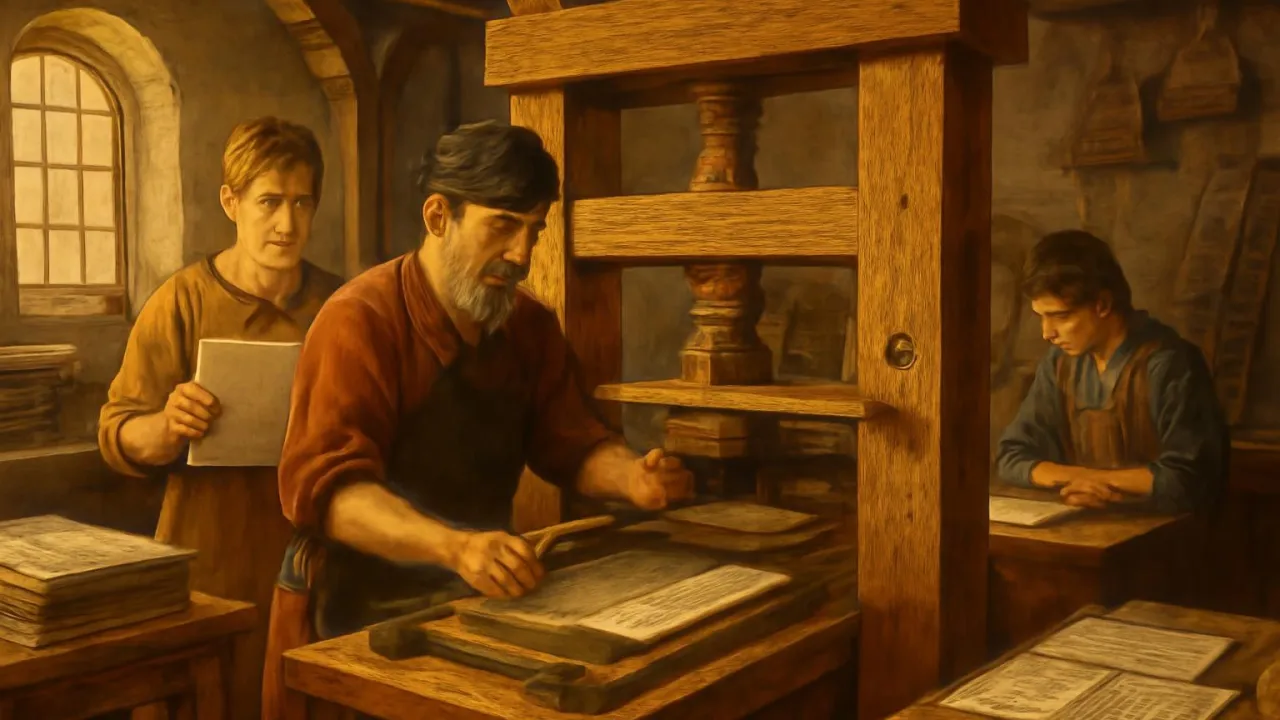
By 1500, over 20 million books had been printed in Europe thanks to the press!
1 A Revolution in a Workshop
In 15th-century Germany, the sound of wooden presses echoed through Gutenberg’s workshop as metal letters clacked into place. Instead of copying books by hand, workers used movable type to line up each word. Thick, sticky ink was rolled onto the letters, and a heavy press pushed the paper down with even pressure. Each printed page was sharp, clear, and could be made again and again.
2 The Mechanics of Printing
The printing press uses the principle of to transfer ink from raised metal type onto sheets of paper. Printers arranged the type blocks in a sturdy frame, creating lines of text for each page. When the press lever was pulled, it created strong, even force, ensuring each letter left a perfect . This process used both engineering skill and careful teamwork.
3 Gutenberg’s Impact on Society
Johannes Gutenberg’s invention changed history by making books faster and cheaper to produce. Before the press, only a few people could own books, but now, information could reach thousands of people. Schools, libraries, and scientists could share ideas more easily than ever before. The printing press sparked the spread of new inventions, discoveries, and even in thinking.
4 A World Connected by Words
As printing presses spread across Europe and beyond, people gained access to stories, science, and news from distant lands. The press helped preserve important knowledge and made learning possible for many more people. Today, we still use printing to share ideas, though technology has changed. The printing press began a global adventure in reading and learning.
1. How did the printing press make books clearer?
2. What did the spread of the press help create?