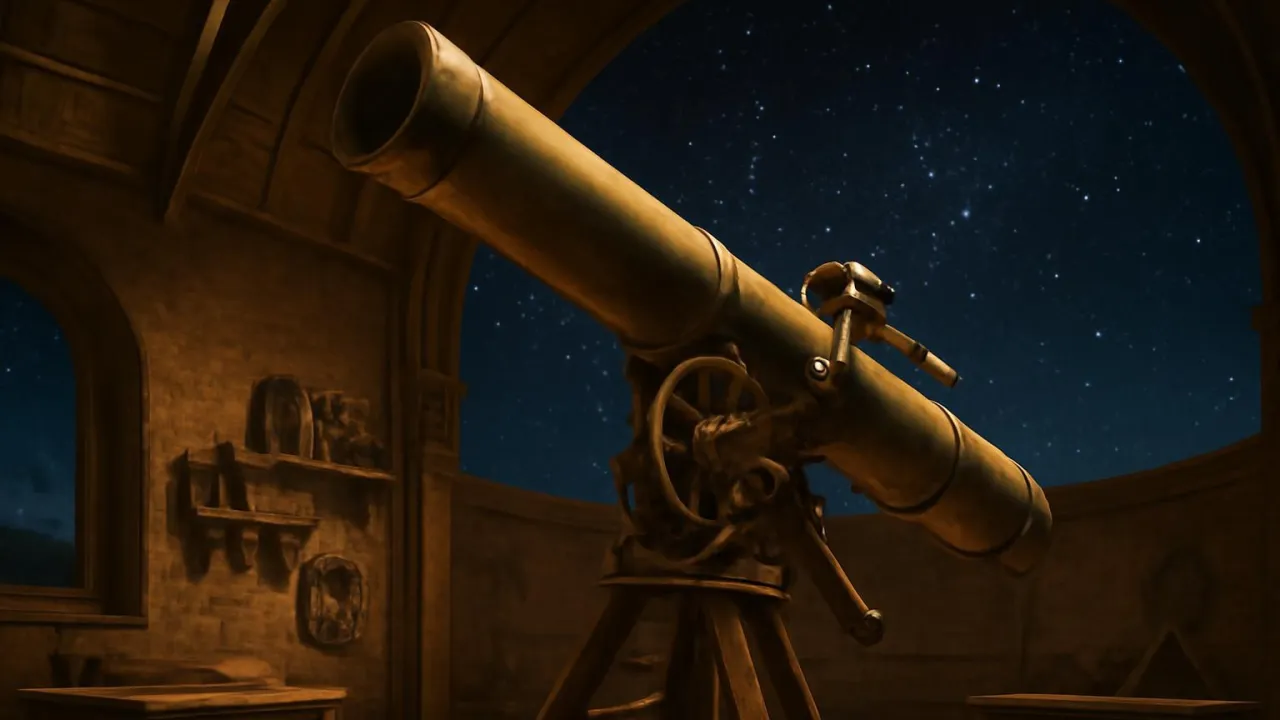
Some reflecting telescopes today have mirrors as big as a school bus!
✨ Word Sparks (Grade 2 Glossary)
Tap 🔊 to hear
curved
Bent or rounded, not flat
eyepiece
The part you look through
astronomy
The science of studying space
🪝
Have you ever wondered how we see faraway stars so clearly?
1
Mirrors Make Magic
A reflecting telescope uses a mirror, not just glass lenses. The mirror gathers light from far-off stars and planets. It bounces the light to a special spot called the . People look in the eyepiece to see space details.
2
A New Way to See Space
Isaac Newton built the first reflecting telescope in England. He wanted to see the sky without blurry colors. His mirror made star images look much clearer and sharper. Now, scientists use big reflecting telescopes to study the universe.
3
Why Mirrors Work So Well
Mirrors do not bend colors like glass lenses do. They help telescopes show true shapes and colors of planets. This lets us discover new things in space. Reflecting telescopes changed forever.
1. What does the curved mirror do in a reflecting telescope?
2. Why did Newton use a mirror instead of glass?
🤯 Mind-Blowing Fact • Grade 3
The largest reflecting telescope mirror is over 10 meters wide—wider than a classroom!
✨ Word Sparks (Grade 3 Glossary)
Tap 🔊 to hear
paraboloid
A special curved shape for mirrors
chromatic aberration
Blurry colors caused by glass lenses
galaxy
A huge group of stars in space
🪝
Imagine hearing a soft 'ping' as starlight bounces off a shiny mirror—what secrets could it reveal?
1
Mirrors That Catch the Universe
Reflecting telescopes use a curved mirror to collect light from distant objects. The mirror’s smooth surface reflects starlight and focuses it to a single point. This focused light travels to an eyepiece or a camera for viewing. Because of the mirror, even faint galaxies become visible to us.
2
Newton’s Bright Idea
Isaac Newton invented the first reflecting telescope in 1668 in England. He used a polished metal mirror instead of a glass lens to avoid color distortion. This design, called a Newtonian telescope, made images much clearer and sharper. Newton’s invention helped astronomers see planets and stars in greater detail.
3
Why Mirrors Matter
Unlike glass lenses, mirrors do not cause , which blurs colors. The mirror’s shape, called a , helps focus all the light to a single spot. This lets scientists observe true colors and fine details in space. Today, the largest telescopes in the world use giant mirrors.
4
Exploring the Cosmos
Reflecting telescopes have revealed new planets, nebulae, and distant galaxies. They help scientists study how stars form and change over time. With powerful reflecting telescopes, we can see objects billions of light-years away. These telescopes continue to expand our understanding of the universe.
1. What problem does a reflecting telescope solve compared to glass lenses?
2. What shape is the main mirror in a reflecting telescope?
🤯 Mind-Blowing Fact • Grade 4
Some modern reflecting telescopes use multiple mirrors working together as one giant eye on the sky.
✨ Word Sparks (Grade 4 Glossary)
Tap 🔊 to hear
focal point
The spot where light comes together
observatory
A special building for space telescopes
coating
A thin layer that helps reflect light
🪝
What if a giant, perfectly curved mirror could let you see galaxies millions of light-years away?
1
A Mirror That Changed Astronomy
The reflecting telescope, first built by Isaac Newton in 1668, uses a curved mirror to gather and focus light from space. Unlike earlier telescopes that used glass lenses, Newton’s design solved the problem of chromatic aberration, which made images blurry and colored at the edges. His invention allowed astronomers to see planets, stars, and nebulae with much greater clarity. This breakthrough marked a turning point in the history of astronomy and optical engineering.
2
How the Reflecting Telescope Works
At the heart of the reflecting telescope is a large, precisely shaped paraboloid mirror. This mirror collects incoming light and reflects it to a , where an eyepiece or camera captures the sharp image. Because mirrors can be made much larger than lenses, reflecting telescopes can collect more light and see fainter objects. Modern reflecting telescopes use advanced to make their mirrors even more efficient at reflecting light.
3
From Newton to Giant Observatories
Newton’s first telescope was small, but today’s reflecting telescopes are enormous, with mirrors over 10 meters wide. These giant telescopes are built in observatories on high mountains, where the air is clear and dark. They use computer-controlled motors to track stars and adjust the mirrors for perfect focus. Thanks to reflecting telescopes, scientists have discovered new planets, black holes, and galaxies far beyond our solar system.
4
Impact on Science and Society
Reflecting telescopes have revolutionized our understanding of the universe and our place within it. They have helped answer questions about how stars are born and how galaxies evolve over billions of years. The images and data collected by these telescopes inspire people all over the world to learn more about space. Reflecting telescopes continue to be essential tools for exploration, discovery, and education.
1. Why are reflecting telescopes often built on high mountains?
2. What is one reason mirrors are better than lenses for big telescopes?
🤯 Mind-Blowing Fact • Grade 5
The James Webb Space Telescope’s 6.5-meter gold-coated mirror unfolds in space to reveal the earliest galaxies ever seen.
✨ Word Sparks (Grade 5 Glossary)
Tap 🔊 to hear
aperture
The opening that lets in light
adaptive optics
Technology that sharpens telescope images
exoplanet
A planet outside our solar system
🪝
If you could build a telescope with a mirror the size of a swimming pool, how far into the universe could you see?
1
The Mirror Revolution in Astronomy
In 1668, Isaac Newton’s invention of the reflecting telescope transformed astronomical observation by replacing traditional glass lenses with a curved metal mirror. This innovation addressed the persistent issue of chromatic aberration, in which glass lenses split light into blurry, rainbow-colored edges. By using a polished paraboloid mirror, Newton’s design focused all wavelengths of light to a single, sharp point, enabling astronomers to observe celestial objects with unprecedented clarity and accuracy.
2
Engineering the Modern Reflecting Telescope
Modern reflecting telescopes feature primary mirrors made from glass coated with a thin layer of highly reflective aluminum or silver. These mirrors are often more than 10 meters in diameter, requiring precise engineering to maintain their perfect shape under their own weight. Secondary mirrors redirect the focused light to an eyepiece or advanced digital sensors, allowing for both visual observation and high-resolution imaging. systems use computer-controlled actuators to adjust the mirror’s surface in real time, correcting for atmospheric distortion and producing crisp, detailed images.
3
Physics Behind the Power
The effectiveness of a reflecting telescope depends on the mirror’s diameter, known as its , and its ability to collect and focus faint light. The larger the mirror, the more light it gathers, increasing both brightness and resolution. Paraboloid mirrors eliminate spherical aberration by ensuring all incoming parallel light rays reflect to a common focal point. This optical precision allows scientists to study extremely distant galaxies, nebulae, and even orbiting other stars.
4
From Newton to the Edge of the Universe
Reflecting telescopes have evolved from Newton’s handheld prototype to massive observatories like the Gran Telescopio Canarias and the twin Keck telescopes in Hawaii. These instruments have revealed black holes, mapped the expansion of the universe, and captured images of galaxies billions of light-years away. The Hubble Space Telescope, which also uses a reflecting mirror, orbits above Earth’s atmosphere to provide even clearer views of deep space. Each new generation of reflecting telescopes pushes the boundaries of our cosmic understanding.
5
Impact on Science and Society
The reflecting telescope has become an essential tool for both professional astronomers and amateur stargazers. Its ability to reveal the structure, composition, and evolution of the universe has inspired countless scientific discoveries and technological advances. Educational programs and public observatories use reflecting telescopes to spark curiosity and encourage careers in science, technology, engineering, and mathematics. As mirror technology continues to advance, the next generation of reflecting telescopes promises to unlock even more secrets of the cosmos.