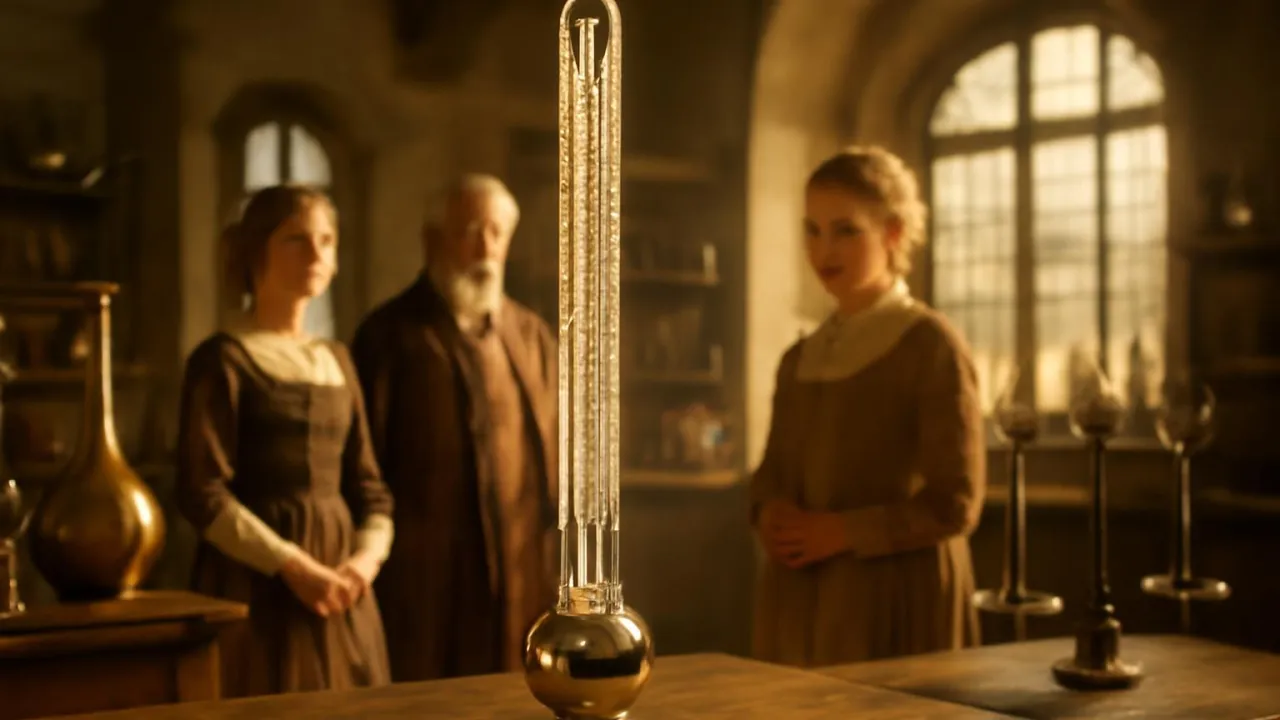
Mercury thermometers can measure temperatures from freezing ice to boiling water!
✨ Word Sparks (Grade 2 Glossary)
Tap 🔊 to hear
measure
To find out how much or how hot
fever
When your body feels too hot
experiment
A science test or try
🪝
Have you ever watched a thermometer’s silver line rise on a warm day?
1
A Magic Silver Climb
When it gets warmer, the silver mercury climbs higher in the tube. When it gets colder, the line drops back down. People can watch the line move and tell the temperature.
2
How Does Mercury Move?
Mercury is a special metal that turns liquid at room temperature. When it gets warm, mercury spreads out and takes up more space. This makes the line in the glass tube rise.
3
Why Do We Need It?
Doctors use thermometers to check if someone has a or is healthy. Scientists use them to heat in labs and . The thermometer helps keep people safe and helps us learn about the world.
Mercury thermometers were once used to measure the temperatures of volcanoes and freezing Arctic air!
✨ Word Sparks (Grade 3 Glossary)
Tap 🔊 to hear
expand
To get bigger or take more space
vibrate
To shake or move quickly
precise
Very exact or correct
🪝
What if you could see heat move as a shiny line in a glass tube?
1
The Shiny Secret Inside
A mercury thermometer has a thin glass tube filled with a silvery liquid called mercury. When the temperature changes, the mercury moves up or down inside the tube. The tube is marked with numbers so you can read the temperature. Watching the mercury rise or fall is like seeing heat itself move!
2
How Does It Work?
Mercury is a metal that stays liquid at room temperature and when it gets warmer. As the air or object around the thermometer heats up, the mercury faster and spreads out. This expansion pushes the mercury higher in the tube, showing a higher temperature. When things cool down, the mercury contracts and drops lower.
3
Who Invented It?
In 1714, Daniel Gabriel Fahrenheit invented the first reliable mercury thermometer. He wanted to make measuring temperature more accurate for science and medicine. His thermometer used a sealed glass tube and a scale, which made it much more than earlier designs. This invention changed how people understood heat and health.
4
Why Does It Matter?
Mercury thermometers helped doctors diagnose fevers and scientists study weather and chemistry. The invention made it possible to compare temperatures in different places and times. It also helped invent new ways to keep people safe and healthy. Today, digital thermometers are safer, but the mercury thermometer’s impact is still remembered.
1. Why does mercury rise in the thermometer when it gets warmer?
2. Who invented the first accurate mercury thermometer?
🤯 Mind-Blowing Fact • Grade 4
Mercury thermometers can measure temperatures as low as –39°C and as high as 356°C!
✨ Word Sparks (Grade 4 Glossary)
Tap 🔊 to hear
thermal expansion
When things get bigger as they heat up
density
How tightly packed something is
standardize
To make things the same everywhere
🪝
Imagine hearing a faint clink as a glass thermometer touches a hot cup—what’s happening inside?
1
A Breakthrough in Measuring Heat
Before the mercury thermometer, people struggled to measure temperature accurately and consistently. Daniel Gabriel Fahrenheit’s invention in 1714 changed that by using a sealed glass tube filled with mercury, a metal that remains liquid at room temperature and expands evenly as it warms. The thermometer’s narrow bore amplifies the mercury’s movement, making even tiny temperature changes easy to read. This breakthrough allowed scientists and doctors to compare temperatures in different places and times.
2
The Science Behind the Shine
Mercury’s unique properties make it perfect for thermometers: it has a high , expands uniformly, and does not wet glass, so it forms a clear line. When heat energy is transferred to the mercury, its molecules vibrate faster and spread apart, causing the liquid to rise up the tube. The scale on the glass, often marked in degrees Fahrenheit or Celsius, lets users read the exact temperature. This precise measurement is called ‘’.
3
From Sickrooms to Science Labs
Mercury thermometers quickly became essential tools in medicine, meteorology, and chemistry. Doctors used them to check for fevers, while meteorologists measured outdoor temperatures to study weather patterns. Chemists relied on them for experiments that required exact heat control. The thermometer’s accuracy helped scientific experiments and improve public health around the world.
4
A Lasting Impact
Although digital thermometers are now more common and safer, the mercury thermometer’s invention marked a turning point in science and medicine. Its design inspired other precision instruments and helped set standards for temperature measurement. Even today, the idea of using expansion and contraction to measure heat is found in many modern devices. The mercury thermometer’s legacy continues to shape how we understand and control temperature.
1. Why was mercury chosen for thermometers over other liquids?
2. How did mercury thermometers help science?
🤯 Mind-Blowing Fact • Grade 5
The world’s longest mercury thermometer, built for a science museum, stands over 40 feet tall!
✨ Word Sparks (Grade 5 Glossary)
Tap 🔊 to hear
capillary
A very thin glass tube
meniscus
The curved top of a liquid in a tube
calibration
Carefully setting a tool to be exact
🪝
What if you could watch invisible heat become visible through a shimmering line of liquid metal?
1
A Revolution in Temperature Measurement
Step into an 18th-century laboratory, and you might witness the birth of modern thermometry. Before Daniel Gabriel Fahrenheit’s invention in 1714, temperature readings were imprecise and varied from place to place. Fahrenheit’s mercury thermometer, using a slender glass and a carefully calibrated scale, enabled scientists and physicians to measure temperature with unprecedented accuracy. This innovation helped establish the Fahrenheit and later Celsius temperature scales, forever changing how people understood heat and cold.
2
The Physics of Mercury Expansion
Mercury’s remarkable physical properties make it ideal for thermometers. It remains liquid between –39°C and 356°C, expands uniformly with temperature, and does not adhere to glass, ensuring a crisp, readable . When thermal energy is absorbed, mercury’s atoms vibrate more rapidly, causing the liquid to expand and rise in the tube. The narrow bore amplifies even tiny changes, allowing for precise readings down to fractions of a degree.
3
Engineering Precision: Design and Calibration
Crafting a mercury thermometer requires expert glassblowing and meticulous . The glass tube must be perfectly sealed to prevent mercury evaporation and contamination. Early thermometers were calibrated using fixed points, such as the freezing and boiling points of water, to ensure accuracy. The scale was then etched or painted onto the glass, enabling consistent readings across different instruments and locations.
4
Global Impact: Medicine, Meteorology, and Beyond
The mercury thermometer transformed medicine by allowing doctors to accurately diagnose fevers and monitor patient health. In meteorology, it enabled precise weather observations, contributing to the development of climate science. Chemists and physicists relied on mercury thermometers for experiments requiring exact temperature control, laying the groundwork for advances in chemistry, engineering, and industry. Its influence extended worldwide, standardizing scientific practice and improving public safety.
5
Legacy and Modern Evolution
Today, digital and alcohol-based thermometers have largely replaced mercury versions due to safety concerns about mercury toxicity. However, the principles pioneered by Fahrenheit remain at the heart of temperature measurement technology. The mercury thermometer’s legacy endures in laboratories, museums, and classrooms, reminding us how one invention can illuminate invisible forces and reshape our understanding of the world.