Papermaking
From Mulberry Bark to Modern Books
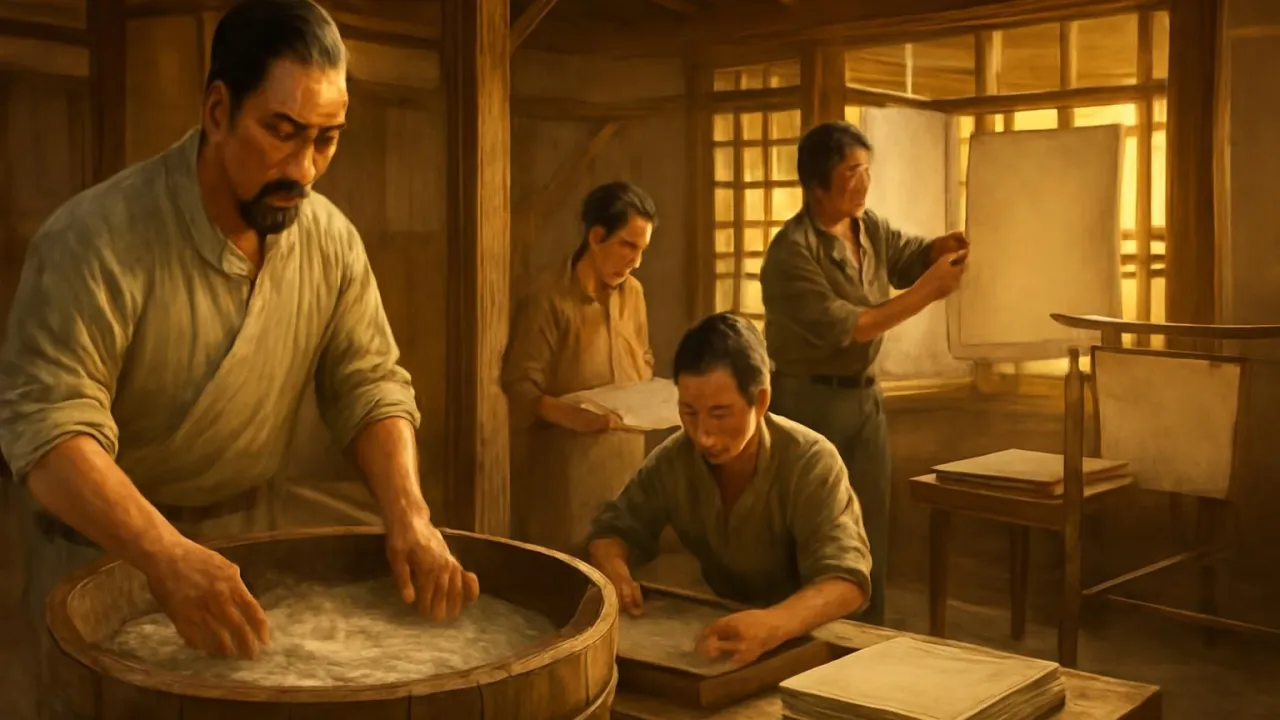
The oldest known piece of paper with writing was found in China and is over 1,800 years old.
1 The Birth of Paper
In 105 CE, Cai Lun of the Han Dynasty in China experimented with plant fibers and old rags to invent paper. Before this, people wrote on heavy bamboo, expensive silk, or animal skins, which were hard to use for everyone. Cai Lun’s process involved soaking mulberry bark and hemp, then pounding them into a wet pulp. This new method made writing materials lighter, cheaper, and easier to produce.
2 The Science of Papermaking
Papermaking relies on the physical properties of plant fibers, which are long and sticky when wet. When these fibers are mashed and mixed with water, they form a called pulp. The pulp is poured onto a fine screen, where water drains away, leaving a of tangled fibers. As the sheet dries, the fibers tightly, creating a flexible and strong piece of paper.
3 From China to the World
After its invention, papermaking technology slowly spread from China to the Middle East, then to Europe. Each region adapted the process using local plants and techniques, improving the quality and speed of production. The invention of paper made books and art more available, helping cultures to record history and share knowledge. Over time, paper became a foundation for education and communication everywhere.
4 The Lasting Impact of Paper
Paper changed how people learned, shared stories, and did business around the world. It allowed for the creation of libraries, newspapers, and printed art, connecting people across distances and generations. Even in our digital age, paper is still used for drawing, writing, and creating important documents. The simple science of fiber and water continues to shape our lives every day.
1. Why did Cai Lun’s paper become so popular?
2. What happens when the pulp dries on the screen?