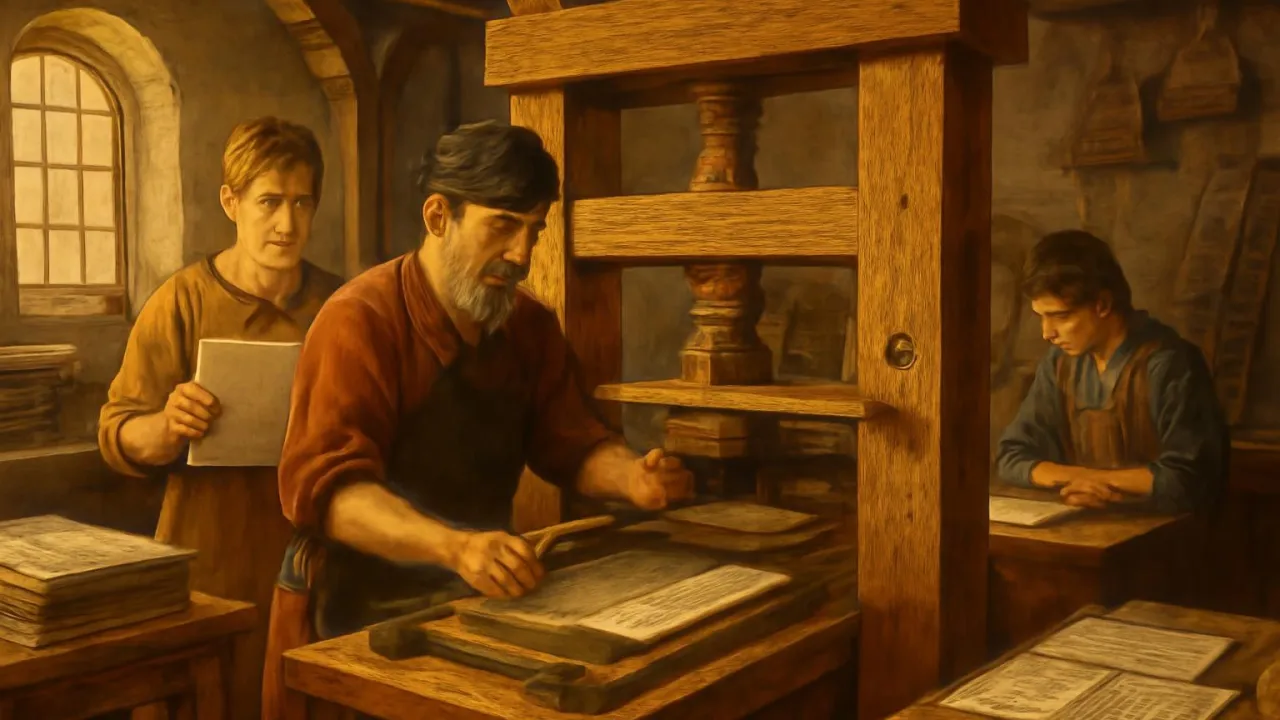
The printing press helped millions of people learn to read.
✨ Word Sparks (Grade 2 Glossary)
Tap 🔊 to hear
metal
A hard, shiny material
pages
Sheets of paper in a book
copy
To make something just like another
🪝
Can you imagine making books super fast with a big wooden machine?
1
A Press Full of Surprises
The printing press makes a clack sound as it works. People put ink on letter blocks and press them onto paper. The press can make many in just one day. It is much faster than writing by hand.
2
Books for Everyone
Before the press, books were rare and slow to . Now, many people can have books to read and share. Stories and facts travel far and wide. Kids and adults can learn new things every day.
3
How the Press Works
Each letter is a small block. The blocks line up to spell words and sentences. Ink sticks to the blocks, and the press pushes them onto paper. This makes clear words appear quickly and neatly.
Gutenberg’s first big book was a giant Bible with over 1,200 pages!
✨ Word Sparks (Grade 3 Glossary)
Tap 🔊 to hear
movable type
Letters you can move and reuse
vibration
A shaking or moving back and forth
frame
A holder for the letter blocks
🪝
What would happen if you could print a whole library in just weeks?
1
The Noisy Workshop
Step into a busy workshop filled with the clack and thump of wooden presses. Workers dip metal letter blocks into thick, sticky ink. The press squeezes the blocks onto paper, leaving rows of crisp, black words. Each page is made much faster than any hand could write.
2
Gutenberg’s Big Idea
Johannes Gutenberg wanted to help more people read. He invented , which means each letter is a separate metal block. This allowed printers to arrange and reuse letters for every new page. The printing press soon spread across Europe, changing how people shared stories and news.
3
How Movable Type Works
uses and pressure to transfer inked letters onto paper. Printers arrange the blocks in a to form lines of text. When the press closes, it pushes all the blocks down together. The result is a clear, even print every time.
4
A World Full of Books
Before the press, books were rare and expensive treasures. Now, libraries and schools could fill their shelves with many new books. People could learn about science, history, and stories from faraway lands. The printing press helped knowledge travel across the world.
By 1500, over 20 million books had been printed in Europe thanks to the press!
✨ Word Sparks (Grade 4 Glossary)
Tap 🔊 to hear
mechanical pressure
Force from a machine pushing down
impression
A mark made by pressing
revolution
A big, important change
🪝
Imagine hearing the steady clack of a press making books for the very first time—how did this change the world?
1
A Revolution in a Workshop
In 15th-century Germany, the sound of wooden presses echoed through Gutenberg’s workshop as metal letters clacked into place. Instead of copying books by hand, workers used movable type to line up each word. Thick, sticky ink was rolled onto the letters, and a heavy press pushed the paper down with even pressure. Each printed page was sharp, clear, and could be made again and again.
2
The Mechanics of Printing
The printing press uses the principle of to transfer ink from raised metal type onto sheets of paper. Printers arranged the type blocks in a sturdy frame, creating lines of text for each page. When the press lever was pulled, it created strong, even force, ensuring each letter left a perfect . This process used both engineering skill and careful teamwork.
3
Gutenberg’s Impact on Society
Johannes Gutenberg’s invention changed history by making books faster and cheaper to produce. Before the press, only a few people could own books, but now, information could reach thousands of people. Schools, libraries, and scientists could share ideas more easily than ever before. The printing press sparked the spread of new inventions, discoveries, and even in thinking.
4
A World Connected by Words
As printing presses spread across Europe and beyond, people gained access to stories, science, and news from distant lands. The press helped preserve important knowledge and made learning possible for many more people. Today, we still use printing to share ideas, though technology has changed. The printing press began a global adventure in reading and learning.
Gutenberg’s press could produce up to 240 pages per hour—over 200 times faster than hand-copying!
✨ Word Sparks (Grade 5 Glossary)
Tap 🔊 to hear
platen
The flat plate that presses paper
leverage
Using force to move something easier
democratization
Making something available to everyone
🪝
What if a single invention could unleash a flood of ideas, changing the course of history forever?
1
The Workshop That Changed the World
Step inside Johannes Gutenberg’s bustling 15th-century workshop, where the clatter of wooden gears and the rhythmic thump of the press fill the air. Instead of laboriously copying books by hand, skilled workers carefully arrange hundreds of tiny metal letter blocks—movable type—into sturdy iron frames. Thick, oil-based ink is rolled evenly across the raised surfaces, and a large screw press applies uniform pressure, transferring the letters’ shapes onto crisp sheets of paper. Each page emerges with lines of perfectly aligned, easily readable text, ready to be bound into books.
2
Engineering Marvels: How the Press Works
The Gutenberg press operates on the principles of mechanical and uniform force distribution, using a screw mechanism adapted from wine and olive presses. When the operator turns the handle, the screw drives a heavy down, pressing the inked type against the paper with consistent pressure. This process ensures high-quality impressions and allows for rapid, repeatable production. The use of movable metal type, cast from durable alloys, means printers can rearrange letters for every new page, maximizing efficiency and minimizing errors.
3
A Catalyst for Knowledge and Social Change
Before the printing press, books were rare, painstakingly hand-copied, and affordable only for the wealthy or religious leaders. Gutenberg’s invention revolutionized access to information by making books cheaper, faster, and more widely available. This of knowledge fueled the Renaissance, the Scientific Revolution, and the Reformation, as ideas could now spread rapidly across continents. Literacy rates soared, and people from many backgrounds could learn, debate, and innovate like never before.
4
Global Impact and Evolution of Printing
Within fifty years of Gutenberg’s press, thousands of print shops had opened across Europe, producing millions of books in dozens of languages. The spread of printed materials accelerated scientific discoveries, preserved ancient texts, and connected distant cultures through shared stories and news. Over centuries, printing technology evolved from hand-powered presses to steam-driven machines and, eventually, to digital printers capable of producing billions of pages annually. Yet, the core principle—using pressure to transfer inked type to paper—remains unchanged.
5
Legacy in the Modern World
Today’s world of instant communication and global publishing owes its roots to Gutenberg’s pioneering invention. The printing press not only transformed education, science, and literature but also empowered ordinary people to share their voices. Modern newspapers, books, and even websites are direct descendants of that first press in Mainz. By making information accessible to all, the printing press set humanity on a path toward greater understanding, creativity, and progress.