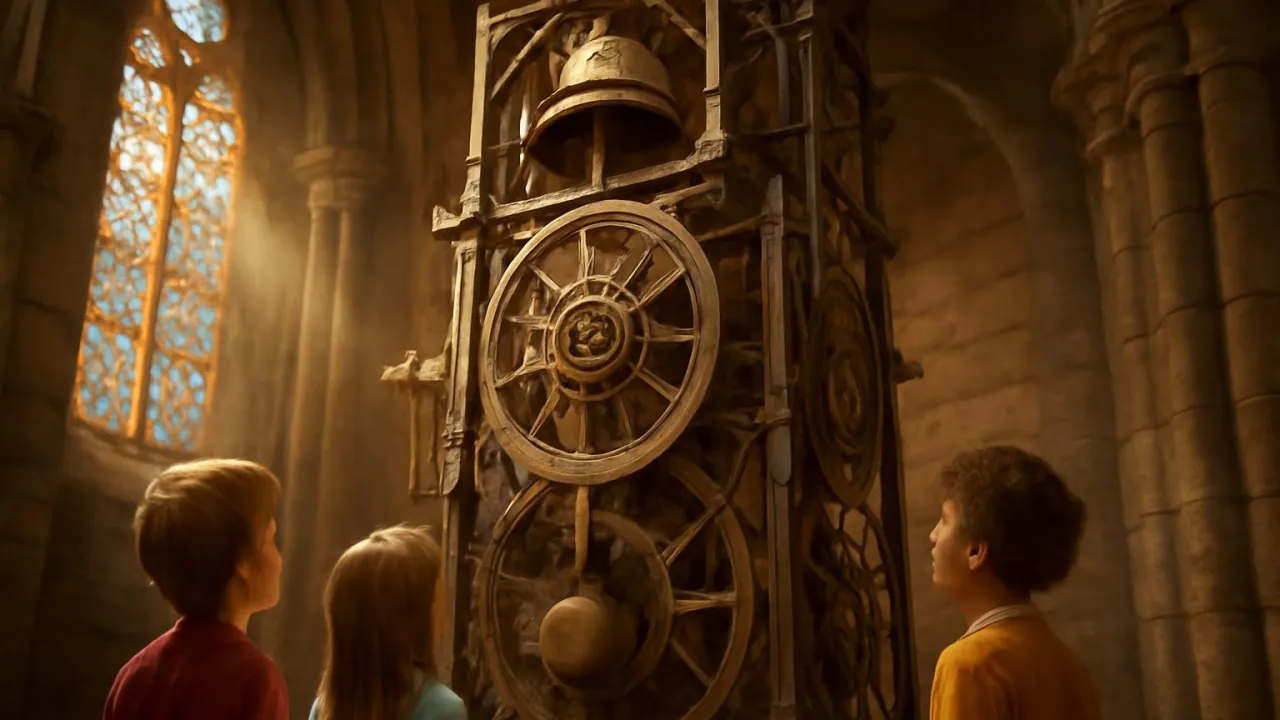
Mechanical Clock
Tick-Tock Timekeepers That Changed the World
Some old clocks have been ticking for hundreds of years!
Can you hear the tick-tock sound?
1 Tick-Tock Mystery
Big clocks go tick-tock all day. spin inside the clock. Bells ring when the comes.
2 How Does It Move?
Heavy weights pull on the . The hands turn slowly around. People watch the hands for time.
3 A Clock for Everyone
Clocks help people know the . Towns put clocks on tall . Everyone can see and hear them.
1. What sound does a big clock make?
2. Where do people put big clocks?
The worldโs oldest working clock is over 600 years old!
What if you could watch time move?
1 Gears and Bells
clocks have many spinning gears and moving hands. Heavy weights pull down to make the gears turn. When the hands reach the hour, a bell rings out loud.
2 Building Clocks High
People built clocks on tall towers in the middle of towns. Everyone could see the clock and hear its each hour. These clocks helped people know when to work, eat, or rest.
3 A New Way to Tell Time
Before clocks, people used the sun or water to tell time. clocks made it easy to know the hour, even on cloudy days. Soon, towns and cities everywhere wanted their own big clock.
1. What makes the clockโs hands move?
2. How did people tell time before clocks?
The Salisbury Cathedral clock in England has no faceโjust bells and gears!
Imagine hearing a bell ring every hourโhow did people make that happen?
1 The Magic Inside the Clock
Mechanical clocks are full of gears, levers, and weights that work together. When a weight drops, it pulls a rope that turns the gears inside. The gears move the hands around the clockโs face, showing minutes and hours. Each hour, a hammer strikes a bell so everyone hears the time.
2 Why Build Tower Clocks?
In the 1200s, towns built huge clocks in church towers or city halls. These clocks helped everyone know the same time, even if they couldnโt see the sun. People gathered to hear the chimes, which marked important moments in daily life.
3 Engineering a Time Machine
Early clockmakers had to solve tricky problems with and . They invented the , a clever device that controls how fast the gears turn. This made clocks much more accurate than sundials or water clocks.
4 Changing the Worldโs Schedule
Mechanical clocks changed how people worked, prayed, and met together. Towns could ring bells for meetings or emergencies at the exact right moment. Soon, every city wanted a large, reliable clock to keep everyone on the same schedule.
1. What device made clocks more accurate?
2. Why did people gather near tower clocks?
Some medieval tower clocks were so large, people could stand inside their wooden gears!
What if you could build a giant machine to tell everyone the exact time?
1 Inside the Tower: Gears, Weights, and Wonders
Mechanical clocks use a system of interlocking gears powered by heavy weights suspended on ropes. As the weights slowly descend, they turn the gears, which move the clockโs hands at a steady, controlled rate. A special called an regulates the movement, preventing the gears from spinning too quickly. This innovation allowed clocks to keep time much more accurately than earlier sun or water clocks.
2 The Birth of Public Timekeeping
The earliest mechanical clocks appeared in European monasteries and in the late 1200s. Monks needed precise times for prayers, so inventors created clocks that could ring bells at set hours. Soon, city leaders realized these clocks could help organize work, trade, and daily life for everyone in town.
3 Engineering Challenges and Triumphs
Building a reliable clock was not easy, as clockmakers had to overcome problems with friction, vibration, and wear. They experimented with different designs, like the verge escapement, to improve accuracy. Over time, clockmakers added more features, such as minute hands and striking that chimed on the hour and quarter-hour.
4 A World Synchronized by Bells
Mechanical clocks changed society by making time public and shared, not just personal. People could now meet at exact times, making towns and cities more organized and connected. The idea of keeping time spread across Europe and later the world, shaping how people live, work, and travel even today.
1. Why did monks want accurate clocks?
2. What problem did the escapement solve?
The Strasbourg astronomical clock has over 18,000 moving parts and tracks planets and eclipses!
What engineering secrets let medieval inventors build machines that could measure every passing minute?
1 The Mechanical Clock: An Engineering Marvel
In the late 13th century, European inventors revolutionized timekeeping by creating the first true mechanical clocks. These devices used a system of descending weights, ropes, and precisely cut gears to convert potential energy into the controlled movement of clock hands. The heart of the mechanism was the verge-and-foliot , which regulated the release of energy and divided time into equal intervals. This breakthrough allowed clocks to measure hours and, eventually, minutes with remarkable accuracy for the era. Early clocks were massive, often filling entire rooms or tower spaces, with some weighing several tons.
2 Physics in Motion: How Clocks Keep Time
The mechanical clockโs operation relies on fundamental physics principles, including gravity, friction, and periodic motion. As the suspended weights descend due to gravity, they drive the gear train, while the mechanism interrupts the motion at regular intervals. This creates a steady tick-tock rhythm, which is both audible and visible in the swinging foliot or, later, the pendulum. Clockmakers had to carefully balance the effects of friction and vibration, using lubricants and precisely crafted metal parts to maintain accuracy over long periods.
3 From Monasteries to Metropolises: Social Impact
Mechanical clocks were first installed in monasteries, where they structured daily prayers and activities. As their reliability improved, city leaders commissioned enormous public clocks for cathedrals, town halls, and market squares. These timekeepers synchronized the lives of thousands, regulating work hours, market times, and community events. The public display and sound of striking bells unified townspeople and introduced the idea of shared, standardized time. This transformation laid the groundwork for modern schedules, transportation, and even global time zones.
4 Innovation and Evolution: The Clockmakerโs Quest
Clockmakers faced numerous technical challenges, such as gear wear, temperature changes, and mechanical that could disrupt accuracy. Over centuries, they introduced improvements like the anchor and, in the 17th century, the pendulum, which dramatically increased . The addition of minute and second hands, along with more compact spring-driven mechanisms, made personal clocks and watches possible. Each innovation built upon earlier designs, showing how science and engineering evolve through experimentation and problem-solving.
5 Legacy: The World Runs on Mechanical Time
The invention of the mechanical clock changed humanityโs relationship with time forever, making it measurable, predictable, and shared. Todayโs digital and atomic clocks are direct descendants of these early inventions, but the fundamental principles remain the same. The mechanical clockโs influence can be seen in everything from school schedules to train timetables and scientific experiments. By mastering the measurement of time, people unlocked new possibilities in science, industry, and daily life, proving that even the tick of a gear can change the world.
1. What key invention let clocks divide time evenly?
2. How did public clocks change city life?