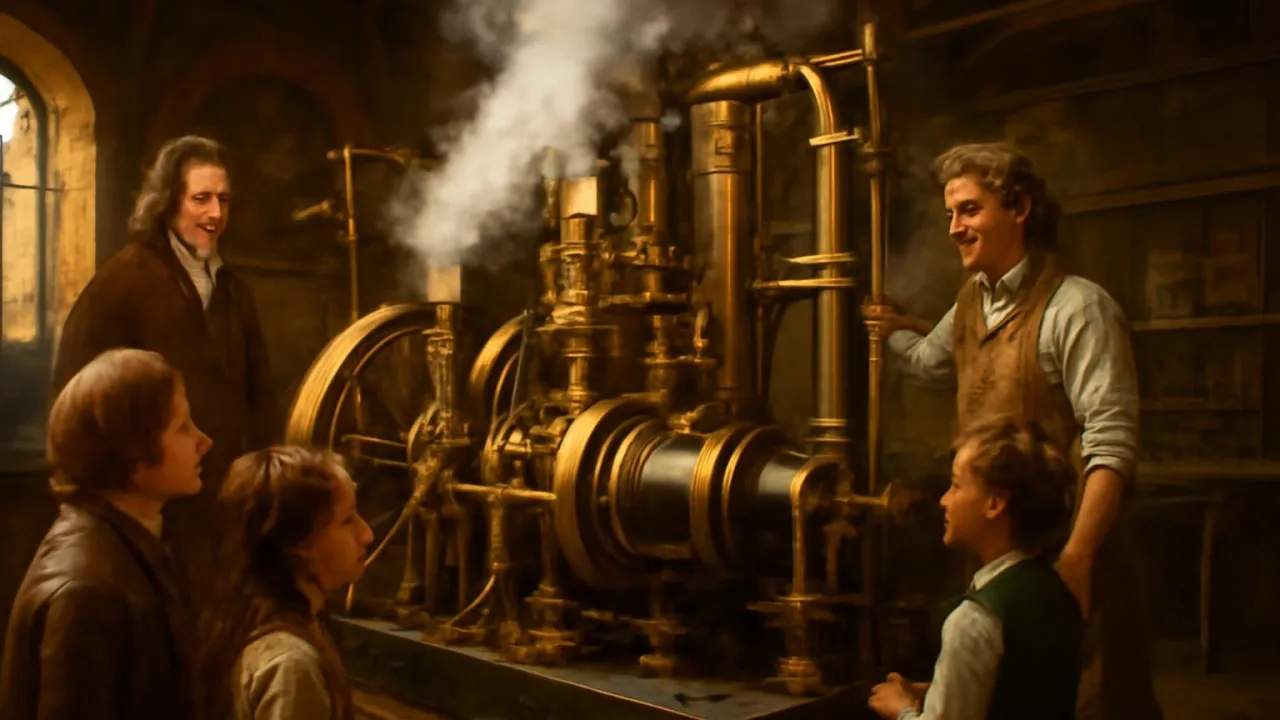
Steam Engine
How Boiling Water Changed the World
A steam engine can pull many heavy train cars at once!
Can you hear the chug-chug of a big, hissing machine?
1 Steam and Sound
makes a loud hiss. Big turn and spin. The chugs along. It makes trains go fast.
2 Hot Water Power
Water gets very hot. It turns into . Steam pushes the parts. The train can move now.
3 People and Engines
People ride trains to far places. Workers use in big factories. engines help many people.
1. What makes the steam engine move?
2. Where do people go on steam trains?
Early steam trains could go faster than horses running!
What if you could ride a train powered by boiling water?
1 The Chugging Engine
Steam engines make loud chugging and hissing sounds as they work. They have big wheels that turn when steam pushes inside. People watch the engine puff out clouds of steam. It pulls trains and helps move heavy things.
2 How Steam Makes Power
Water is heated until it turns into steam, which pushes a . The piston moves, turning the engineโs wheels or other parts. This power lets trains and boats travel far and fast. Factories use steam engines to run big machines.
3 Changing the World
Steam engines helped people travel and build new cities. They made it easier to move things across the country. like James Watt made steam engines better and stronger. People everywhere started using steam to power their world.
1. What does steam do inside the engine?
2. Who made steam engines better?
James Wattโs improved steam engine could pump water out of deep mines!
Can you imagine a world where machines run on clouds of steam?
1 The Hissing Power
Steam engines fill the air with hissing sounds and puffs of white vapor. When water is heated in a , it turns into steam. The steam builds up and pushes against a piston inside the engine. This vibration makes the engineโs wheels spin or machines move.
2 Inventors and Innovations
Thomas Newcomen built one of the first working steam engines in 1712. Later, James Watt improved the design, making engines more efficient and powerful. Watt added a separate condenser, which saved energy and made the engines run longer. These inventors earned for their important ideas.
3 How Steam Engines Work
A steam engine uses a to heat water until it becomes steam. The steamโs pushes a piston or turns a wheel, creating motion. This mechanical power can pull heavy trains or run giant factory machines. The process is called converting thermal energy into mechanical energy.
4 Changing the World
Steam engines made it possible to travel faster and farther than ever before. Trains, ships, and factories all used steam power to grow cities and connect people. The Industrial Revolution began because steam engines could do so much work. Today, we still use steam in some power plants to make electricity.
1. What part did James Watt add to improve steam engines?
2. What kind of energy does a steam engine use first?
The first steam-powered locomotive could pull 10 times its own weight!
What if a simple pot of boiling water could power entire cities and change history?
1 The Magic of Steam
Imagine hearing the rhythmic chug and hiss of a steam engine as it powers a train across the countryside. Steam engines work by heating water in a boiler until it becomes high-pressure steam. This steam pushes against a piston or turns a turbine, creating mechanical motion. The vibration and resonance inside the engine make it possible to move heavy loads quickly.
2 Inventors Who Changed the World
Thomas Newcomen created the first practical steam engine in 1712 to pump water from mines. James Watt later improved the design by adding a separate , making the engine much more efficient. Wattโs innovations allowed steam engines to be used in factories, ships, and trains. These inventors held patents that protected their groundbreaking ideas and inspired others.
3 How Does It Work?
A steam engineโs boiler heats water until it boils and turns into steam, building up high pressure. This pressurized steam enters a cylinder, pushing a piston back and forth or spinning a wheel. The mechanical energy produced can power , factory machines, or even ships crossing the ocean. This process of converting to mechanical energy sparked the Industrial Revolution.
4 A World Transformed
Steam engines made travel faster, factories more productive, and cities much larger. They allowed people and goods to move across continents, changing trade and daily life forever. The spread of steam power led to new inventions and jobs, connecting people in ways never seen before. Even today, some power plants use steam turbines to generate electricity for our modern world.
1. Why did James Wattโs condenser make engines better?
2. What did steam engines help start in history?
Some modern steam turbines can spin at 3,600 revolutions per minute and power entire cities!
What if the power to move mountainsโor entire citiesโcame from nothing but heated water and clever engineering?
1 The Physics of Steam Power
When water is heated in a closed boiler, it transforms into steam, dramatically increasing in volume and pressure. This high-pressure steam is directed into a cylinder, where it pushes a piston or rotates a , converting thermal energy into mechanical work. The movement of pistons or turbines creates vibration and , which can be harnessed to drive wheels, gears, or entire factory systems. Early steam engines operated at relatively low pressures, but later designs, like those of James Watt, used improved materials and separate condensers to handle higher pressures efficiently. The fundamental principle behind all steam engines is the conversion of heat energy to kinetic energy, which revolutionized the way humans powered machines.
2 Inventors and the Evolution of Design
Thomas Newcomenโs 1712 atmospheric engine was the first practical device to use steam for mechanical work, primarily pumping water from deep mines. James Wattโs enhancements in the late 18th century, especially the addition of a separate condenser and rotary motion, vastly improved efficiency and broadened applications. Wattโs engine could now power textile mills, locomotives, and ships, transforming entire industries. The development of the steam engine also spurred the creation of patents, encouraging inventors to protect and share their innovations. Over time, steam engine designs evolved from simple reciprocating pistons to complex compound and triple-expansion systems, increasing both power and fuel efficiency.
3 Engineering Marvels and Quantitative Impact
Early steam locomotives, like George Stephensonโs Rocket, could reach speeds of 30 miles per hour and pull loads weighing over 50 tons. Steam-powered ships crossed oceans, shrinking travel times from months to weeks and making global trade possible. In factories, steam engines could drive dozens of machines simultaneously, multiplying productivity and reducing manual labor. The largest stationary steam engines, used in pumping stations and power plants, generated thousands of horsepower. By the late 1800s, steam engines powered entire cities, from streetcars to electricity generation. These quantitative leaps in speed, power, and capacity changed the scale of human achievement.
4 Global and Cultural Transformations
The widespread adoption of steam engines ignited the Industrial Revolution, reshaping economies, societies, and the environment. Cities grew rapidly as people moved to work in steam-powered factories, leading to and new social structures. Railroads and steamships connected continents, enabling mass migration, trade, and the exchange of ideas. Steam power also had environmental impacts, increasing the demand for coal and contributing to air pollution. Despite these challenges, the cultural legacy of the steam engine endures, symbolizing human ingenuity and the dawn of the modern age. Today, steam still generate much of the worldโs electricity, showing the lasting influence of this invention.
5 From Past to Present: The Steam Engineโs Legacy
Modern power plants use advanced steam , some exceeding 1,000 megawatts, to produce electricity for millions of people. The engineering principles developed for early steam enginesโsuch as pressure control, heat exchange, and mechanical efficiencyโform the foundation of todayโs energy systems. Museums around the world preserve historic steam engines, allowing visitors to witness the intricate gears, polished pistons, and roaring boilers that once powered the world. The steam engineโs evolution from simple atmospheric pumps to high-efficiency turbines illustrates the power of scientific discovery and engineering creativity. As we look to the future, the story of the steam engine reminds us that even basic elements, like water and heat, can change the course of history when combined with human imagination.
1. How did the steam engine change global travel and trade?
2. What engineering principle is key to all steam engines?