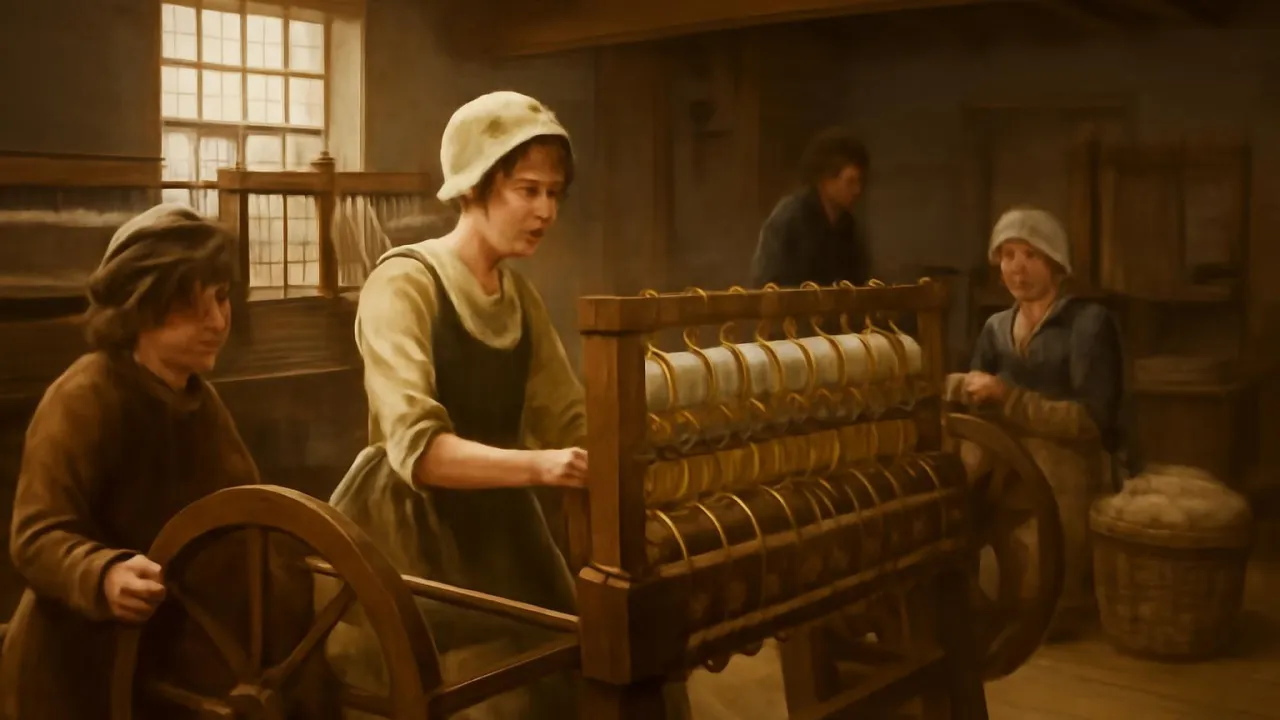
2. How many threads could the Spinning Jenny spin at once?
🤯 Mind-Blowing Fact • Grade 2
The first Spinning Jenny had eight spools, but later ones had even more!
✨ Word Sparks (Grade 2 Glossary)
Tap 🔊 to hear
invent
To make something new
factory
A place where things are made
workshop
A room for building or making things
🪝
What if you could spin eight threads at once?
1
A New Way to Spin
Long ago, people spun thread by hand, which took a long time. The Spinning Jenny changed this by spinning many threads together. It had a big handle and many spools. Turning the handle made all the spools spin at once.
2
A Busy Workshop
In the , you could hear the whirring sound of spinning. Workers watched the threads to make sure they did not tangle. The Jenny made it much faster to make thread for cloth. More thread meant more clothes for everyone.
3
Changing the World
The Spinning Jenny helped people make clothes much faster than before. It was invented by James Hargreaves in England. Soon, many used the Jenny to spin thread. It was a big step in making factories.
The Spinning Jenny helped spark the Industrial Revolution by making thread production much faster.
✨ Word Sparks (Grade 3 Glossary)
Tap 🔊 to hear
spindle
A rod that spins thread
vibration
Fast shaking or moving back and forth
prototype
A first model of a new invention
🪝
Can you imagine a machine spinning eight threads at once, all with a single crank?
1
The Spinning Jenny’s Big Surprise
In the 1700s, making thread was slow and done by hand. Then, James Hargreaves invented the Spinning Jenny, a machine that could spin eight threads at once. Turning its crank made several spin together. This invention made the whirring sound of progress in every workshop.
2
How the Jenny Worked
The Spinning Jenny used a clever system of and a hand-crank. When a worker turned the crank, all the spindles spun at the same time. This meant one person could do the work of eight. The machine’s and movement made it important to keep threads from tangling.
3
A New Era for Factories
The Spinning Jenny was a that changed how people made cloth. It helped start the Industrial Revolution, when many new machines were invented. Factories began to use more machines instead of just people. This made clothes cheaper and easier for everyone to get.
4
A World of Threads
The Spinning Jenny’s acoustic whir filled workshops across England and beyond. Its design inspired even bigger machines with more . Today, we remember the Jenny as a symbol of invention and teamwork. It showed how one idea could spin the world forward.
1. What did the Spinning Jenny use to spin threads?
2. How did the Spinning Jenny help factories?
🤯 Mind-Blowing Fact • Grade 4
Later versions of the Spinning Jenny could spin up to 120 threads at once!
✨ Word Sparks (Grade 4 Glossary)
Tap 🔊 to hear
tension
How tight or loose something is pulled
textile
A material made from thread or yarn
acoustic
Related to sound and hearing
🪝
What if one person could spin as much thread as eight people at once?
1
A Whirring Revolution Begins
Imagine the sound of eight spools spinning together, all powered by one hand-crank. In 1764, James Hargreaves invented the Spinning Jenny in Lancashire, England, completely transforming workshops. Before this, spinning thread was slow and done by hand, but the Jenny sped up the process dramatically. Its invention marked the start of a new era for making cloth.
2
Engineering the Jenny
The Spinning Jenny worked by linking several spindles to a single wheel and crank. When the crank was turned, all the spindles rotated, twisting fibers into thread at once. This mechanical system used vibration and to keep the threads even and strong. The Jenny’s design was simple but clever, making it easy to use in small workshops.
3
Changing Factories and Lives
The Jenny was a prototype that led to more advanced spinning machines. It allowed one worker to do the job of many, which helped factories grow quickly. This invention made cloth cheaper and more available to people everywhere. The Spinning Jenny’s impact was felt in homes, shops, and entire cities.
4
A Global Impact
The Spinning Jenny played a key role in the Industrial Revolution, a time of great invention and change. Its whir became a symbol of progress in England and soon around the world. The Jenny inspired inventors to build even bigger machines with hundreds of spindles. Today, the Spinning Jenny is remembered as a spark that helped spin the modern world into motion.
1. Why did the Spinning Jenny help factories grow?
2. What important era did the Spinning Jenny help start?
🤯 Mind-Blowing Fact • Grade 5
By 1788, over 20,000 Spinning Jennies were operating in textile mills across Britain!
✨ Word Sparks (Grade 5 Glossary)
Tap 🔊 to hear
resonance
When something vibrates and makes a strong sound
patent
A legal right to an invention
mill
A factory where things are made or processed
🪝
What would it feel like to invent a machine that could multiply your work by eight—or even one hundred?
1
The Whirring Birth of Industrial Change
Step into an 18th-century English workshop filled with the constant whir of spinning wood and the scent of raw cotton. In 1764, James Hargreaves, a weaver from Lancashire, invented the Spinning Jenny, a revolutionary device that forever altered the textile industry. Before this invention, spinning thread was a slow, manual process, with each person operating a single spindle by hand. The Spinning Jenny, however, allowed one worker to spin eight threads simultaneously, multiplying productivity and transforming the pace of cloth-making.
2
Mechanical Marvel: How the Jenny Worked
The Spinning Jenny’s design featured a horizontal wooden frame holding multiple spindles, all connected by bands to a single hand-crank. When the crank was turned, the spindles rotated in unison, twisting fibers into thread through mechanical tension and controlled vibration. A movable carriage drew out the fibers, while the spindles spun rapidly, winding the new thread onto bobbins. This system required careful adjustment to maintain even tension and prevent breakage, demonstrating early principles of mechanical engineering and .
3
From Prototype to Industrial Powerhouse
Hargreaves’ prototype quickly evolved as inventors and manufacturers recognized its potential. Later models of the Spinning Jenny could spin as many as 120 threads at once, dramatically increasing output in textile . The machine’s success paved the way for even more advanced inventions, such as the water frame and spinning mule, which further automated textile production. The Spinning Jenny’s in 1770 protected Hargreaves’ design, encouraging a wave of innovation across Britain.
4
Global Impact and Social Change
The Spinning Jenny was a catalyst for the Industrial Revolution, helping to shift textile production from small home workshops to large urban factories. This transformation made cloth cheaper and more widely available, fueling economic growth and changing how people lived and worked. However, the Jenny also sparked protests among hand-spinners who feared losing their jobs, highlighting the challenges and opportunities that come with technological progress.
5
Legacy of the Spinning Jenny
Today, the Spinning Jenny is celebrated as a symbol of ingenuity and industrial progress. Its core principles—using mechanical systems to multiply human effort—are still found in modern manufacturing and engineering. The Jenny’s acoustic whir became the soundtrack of a new era, inspiring inventors to create machines that shaped the modern world. By dramatically increasing the speed and scale of thread production, the Spinning Jenny helped weave the fabric of our global society.