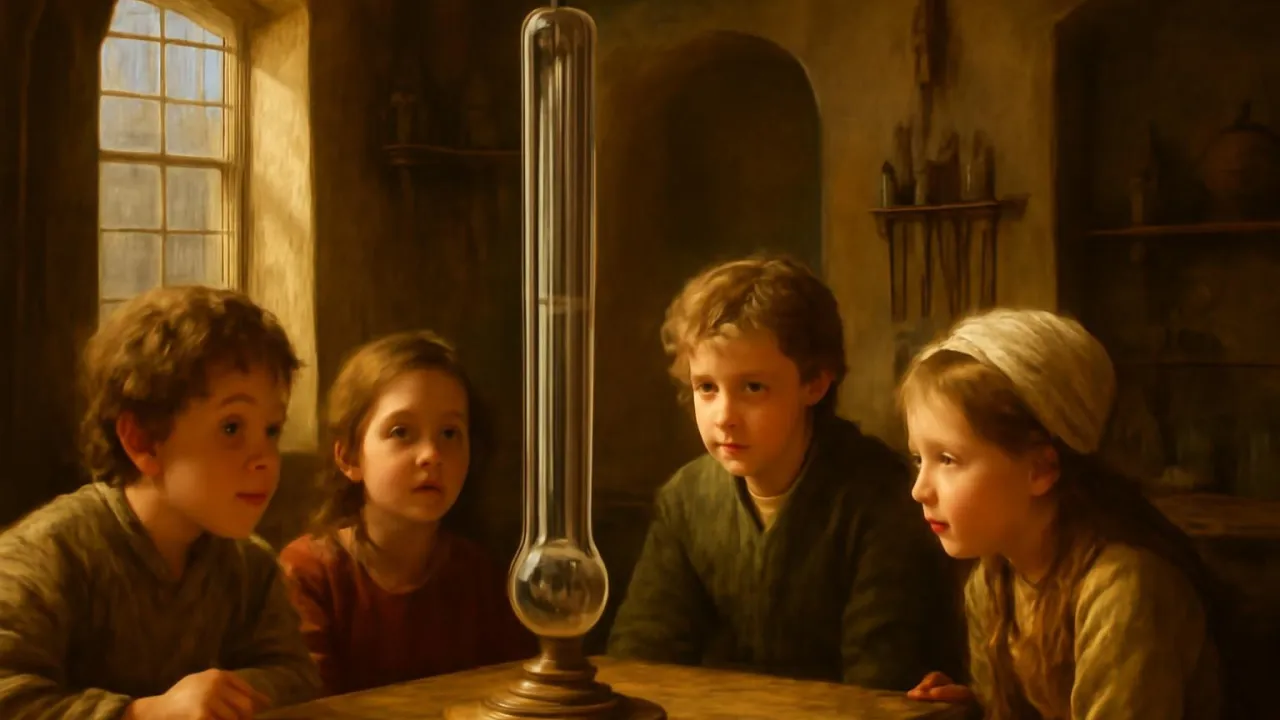
Mercury barometers can measure tiny changes in air pressure as small as 1 millibar!
✨ Word Sparks (Grade 3 Glossary)
Tap 🔊 to hear
mercury
A heavy, shiny, silver liquid metal.
vibration
A movement that goes up and down.
predict
To guess what will happen next.
🪝
What if you could predict a storm by watching a tube?
1
The Mystery of Air Pressure
Air is invisible, but it presses on everything around us every moment. This pressing force is called air pressure, and it changes when the weather changes. Scientists wanted to measure this invisible force to learn more about storms and sunshine. They needed a special tool to make the invisible visible.
2
Torricelli’s Glass Tube
In 1643, Evangelista Torricelli invented the barometer in Italy. He filled a long glass tube with , a heavy, shiny liquid metal. When he turned the tube upside down in a dish, some mercury stayed in the tube. The height of the mercury showed how much the air was pressing down.
3
How the Barometer Works
A barometer measures air pressure by showing how high the rises. When air pressure increases, it pushes the mercury higher in the tube. When air pressure drops, the mercury falls lower. This movement is called a , but it is slow and steady.
4
Why Barometers Matter
Barometers help people the weather by watching changes in air pressure. A sudden drop in pressure can mean a storm is coming soon. Sailors, pilots, and weather scientists use barometers to stay safe. This invention changed how people understand and prepare for weather.
2. What liquid did Torricelli use in his barometer?
🤯 Mind-Blowing Fact • Grade 4
The word 'barometer' comes from Greek words meaning 'weight' and 'measure'!
✨ Word Sparks (Grade 4 Glossary)
Tap 🔊 to hear
atmospheric pressure
The weight of air pressing down.
vacuum
A space with no air inside.
meteorologist
A scientist who studies the weather.
🪝
Imagine you could sense storms before they arrived—just by watching a shiny liquid move.
1
Invisible Air, Powerful Pressure
Air surrounds us and presses down with a force called , even though we cannot see it. This pressure changes with the weather, affecting everything from gentle breezes to powerful storms. Scientists in the 1600s wondered how to measure this invisible force accurately. They needed a device that could reveal the secrets of the air.
2
Torricelli’s Ingenious Experiment
Evangelista Torricelli, an Italian physicist, filled a long glass tube with mercury and sealed one end. He flipped the tube into a mercury dish, and some mercury remained in the tube, leaving a at the top. The height of the mercury column balanced the pushing on the dish, creating the first accurate barometer.
3
How Barometers Predict Weather
Barometers work by measuring the height of mercury in the tube, which rises or falls as air pressure changes. When air pressure increases, the mercury climbs higher, but when pressure drops, it sinks lower. A sudden drop in pressure often signals that a storm or rainy weather is approaching. This simple, yet powerful, principle helps forecast changes in the weather.
4
A World-Changing Invention
The barometer revolutionized weather prediction and made sailing, farming, and flying much safer for people everywhere. Today, digital barometers use sensors instead of mercury, but they still rely on the same principle of measuring air pressure. Torricelli’s invention opened the door to modern meteorology and helped us understand our ever-changing atmosphere.
1. Why did Torricelli use mercury instead of water?
2. What does a sudden drop in barometer pressure usually mean?
🤯 Mind-Blowing Fact • Grade 5
A single mercury barometer can detect a pressure change as small as 0.01 inches—enough to sense a distant hurricane!
✨ Word Sparks (Grade 5 Glossary)
Tap 🔊 to hear
millibar
A unit for measuring air pressure.
vacuum
A space completely empty of air.
altimeter
A tool that measures how high you are above sea level.
🪝
What if you could predict a hurricane’s arrival days in advance, using just a glass tube and a shimmering liquid?
1
The Hidden Force of the Atmosphere
Every moment, the atmosphere presses on us with a force of about 1 kilogram per square centimeter, though we rarely notice it. This invisible pressure, known as atmospheric pressure, is crucial for weather patterns, ocean currents, and even our ability to breathe. In the early 17th century, scientists struggled to prove that air had weight and could exert force. They needed a device that could make the invisible, visible—and measurable.
2
Torricelli’s Breakthrough: The Mercury Barometer
In 1643, Evangelista Torricelli, a student of Galileo, filled a 1-meter-long glass tube with mercury and inverted it into a basin of mercury. The mercury level dropped, creating a at the top, while the height of the remaining mercury column balanced exactly with the atmospheric pressure. This experiment not only proved that air had weight, but also established the first practical method for measuring atmospheric pressure quantitatively.
3
The Physics Behind Barometer Function
A mercury barometer operates on the principle that atmospheric pressure supports a column of mercury against the force of gravity. Standard atmospheric pressure at sea level can support a mercury column approximately 760 millimeters high (about 29.92 inches). When air pressure increases, the mercury rises; when it decreases, the mercury falls. The difference in height directly correlates to changes in atmospheric pressure, which meteorologists record in units called or inches of mercury.
4
From Storm Prediction to Modern Science
The barometer’s ability to detect subtle shifts in atmospheric pressure revolutionized weather forecasting, navigation, and aviation. Sudden drops in barometric pressure warn of approaching storms, hurricanes, or rapid weather changes, allowing people to prepare and stay safe. Today, digital barometers use electronic sensors, but the fundamental principle remains unchanged since Torricelli’s time. Barometers are also essential in scientific research, helping to calibrate and study climate patterns worldwide.
5
Legacy and Evolution of the Barometer
Torricelli’s invention inspired generations of scientists, including Blaise Pascal, who used barometers to prove that air pressure decreases with altitude. Aneroid barometers, invented in the 19th century, replaced mercury with flexible metal chambers, making them safer and more portable. Barometers remain vital tools in meteorology, aviation, and environmental science, demonstrating how a simple observation of liquid in a tube can unlock the secrets of our dynamic atmosphere.