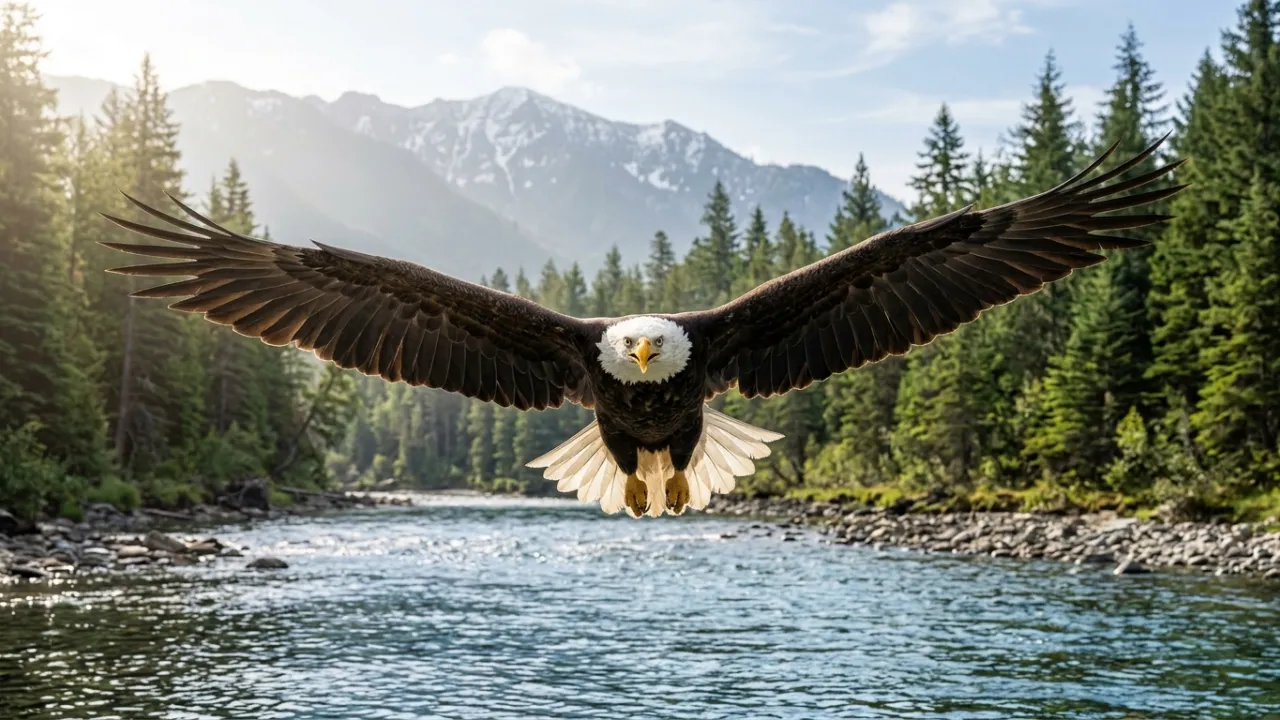
1. What food does a Bald Eagle love to grab from rivers?
2. What color are an adult Bald Eagle's head feathers?
🤯 Mind-Blowing Fact • Grade 2
One record Bald Eagle nest in Florida measured 9.5 feet wide and weighed nearly two tons!
✨ Word Sparks (Grade 2 Glossary)
Tap 🔊 to hear
talons
Sharp curved claws on hunting birds
eaglet
Young baby eagle growing in nest
perch
Rest high up on tree branch
🪝
How can a bird build a treetop nest heavier than a small car?
1
Built for Water Skies
Imagine spotting a tiny rabbit from a mile away! Bald Eagles patrol lakes, coasts, and wide rivers across North America, including Virginia's Chesapeake Bay. They high on tall pine branches and watch the sparkling water below for dinner.
2
Curved Talons That Lock
When a fish swims near the surface, the eagle dives fast and stretches out four curved . Tiny rough bumps on its yellow toes grip wet scales tightly, so a heavy fish cannot wiggle free.
3
Growing Up Brown to White
Young hatch covered in soft gray down and grow dark brown feathers first. They practice flapping on huge stick nests, and they earn their snowy white head and tail around age five.
1. What helps a Bald Eagle hold onto a wet, slippery fish?
2. When does a young Bald Eagle get its famous white head and tail?
🤯 Mind-Blowing Fact • Grade 3
If a Bald Eagle hooks a fish too heavy to lift, it can row itself safely to shore using its giant wings like swim paddles!
✨ Word Sparks (Grade 3 Glossary)
Tap 🔊 to hear
raptor
Hunting bird with sharp beak, talons
thermal
Rising column of warm outdoor air
aerie
Large high nest of an eagle
🪝
What secret survival adaptations turn the Bald Eagle into North America's ultimate river predator?
1
Telescopic Raptor Eyesight
Stand at one end of a football field and try reading a newspaper on the far goal line—a Bald Eagle could! As a powerful daytime predator, this possesses eyes nearly as large as a human's, giving it crystal-clear vision four to five times sharper than ours.
2
Solar-Powered Wing Gliding
Flapping seven-foot wings nonstop would burn enormous energy, so eagles ride rising columns of sun-warmed air called . Wide primary wingtips spread apart like feathers on fingers to catch upward breezes, letting the bird circle effortlessly above lakes and rivers for hours.
3
Built-In Goggles and Fish Hooks
During a steep hunting dive, a clear inner eyelid sweeps sideways across each eye like swimming goggles to block rushing wind and splashy spray. Beneath its feet, spiky toe pads called spicules clamp slippery prey securely while a hooked yellow beak tears neat, bite-sized pieces.
4
Lifelong Treetop Fortresses
Mated pairs return to the same treetop year after year, weaving fresh branches, soft moss, and dry grass into a sturdy wooden fortress that shelters their growing chicks from spring storms.
1. How do rising columns of warm air called thermals help a Bald Eagle survive?
2. Why does a clear inner eyelid sweep across the eagle's eye during a dive?
🤯 Mind-Blowing Fact • Grade 4
Virginia's Chesapeake Bay watershed now hosts over 3,000 Bald Eagles, up from fewer than 60 breeding pairs in the 1970s!
✨ Word Sparks (Grade 4 Glossary)
Tap 🔊 to hear
scavenger
Animal that eats dead leftover animals
watershed
Land area draining into one waterway
conservation
Careful protection of nature and wildlife
🪝
How did North America's national bird nearly vanish from our rivers—and stage one of history's greatest wildlife comebacks?
1
Coast-to-Coast Waterway Specialists
Stretch your arms as wide as you can, then add nearly three more feet—that is the seven-foot wingspan gliding over Virginia's James River and Alaska's icy salmon streams! Bald Eagles thrive solely in North America, ranging from northern Mexico to Canada and Alaska wherever clean, fish-rich estuaries, lakes, and wide rivers meet tall shoreline forests.
2
Apex Regulators of River Food Webs
As both apex predators and opportunistic , Bald Eagles keep aquatic ecosystems healthy and balanced. Because they snatch slow, injured, or spawned-out fish near the water's surface—along with occasional ducks or small mammals—and clean up shoreline carrion during icy winters, they recycle vital nutrients and prevent disease from spreading along riverbanks.
3
How One Chemical Cracked Their Eggs
By 1963, disaster struck across the continent: only 417 nesting pairs survived in the lower 48 United States. Stormwater washed an agricultural insect spray called DDT into rivers, where microscopic water plants, small minnows, larger fish, and finally fish-eating eagles absorbed higher and higher doses. Inside female eagles, DDT blocked calcium formation, causing mothers to lay shells so fragile they crushed beneath an incubating parent's weight.
4
Science and Conservation Save the Skies
Once wildlife biologists uncovered this hidden food-web chain reaction, the United States banned DDT in 1972 and safeguarded shoreline nesting trees under the Endangered Species Act. Thanks to cleaner waterways, protective laws, and careful reintroduction programs across states like Virginia, Bald Eagle populations soared past 31,800 nesting pairs—proving that informed human stewardship can rescue an imperiled species from extinction! Today, families paddling along rivers across North America can once again spot white-headed eagles soaring overhead.
1. Why did the pesticide DDT cause Bald Eagle numbers to plunge by the 1960s?
2. How do Bald Eagles keep river and bay ecosystems healthy?
🤯 Mind-Blowing Fact • Grade 5
All 7,000 feathers on an adult Bald Eagle weigh roughly twice as much as its entire hollow-boned skeleton!
✨ Word Sparks (Grade 5 Glossary)
Tap 🔊 to hear
dimorphism
Size or look difference between sexes
pneumatic
Filled with air spaces for lightness
biomagnification
Toxins growing stronger up food chains
🪝
What optical physics and aerodynamic engineering allow Haliaeetus leucocephalus to spot a trout from a mile away and snatch it at 75 miles per hour?
1
Taxonomy of the White-Headed Sea Eagle
Before angling into a hunting stoop at 75 to 100 miles per hour (120 to 160 km/h), Haliaeetus leucocephalus locks onto surface ripples invisible to human eyes. Classified within the raptor family Accipitridae among eight global sea-eagle species, its binomial name combines Greek roots meaning 'white-headed sea eagle.' Like most birds of prey, the species displays reverse sexual : northern females weigh up to 14 pounds (6.3 kg) and span 7.5 feet (2.3 m) wingtip to wingtip, roughly 25 percent larger than their male partners.
2
Dual-Fovea Optical Engineering
Inside each large, bony-ringed eye socket sits a retina packed with approximately one million light-detecting cone photoreceptors per square millimeter—nearly five times human density—delivering visual acuity estimated around 20/4 to 20/5. Even more remarkably, each eye houses two specialized focal pits called foveae (one directed forward, one angled 45 degrees sideways), granting simultaneous binocular depth perception and wide-angle scanning while filtering surface glare above shimmering rivers.
3
Pneumatic Flight Mechanics and Ratchet Tendons
Despite appearing massive aloft, an adult eagle's entire air-filled skeleton weighs scarcely half a pound (about 250 grams)—only half the combined weight of its 7,000 interlocking, oil-waterproofed feathers! Slotted primary wingtips reduce wingtip drag vortices as the bird climbs thermal updrafts to 10,000 feet. At the moment of impact, ridged flexor tendons inside the toes automatically ratchet shut around thrashing prey with hundreds of pounds per square inch of grip pressure, holding fast without exhausting leg muscles.
4
Biomagnification and Aquatic Sentinel Science
Occupying the top trophic tier of freshwater and estuarine food webs makes Haliaeetus leucocephalus an exacting bioindicator of watershed chemistry. Mid-twentieth-century organochlorine pesticides—specifically DDT and its metabolite DDE—biomagnified millions of times from phytoplankton to forage fish to eagles, inhibiting calcium-ATPase enzymes inside the oviduct shell gland until eggs fractured prior to hatching.
5
Continental Recovery of an American Emblem
Adopted on the Great Seal of the United States in 1782, the Bald Eagle rebounded after the 1972 DDT ban and 1973 Endangered Species Act from 417 lower-48 breeding pairs in 1963 to over 316,000 individuals nationwide. Removed from the federal endangered list in 2007, this long-lived sea eagle—capable of surviving 20 to 30 years in the wild—stands as modern conservation science's flagship triumph.