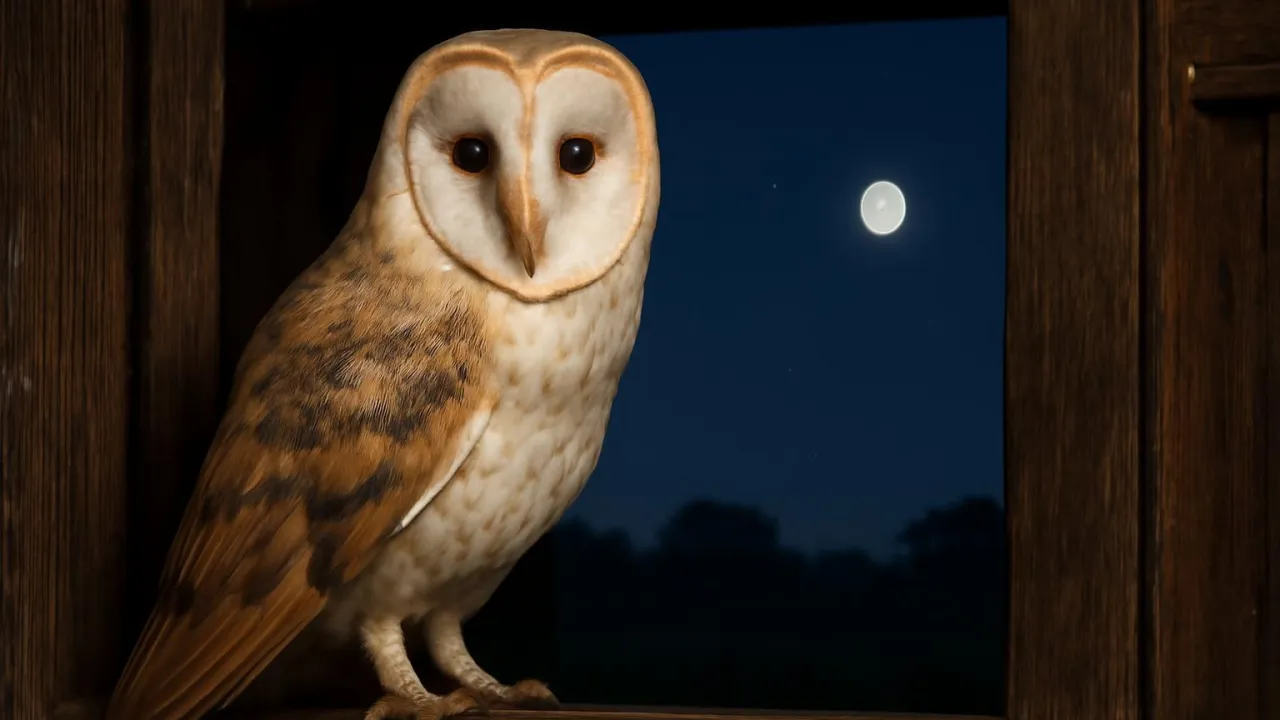
Barn owls can hear tiny sounds from mice moving under leaves, even in total darkness!
✨ Word Sparks (Grade 2 Glossary)
Tap 🔊 to hear
talons
Sharp claws birds use to catch food
prey
Animals that other animals eat
nest
A bird’s home where eggs are kept
🪝
Have you ever wondered how a barn owl can fly so quietly at night?
1
A Face Like a Heart
The barn owl has a heart-shaped face that helps it hear very well. Its feathers are soft and light brown with white spots. It uses its big eyes to see in the dark and find food.
2
Nighttime Hunter
Barn owls fly silently when they hunt at night for mice and small animals. They use their sharp to catch quickly. Their silent flight helps them sneak up without being heard.
3
Home Sweet Home
Barn owls live in open fields, farms, and old barns where they can find food easily. They build in quiet places like tree holes or barn rafters. During the day, they rest hidden from danger.
Barn owls can pinpoint a mouse’s location by sound alone, even under thick leaves or snow!
✨ Word Sparks (Grade 3 Glossary)
Tap 🔊 to hear
camouflage
Colors that help animals hide in nature
predator
An animal that hunts other animals
adaptation
A special trait that helps survival
🪝
How does the barn owl’s silent flight help it catch prey in the dark?
1
Unique Face and Hearing
The barn owl’s heart-shaped face acts like a radar to catch sound waves. This special shape helps it locate prey even in total darkness. Its large eyes also help it see well at night. These make it a skilled nighttime hunter.
2
Silent Flight and Hunting
Barn owls have soft feathers that reduce noise when they fly. This silent flight helps them sneak up on prey without being heard. Their sharp talons grab small mammals like mice and voles quickly. This hunting method is very effective in open fields.
3
Camouflage and Nesting
Their light brown and white feathers provide in dry grass and barns. Barn owls build nests in quiet places like tree hollows or old buildings. This protects their eggs and young owlets from . Camouflage helps them stay safe during the day.
4
Role in the Ecosystem
Barn owls control rodent populations by eating many small mammals. This helps farmers protect crops naturally without chemicals. They are important in their food web. Their presence signals a healthy ecosystem in farmland areas.
Barn owls can hunt prey hidden under thick snow or dense vegetation using only their hearing!
✨ Word Sparks (Grade 4 Glossary)
Tap 🔊 to hear
ecosystem
A community of living things and their environment
conservation
Protecting animals and nature from harm
habitat
The natural home where an animal lives
🪝
What makes the barn owl a vital part of many ecosystems around the world?
1
Specialized Hearing and Vision
The barn owl’s heart-shaped facial disc focuses sound into its ears, allowing precise prey detection. Its asymmetrical ears help it judge the distance and direction of sounds accurately. Large, dark eyes enhance night vision, enabling it to hunt effectively in low light. These sensory adaptations provide a survival advantage in diverse .
2
Silent Flight and Hunting Strategy
Barn owls have velvety feathers with serrated edges that muffle air turbulence during flight, resulting in near-silent movement. This stealth allows them to approach prey undetected, increasing hunting success. They primarily feed on small mammals such as mice, voles, and shrews, which they capture using sharp talons. Their hunting behavior helps regulate rodent populations across farmlands and grasslands.
3
Ecosystem Role and Human Impact
By controlling rodent numbers, barn owls play a crucial role in maintaining balanced food webs and protecting crops naturally. However, loss from urbanization and pesticide use threatens their populations in some regions. efforts include installing nest boxes and preserving natural hunting grounds. These measures help sustain barn owl populations and promote healthy .
4
Global Distribution and Habitat Preferences
Barn owls are found worldwide except in polar and desert regions, favoring open like farmland, grasslands, and rural areas. They often nest in barns, hollow trees, and abandoned buildings, taking advantage of human structures. Their adaptability to various environments allows them to thrive across continents. This wide distribution highlights their ecological importance globally.
2. What human action helps barn owl populations survive?
🤯 Mind-Blowing Fact • Grade 5
Barn owls can hunt prey hidden under dense vegetation or snow using sound alone, a sensory skill unmatched by most birds!
✨ Word Sparks (Grade 5 Glossary)
Tap 🔊 to hear
binaural
Using two ears to hear sounds in 3D
fragmentation
Breaking habitats into smaller, separate parts
morphology
The shape and structure of an animal
🪝
How do barn owls’ unique physical traits and behaviors make them effective nocturnal predators worldwide?
1
Taxonomy and Scientific Classification
The barn owl, scientifically named Tyto alba, belongs to the family Tytonidae, distinct from typical owls in Strigidae. It is characterized by a heart-shaped facial disc that differentiates it from other owl species. This facial structure enhances auditory localization, crucial for nocturnal hunting. The species has a global distribution except polar and desert zones, reflecting its ecological versatility.
2
Physiological Adaptations for Silent Flight
Barn owls possess specialized feathers with serrated leading edges and velvety surfaces that reduce aerodynamic noise during flight. Their wing allows slow, controlled gliding, minimizing sound that might alert prey. Asymmetrical ear placement enhances hearing, enabling precise three-dimensional sound mapping. These adaptations collectively facilitate stealthy hunting in complete darkness.
3
Ecological Role and Conservation Challenges
Barn owls serve as natural pest controllers by preying on rodents, thus supporting agricultural productivity and ecosystem stability. However, habitat , pesticide exposure, and road mortality pose significant threats to their populations globally. Conservation initiatives include installing artificial nest boxes, habitat restoration, and public education to reduce human-wildlife conflicts. Monitoring population trends helps guide effective management.
4
Historical and Cultural Significance
Throughout history, barn owls have appeared in folklore and symbolism, often associated with wisdom or omens. Their silent flight and nocturnal habits have fascinated humans for centuries. Scientific studies on their echolocation-like hearing have advanced understanding of sensory biology. Cultural respect has sometimes aided conservation, while myths have occasionally led to persecution.
5
Quantitative Comparisons and Behavior
Barn owls typically weigh between 14 to 24 ounces (400 to 700 grams) and have a wingspan of 31 to 37 inches (80 to 95 centimeters). They can fly at speeds up to 20 miles per hour (32 kilometers per hour) during hunting. Their hearing can detect prey movements as faint as a few millimeters per second in complete darkness. These precise sensory and physical traits enable efficient nocturnal predation.