Laser
Light Beams That Changed the World
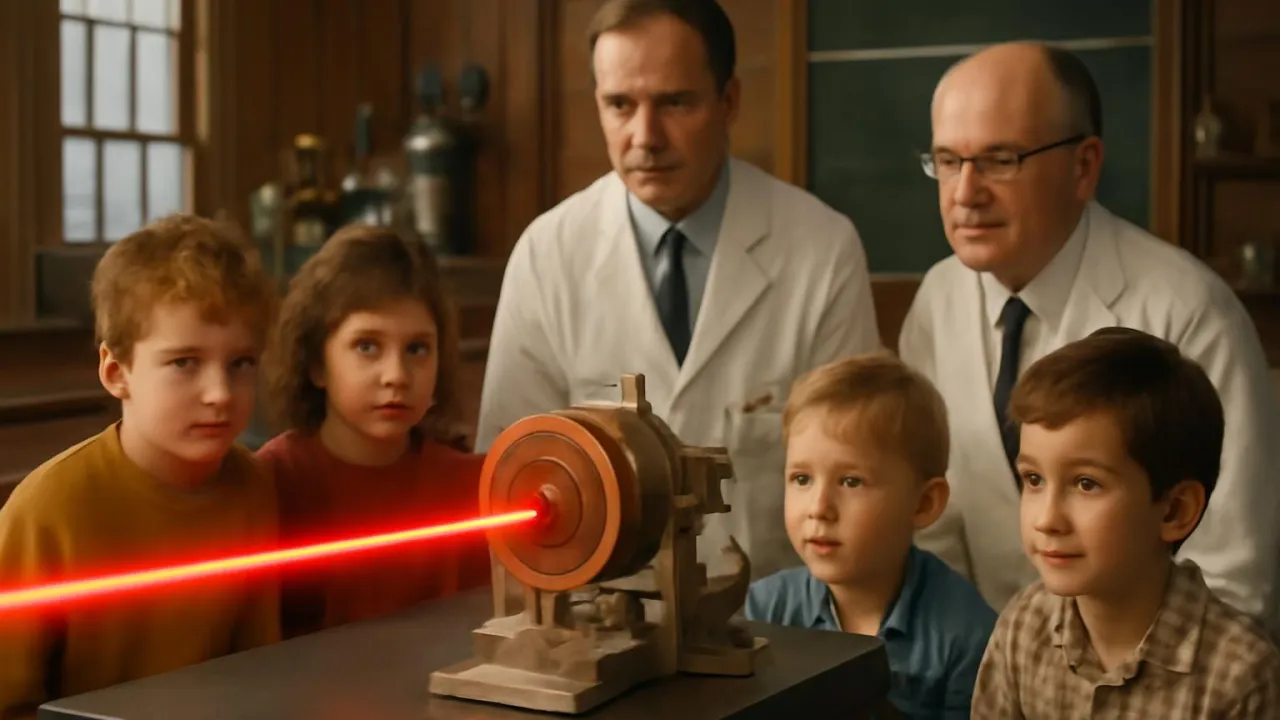
Lasers have helped scientists measure the exact distance from Earth to the Moon within centimeters!
1 Inventing the Impossible Beam
In 1960, physicist Theodore Maiman built the first working laser using a ruby crystal and a flash lamp. He discovered that by exciting atoms in the crystal, he could create a powerful, perfectly straight beam of light. This beam was different from ordinary light because all its waves were synchronized, a property called . The invention launched a new era in science and technology, making the impossible possible.
2 How Lasers Work Their Magic
A laser works by exciting atoms until they release photons, which are particles of light. These photons bounce between mirrors inside the laser, causing more photons to be released in a process called . All the photons vibrate together with the same frequency and direction, creating a focused, high-energy beam. This precise control of light allows lasers to cut, measure, and communicate in ways regular light cannot.
3 Lasers in Everyday Life
Lasers are everywhere—from supermarket scanners to eye surgeries and even in your DVD player. Doctors use lasers to perform delicate surgeries with incredible accuracy, while engineers use them to cut through tough materials. In science, lasers help measure the distance from Earth to the Moon and analyze the tiniest particles. Their unique properties have made lasers essential in medicine, industry, and research worldwide.
4 Safety, Science, and Society
While lasers are powerful tools, they must be used with care to prevent injury, especially to the eyes. Special safety goggles are worn in labs and factories to protect workers from intense laser beams. The laser’s invention sparked new fields like communication and laser surgery, changing how we live and connect. Today, lasers continue to inspire new inventions and discoveries all over the globe.
1. What property makes laser light different from regular light?
2. Why do people wear goggles when using strong lasers?