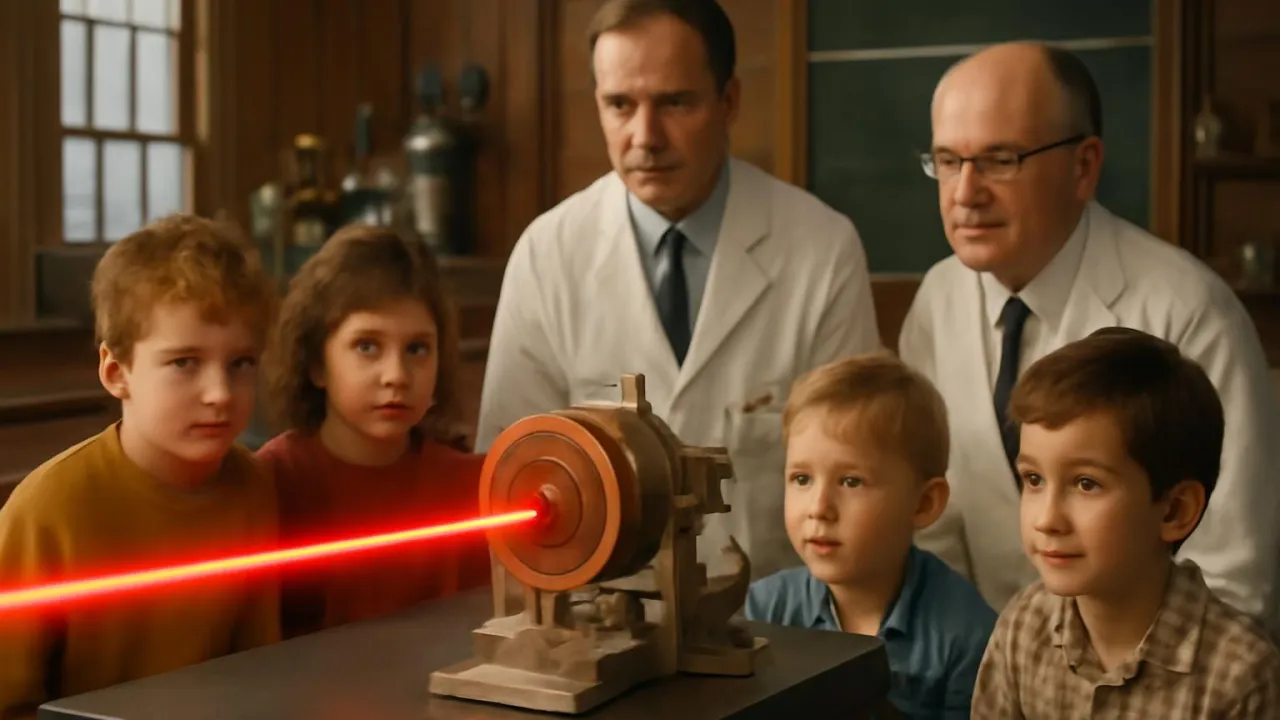
Lasers can travel to the Moon and bounce back to Earth!
✨ Word Sparks (Grade 2 Glossary)
Tap 🔊 to hear
precise
Very exact and careful
vision
How well you can see
measure
To find out how big or long something is
🪝
Have you ever seen a super-straight light beam?
1
A Light Like No Other
Lasers make a very straight, bright line of light. The beam can be red, green, or even blue. People use lasers in stores to scan barcodes. Lasers can also be found in fun toys and light shows.
2
Helping People See
Doctors use lasers to help people see better. Some eye surgeries use lasers to fix . Lasers are very , so they can help without touching the eye. Scientists use lasers to things very carefully.
3
Safe and Smart
Lasers can be very strong, so we use them carefully. Never shine a laser in someone’s eyes. Lasers help us learn, play, and even build things. They are a big part of our world today.
The word 'laser' stands for Light Amplification by Stimulated Emission of Radiation!
✨ Word Sparks (Grade 3 Glossary)
Tap 🔊 to hear
coherence
When light waves move together perfectly
photon
A tiny particle of light
stimulated emission
When excited atoms make more light
🪝
Can you imagine a light so straight it never spreads out?
1
The Magic of Laser Light
A laser makes a powerful, focused beam of light using special mirrors and energy. Unlike a flashlight, a laser’s light does not scatter in all directions. The laser beam can travel long distances without losing its brightness. This is because all the light waves move together in perfect step, which is called .
2
How Lasers Work
Inside a laser, atoms get excited by energy and release . These photons bounce between mirrors, making more photons with the same vibration. When the light escapes, it forms a narrow, intense beam. This process is called , and it’s what makes lasers so unique.
3
Lasers in Our World
Lasers are used in many places, like doctors’ offices, factories, and even in space. In medicine, lasers can fix eyes with amazing accuracy. In industry, lasers cut metal with their powerful, focused energy. Scientists use lasers to measure distances, study atoms, and even send signals across space.
4
Safety and Wonders
Lasers are helpful, but they must be used carefully to protect our eyes and skin. Special goggles are worn when using strong lasers in labs. Even at home, laser pointers should never be aimed at people. The invention of the laser has changed science, medicine, and technology all around the world.
Lasers have helped scientists measure the exact distance from Earth to the Moon within centimeters!
✨ Word Sparks (Grade 4 Glossary)
Tap 🔊 to hear
coherence
Light waves moving in perfect step
stimulated emission
Atoms making more light when excited
fiber-optic
Thin glass wires that carry light signals
🪝
What if you could control light like a ruler draws a perfect line?
1
Inventing the Impossible Beam
In 1960, physicist Theodore Maiman built the first working laser using a ruby crystal and a flash lamp. He discovered that by exciting atoms in the crystal, he could create a powerful, perfectly straight beam of light. This beam was different from ordinary light because all its waves were synchronized, a property called . The invention launched a new era in science and technology, making the impossible possible.
2
How Lasers Work Their Magic
A laser works by exciting atoms until they release photons, which are particles of light. These photons bounce between mirrors inside the laser, causing more photons to be released in a process called . All the photons vibrate together with the same frequency and direction, creating a focused, high-energy beam. This precise control of light allows lasers to cut, measure, and communicate in ways regular light cannot.
3
Lasers in Everyday Life
Lasers are everywhere—from supermarket scanners to eye surgeries and even in your DVD player. Doctors use lasers to perform delicate surgeries with incredible accuracy, while engineers use them to cut through tough materials. In science, lasers help measure the distance from Earth to the Moon and analyze the tiniest particles. Their unique properties have made lasers essential in medicine, industry, and research worldwide.
4
Safety, Science, and Society
While lasers are powerful tools, they must be used with care to prevent injury, especially to the eyes. Special safety goggles are worn in labs and factories to protect workers from intense laser beams. The laser’s invention sparked new fields like communication and laser surgery, changing how we live and connect. Today, lasers continue to inspire new inventions and discoveries all over the globe.
1. What property makes laser light different from regular light?
2. Why do people wear goggles when using strong lasers?
🤯 Mind-Blowing Fact • Grade 5
Scientists have used lasers to cool atoms to just billionths of a degree above absolute zero!
✨ Word Sparks (Grade 5 Glossary)
Tap 🔊 to hear
monochromatic
Light made of only one color or wavelength
gain medium
The material inside a laser that makes light
quantum optics
The science of how light acts in tiny ways
🪝
Imagine a single beam of light so precise it can travel to the Moon and back—what secrets could it reveal?
1
A Spark of Innovation: The Birth of the Laser
In 1960, physicist Theodore Maiman achieved a scientific breakthrough by constructing the first operational laser at Hughes Research Laboratories in California. He used a synthetic ruby crystal and a powerful flash lamp to create a beam of light that was not only intensely bright but also incredibly focused. This invention built upon earlier discoveries in quantum physics, particularly the concept of stimulated emission, which was first theorized by Albert Einstein in 1917. Maiman’s ruby laser produced a flash of coherent red light, launching the field of and revolutionizing technology across the globe.
2
The Science Behind the Beam
A laser, which stands for Light Amplification by Stimulated Emission of Radiation, operates by exciting atoms within a , such as a crystal, gas, or semiconductor. When these atoms are energized, they emit photons, which then trigger additional atoms to release even more photons in a chain reaction known as stimulated emission. The photons bounce between two mirrors—one fully reflective and one partially transparent—until a narrow, coherent beam escapes. This process results in light that is (single color), highly directional, and extremely intense, making lasers unique among light sources.
3
Engineering Marvels and Applications
Lasers come in many types, including solid-state, gas, dye, and semiconductor lasers, each engineered for specific tasks. Industrial lasers can cut through thick steel plates with millimeter precision, while medical lasers perform delicate eye surgeries by reshaping the cornea with micron-level accuracy. In telecommunications, fiber-optic cables use laser pulses to transmit data at nearly the speed of light, connecting continents and powering the internet. Scientific research relies on lasers for spectroscopy, holography, and even cooling atoms to near absolute zero temperatures.
4
From Moon Landings to Everyday Life
One of the most spectacular uses of lasers is lunar ranging, where scientists bounce laser beams off mirrors left on the Moon by Apollo astronauts to measure the Earth-Moon distance within centimeters. Lasers are also essential in barcode scanners, DVD players, 3D printers, and even in the alignment of skyscrapers during construction. Their ability to deliver energy with pinpoint accuracy has transformed manufacturing, medicine, communications, and entertainment, making lasers a cornerstone of modern society.
5
Safety, Ethics, and the Future
While lasers have unlocked countless possibilities, their power demands careful handling and ethical use. High-powered lasers can cause permanent eye or skin damage, so safety goggles and strict protocols are required in laboratories and factories. As laser technology advances, it raises questions about privacy, security, and responsible innovation, especially with the development of laser weapons and surveillance tools. Looking ahead, lasers are expected to play a key role in emerging fields like quantum computing, clean energy, and interplanetary communication, continuing to illuminate new frontiers for humanity.