Wright Flyer Airplane
The First Powered Flight That Changed the Sky
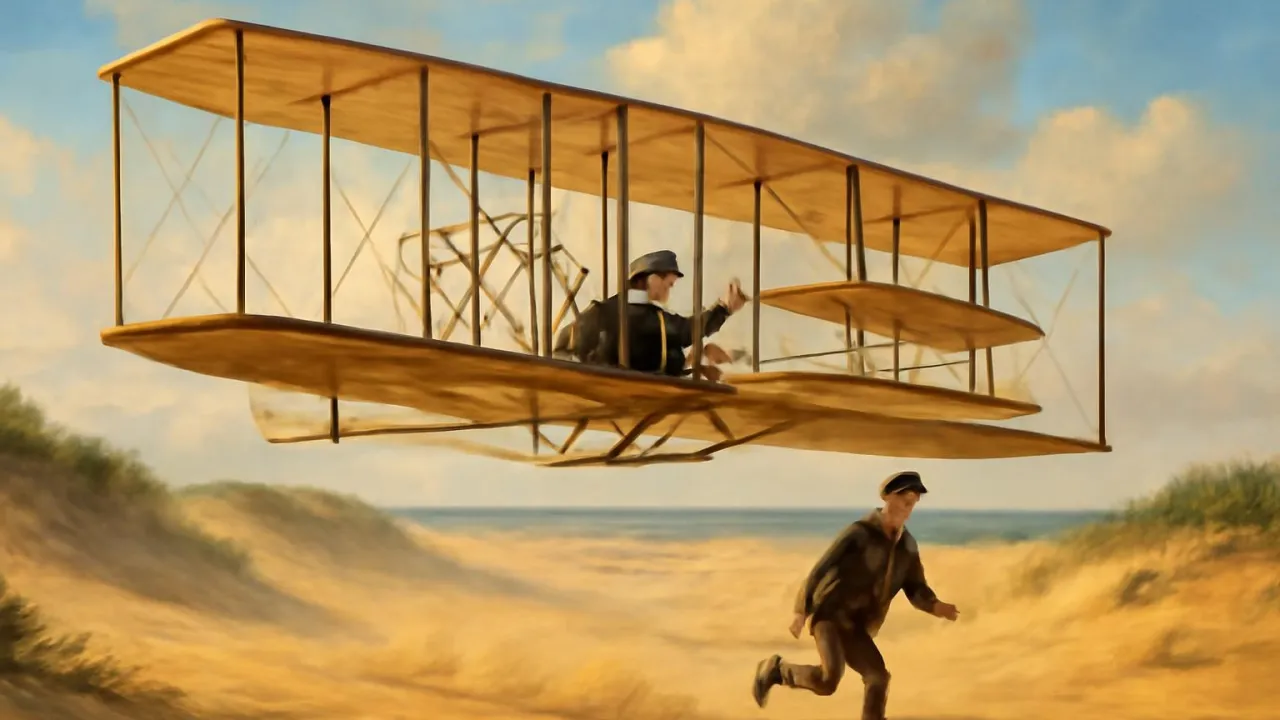
The Flyer’s propellers spun at 350 revolutions per minute during its first flight!
1 The Dawn of Powered Flight
On December 17, 1903, the windswept dunes of Kitty Hawk, North Carolina, echoed with the mechanical rumble of the Wright Flyer’s 12-horsepower engine. Orville Wright, lying prone on the lower wing, grasped the Flyer’s wooden controls while Wilbur sprinted alongside, steadying the delicate structure. The Flyer’s dual propellers, powered by a lightweight gasoline engine and bicycle chains, generated enough thrust to overcome gravity and friction. In just 12 seconds, the Flyer covered 120 feet, marking the world’s first sustained, powered, and controlled flight.
2 Engineering Marvels and Aerodynamic Principles
The Wright Flyer’s design showcased advanced understanding of aerodynamics and lightweight engineering for its era. Its 40-foot wingspan and cambered muslin wings exploited , generating lift by creating faster airflow above the wing than below. The wooden frame, constructed from spruce and ash, balanced strength with minimal weight. The Flyer’s twin propellers, meticulously hand-carved, rotated in opposite directions to cancel out and stabilize the plane in flight.
3 Innovative Control Systems
Unlike earlier gliders, the Flyer featured a three-axis control system: wing-warping for roll, a forward elevator for pitch, and a rear rudder for yaw. This allowed the pilot to manage the Flyer’s orientation in all directions, a critical breakthrough in flight control. The brothers’ use of wing-warping cables, activated by a hip cradle, enabled precise adjustments to the wing shape during flight. Their patented system set the foundation for all modern aircraft controls.
4 Historical Impact and Global Influence
The Wright Flyer’s flight was witnessed by only five people, but its news quickly spread worldwide, igniting the age of aviation. Within a decade, aircraft evolved rapidly, enabling mail delivery, aerial photography, and even military . The Flyer’s success inspired inventors and engineers across continents, leading to international air races and the birth of commercial aviation. The Wright brothers’ achievement transformed human transportation, shrinking the world and connecting distant places.
5 Legacy in Science and Society
Today, the original Wright Flyer is displayed at the Smithsonian National Air and Space Museum, symbolizing human ingenuity and perseverance. Its principles of lift, thrust, and control remain fundamental in modern aerospace engineering. The Flyer’s 12-second journey proved that powered flight was possible, paving the way for supersonic jets, space exploration, and global connectivity. The Wright brothers’ relentless experimentation and scientific curiosity continue to inspire future generations of engineers and dreamers.
1. How did the Wright Flyer’s propellers help stabilize the plane?
2. Why is the Flyer’s three-axis control system important for modern airplanes?