Radar System
The Invisible Eyes That See Far
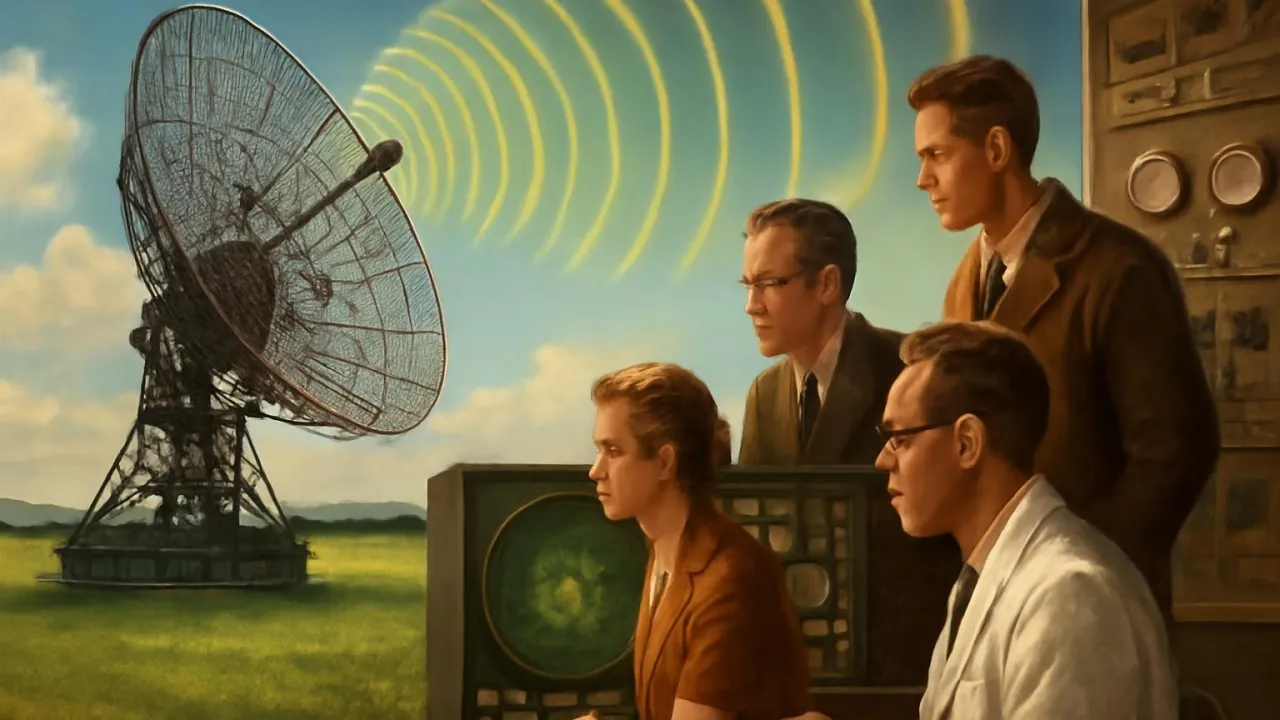
Radar can see airplanes even when it is very dark outside!
What if you could see things far away, even in the dark?
1 Beep! Beep! Radar Spins
A big spins around fast. It sends out invisible . The waves bounce off things. The radar when it finds something.
2 Finding Planes and Boats
Radar helps people find planes in the sky. It can see boats on the water. Even in fog or rain, radar can help.
3 Watching the Weather
Radar can see storms far away. It helps people stay safe. Weather radars spin and too.
1. What does radar help people see?
2. What shape is a radar dish?
Some radars can spot raindrops that are smaller than a pea!
Have you ever heard a radar beep as it finds something hidden?
1 How Radar Works
A radar sends out invisible that travel through the air. These waves bounce off objects like airplanes or rain clouds and return to the radar dish. When the waves come back, the radar makes a beeping sound. That helps people know something is there.
2 Helping People Stay Safe
Radar is used at airports to planes and keep them safe. Boats use radar to avoid crashing into things, especially in fog. Weather radars help see storms and warn people about bad weather.
3 A Cool Invention
Radar was first made in the 1930s to help spot enemy planes. Today, radar helps us every day, from driving cars to watching the weather on TV. It is a super helpful invention.
1. What do radar waves do when they hit something?
2. Who uses radar to see storms?
Modern weather radars can scan the entire sky every five minutes!
What if you could spot a speeding airplane on a stormy night, just by listening for a beep?
1 The Magic of Invisible Waves
Radar systems send out waves that travel at the speed of light. When these waves hit an object, they bounce back to the radar dish. The radar measures how long it takes for the waves to return. This helps people know how far away the object is.
2 A Tool for Safety
Air traffic use radar to track airplanes in the sky, even during storms. Ships rely on radar to avoid crashing into rocks or other boats in thick fog. Weather radars help meteorologists detect rain, snow, and tornadoes before they reach towns.
3 How Radar Changed the World
Radar was invented in the 1930s by Sir Robert Watson-Watt in the United Kingdom. It played a key role during World War II by warning people about enemy planes. Today, radar is used in cars, airports, and even to study space.
4 The Science Inside
Radar works by using vibration and , just like an echo. The radar screen shows a bright dot when something is detected. Engineers keep making radar better with new technology every year. Radar helps us see things our eyes cannot.
1. Why do ships use radar?
2. What does radar measure to find distance?
Some space radars can map the surface of Venus through thick clouds!
Imagine standing in a dark field, hearing a radar dish spin and detect things you cannot seeâhow does it work?
1 How Radar Sees the Unseen
Radar systems transmit pulses of electromagnetic energy, which travel outward at light speed. When these pulses strike an object, such as an airplane or a rain cloud, they reflect back toward the radar . By analyzing the time it takes for the reflected signal to return, the radar can calculate the object's distance and direction. This process lets radar 'see' through darkness, fog, or storms where human eyes cannot.
2 A Revolution in Safety and Science
Invented by Sir Robert Watson-Watt in 1935, radar technology became crucial during World War II for detecting enemy aircraft. After the war, radar spread into airports, harbors, and weather stations, making travel and forecasting much safer. Meteorologists use weather radar to track rain, snow, and tornadoes, helping communities prepare for dangerous storms. Radar even helps astronomers map planets and asteroids in space.
3 Inside the Radar System
A radar system includes a , which sends out the radio waves, and a receiver, which listens for returning . The rotating dish helps the radar scan a wide area, creating a sweeping pattern. The radar display shows blips or dots where objects are detected, allowing operators to track many moving things at once. Engineers continue to improve radar with digital technology and better antennas.
4 Global Impact and Everyday Uses
Today, radar is used in air traffic control, weather forecasting, ship navigation, and even in some cars for collision avoidance. It has made travel safer and given scientists powerful tools to explore the world and beyond. Radarâs ability to see through darkness and storms has changed how we understand and interact with our environment. Its invention remains one of the most important advances in modern engineering.
1. How does radar find the distance to an object?
2. Which field did radar help after World War II?
Doppler radar can detect tornado rotation inside a thunderstorm miles before it touches down.
What if you could detect a distant airplane or a hidden mountain, even in total darkness or a raging storm, just by measuring invisible echoes?
1 The Physics Behind Radar
Radar, which stands for Radio Detection and Ranging, operates by transmitting bursts of electromagnetic wavesâspecifically radio wavesâinto the environment. These waves travel at approximately 300,000 kilometers per second, the speed of light, until they encounter an object. When the waves strike an object, such as an aircraft, ship, or rain cloud, a portion of the energy is reflected back toward the radar antenna. By precisely measuring the time delay between transmission and reception, the radar system calculates the object's distance using the formula: Distance = (Speed of Light à Time Delay) Ãˇ 2.
2 Engineering Marvels: Components and Design
A typical radar system consists of a transmitter, a highly sensitive receiver, and a rotating antenna. The transmitter generates powerful radio pulses, while the receiver detects the faint echoes returning from distant objects. The parabolic dish focuses the radio waves into a narrow beam, increasing sensitivity and directional accuracy. Modern radar systems employ digital signal processing to filter out noise and enhance detection of small or fast-moving targets. Some advanced radars use antennas, which steer beams electronically without moving parts.
3 Historical Evolution and Global Impact
Radar was first developed by Sir Robert Watson-Watt and his team in the United Kingdom in 1935, initially to provide early warning of enemy aircraft. During World War II, radar networks played a decisive role in the Battle of Britain and greatly improved air and sea defense. After the war, radar technology rapidly expanded into civil aviation, maritime navigation, and meteorology. Today, radar is essential for air traffic control, severe weather forecasting, planetary mapping, and even automotive safety systems like adaptive cruise control.
4 Scientific Applications and Quantitative Power
Weather radar systems can detect raindrops as small as one millimeter in diameter and measure storm movement with kilometer-scale precision. Doppler radar, a special type, measures the speed and direction of moving objects by analyzing frequency shifts in the returned signal. Spaceborne radar instruments have mapped the surface of Venus through dense clouds and revealed hidden riverbeds beneath Earth's deserts. Radarâs ability to operate day or night, and in almost any weather, makes it a cornerstone of modern science and safety.
5 The Future of Radar Technology
Emerging radar systems use higher frequencies, such as millimeter waves, to achieve even finer resolution and faster scanning rates. Artificial intelligence and machine learning are being integrated to automatically identify objects and predict hazards. Quantum radar, still in experimental stages, promises to detect stealth aircraft and provide unprecedented imaging detail. As radar technology continues to evolve, its applications will expand into autonomous vehicles, environmental monitoring, and deep-space exploration, shaping the future of discovery and protection.
1. What formula does radar use to calculate distance?
2. What new technology may help radar detect stealth aircraft?