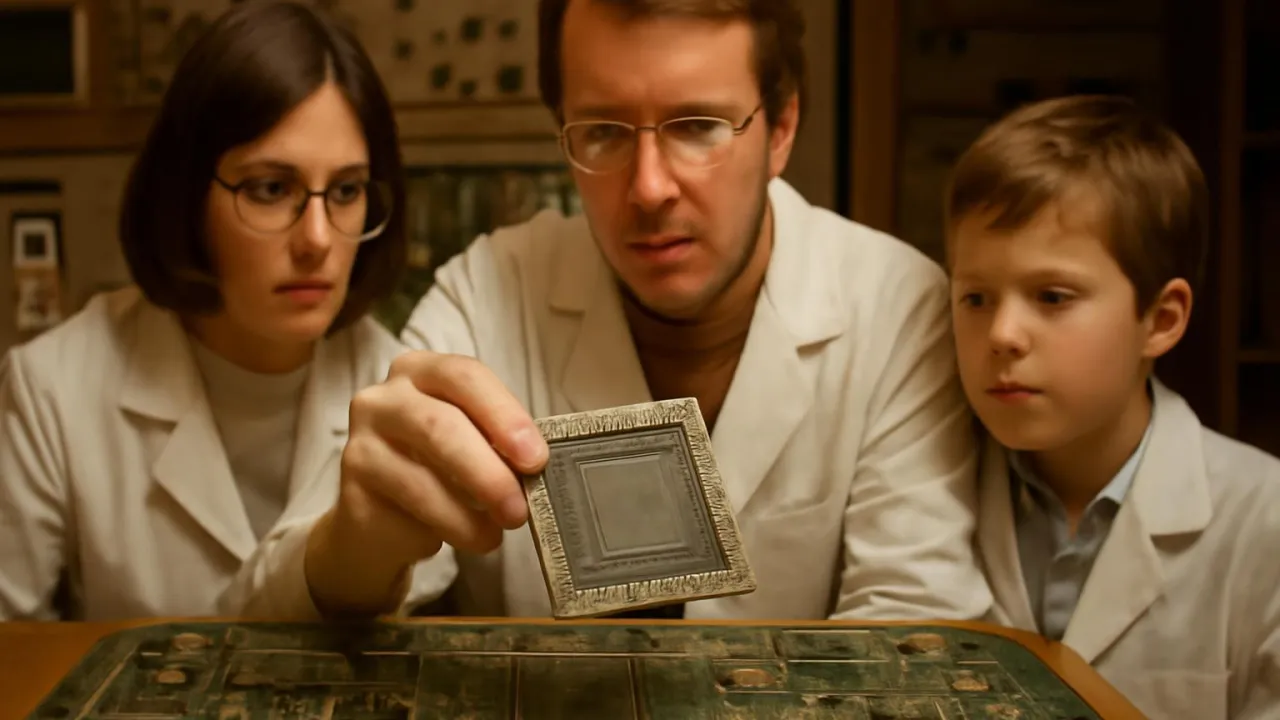
Some microprocessors can do more than a million jobs every single second!
✨ Word Sparks (Grade 2 Glossary)
Tap 🔊 to hear
transistor
A tiny switch inside a chip
gadget
A small tool or machine
boss
Someone or something in charge
🪝
What if a tiny chip inside your toy could make it play games with you?
1
The Chip That Thinks Fast
Imagine hearing a soft beep as your toy robot lights up and moves. That’s the microprocessor at work, acting like a inside your toy or computer. Even though it is small enough to sit on your finger, it gives big instructions to your favorite machines.
2
Microprocessors Are Everywhere
Microprocessors help your phone show pictures and help cars drive safely down the street. They make sure games run smoothly and robots follow your commands. Without microprocessors, many things you use every day would not work as quickly or as well.
3
How This Tiny Brain Works
Inside the chip, tiny switches called flip on and off super fast. These switches help the chip solve math problems and remember things for your games. The microprocessor is like a tiny brain for all your favorite .
1. What does a microprocessor act like inside a computer?
2. What do transistors do inside a microprocessor?
🤯 Mind-Blowing Fact • Grade 3
The first microprocessor, the Intel 4004, could perform 92,000 instructions per second!
✨ Word Sparks (Grade 3 Glossary)
Tap 🔊 to hear
binary
A code made of only 1s and 0s
calculation
Solving math problems or steps
digital
Using numbers and electricity
🪝
Can you imagine a world without computers or video games?
1
The Chip Revolution
In 1971, engineers at Intel invented the first microprocessor. This tiny chip changed how people use machines everywhere. It made computers smaller, faster, and more affordable for everyone. Today, microprocessors are found in phones, cars, and even toys.
2
How Does It Work?
A microprocessor uses thousands of tiny switches called transistors. These transistors open and close to create patterns called code. The chip follows instructions, solves math problems, and stores information using electricity. This process is called computing.
3
A Tiny Brain for Machines
People often call the microprocessor the 'brain' of a computer. It controls what the computer does by following instructions very quickly. Microprocessors can perform millions of every second. They help machines make decisions and respond to commands.
4
Changing the World
Before microprocessors, computers were huge and used lots of power. The invention of the microprocessor made it possible to build laptops, tablets, and smart devices. Now, people all over the world use microprocessors every day. This tiny chip started a revolution.
1. Why do people call the microprocessor a 'brain'?
2. What did microprocessors make possible?
🤯 Mind-Blowing Fact • Grade 4
Modern microprocessors can contain over 50 billion transistors on a chip smaller than your fingernail!
✨ Word Sparks (Grade 4 Glossary)
Tap 🔊 to hear
silicon
A shiny material used to make chips
gigahertz
A way to measure chip speed
revolution
A big, important change
🪝
What if you could hold a supercomputer’s power in your hand?
1
Birth of the Microprocessor
In 1971, engineers at Intel, led by Ted Hoff, created the first commercial microprocessor, the Intel 4004. This invention marked a turning point in electronics history by combining thousands of transistors onto a single chip. Before this, computers were room-sized and used many separate parts. The microprocessor made it possible for computers to become smaller, cheaper, and more powerful.
2
How Microprocessors Work
A microprocessor is made up of millions or even billions of microscopic transistors. These transistors act as switches, turning on and off to process binary code, which is made of 1s and 0s. The chip follows a set of instructions, called a program, to perform calculations, store data, and control other devices. This process is known as digital computation, and it happens at incredible speeds measured in megahertz or .
3
The Heart of Modern Technology
Microprocessors are often called the 'brains' of computers because they make decisions and process information. They are found in almost every electronic device, from smartphones and tablets to cars and home appliances. Microprocessors have made possible the rise of smart technology, robotics, and the internet. Their small size and amazing speed have changed how people live, work, and communicate.
4
A Global Impact
The microprocessor sparked a technological that spread across the world. It enabled the creation of personal computers, video games, and advanced robots. Today, billions of microprocessors are produced each year, powering devices in every country. As microprocessors become even faster and smaller, they continue to shape the future of science, medicine, and communication.
2. Why was the microprocessor important for computers?
🤯 Mind-Blowing Fact • Grade 5
If you stacked today’s microprocessor transistors, they’d reach the moon and back over 1,000 times!
✨ Word Sparks (Grade 5 Glossary)
Tap 🔊 to hear
integrated circuit
A tiny part with many electronic pieces
nanotechnology
Building things smaller than a germ
legacy
Something important left for the future
🪝
What if the power of an entire computer could be squeezed onto a single chip smaller than your thumb?
1
A Breakthrough in Miniaturization
In 1971, the Intel 4004 microprocessor was released, marking the dawn of the microchip era. Designed by Ted Hoff and Federico Faggin, this chip contained 2,300 transistors and performed 92,000 instructions per second, all on a piece of silicon measuring just 12 by 4 millimeters. The microprocessor’s invention allowed engineers to replace entire circuit boards with a single , making computers smaller, more reliable, and affordable for the first time in history.
2
Engineering the Digital Brain
A microprocessor operates by processing binary instructions, using millions to billions of transistors as electronic switches. These transistors form logic gates, which carry out arithmetic, data storage, and control operations at astonishing speeds. Modern microprocessors are built using , with features as tiny as 3 nanometers, allowing for more power and efficiency. The chip’s clock, measured in gigahertz, synchronizes all operations, enabling billions of calculations per second.
3
From Mainframes to Mobile Devices
Before microprocessors, computers filled entire rooms and consumed enormous amounts of electricity. The microprocessor’s arrival enabled the development of personal computers, laptops, smartphones, and tablets. Today, microprocessors are embedded in everything from medical equipment and vehicles to smartwatches and household appliances. Their versatility and speed have revolutionized every industry, from science and medicine to entertainment and transportation.
4
Global Impact and Future Innovation
The microprocessor ignited the Information Age, making advanced computing accessible to billions of people worldwide. It has powered the rise of the internet, artificial intelligence, robotics, and space exploration. Each year, over 15 billion microprocessors are manufactured, with new designs pushing the limits of speed, energy efficiency, and miniaturization. As scientists explore quantum computing and neuromorphic chips, the microprocessor’s continues to inspire future breakthroughs.
5
A World Transformed
Microprocessors have reshaped how people learn, communicate, and solve problems on a global scale. Their invention sparked waves of innovation in software, hardware, and digital networks, connecting cultures and economies in ways never before possible. As microprocessors become even more powerful, they promise to unlock new discoveries in science, medicine, and technology, shaping the world for generations to come.