Fiber-Optic Cable
Light Beams That Carry Our Voices
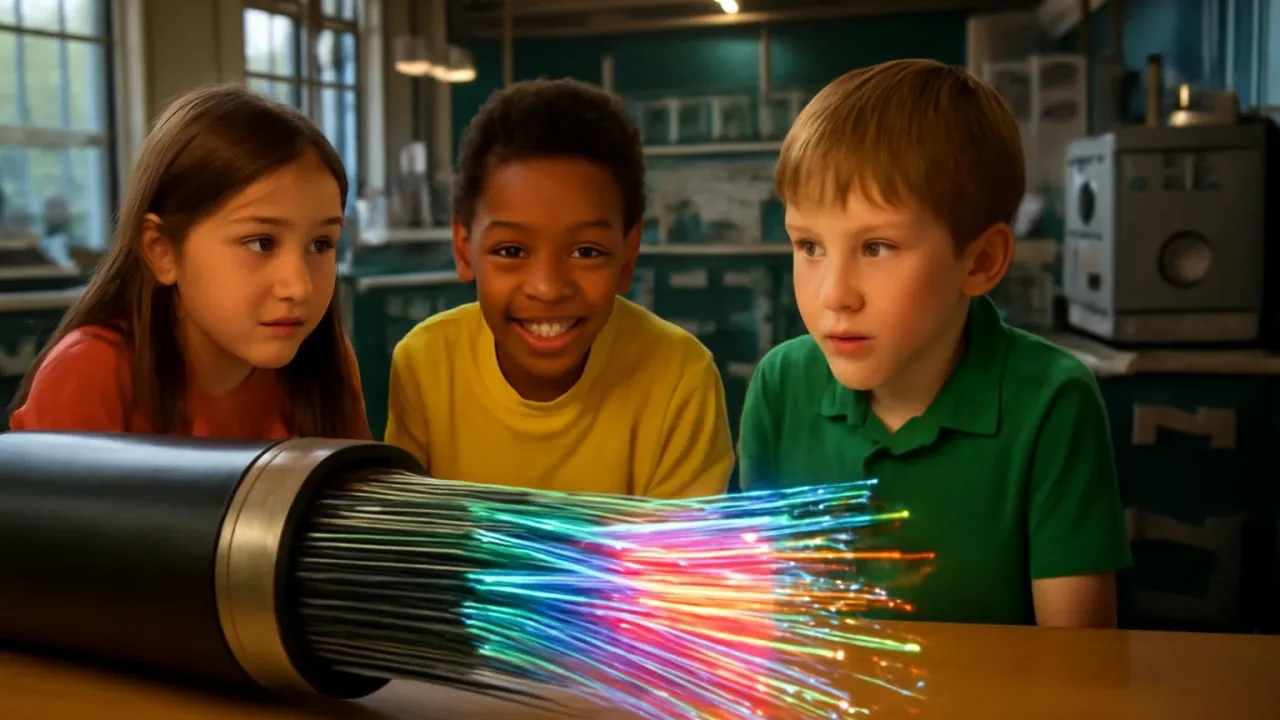
A single modern fiber-optic cable can transmit more data in one second than all the world’s radio signals combined!
1 Engineering a Pathway for Light
Fiber-optic cables are marvels of modern engineering, consisting of bundles of ultra-thin glass fibers, each with a core diameter as small as 8 microns. When digital information is sent, lasers or LEDs convert it into rapid pulses of light that travel through these fibers. The principle of total internal reflection ensures that the light signals bounce repeatedly off the core-cladding boundary, remaining trapped and moving forward with minimal loss. This process allows data to travel at speeds close to 200,000 kilometers per second, making fiber optics the fastest communication medium ever invented.
2 From Laboratory to Global Network
The first practical fiber-optic cable was developed in 1970 by Dr. Robert Maurer, Dr. Donald Keck, and Dr. Peter Schultz at Corning Incorporated in New York. Their breakthrough was creating glass pure enough for light to travel long distances without significant , or weakening. Since then, fiber-optic technology has rapidly evolved, replacing copper wires in most long-distance and high-speed data networks. Today, over 99% of all international data—including phone calls, video, and internet traffic—travels through more than 1.3 million kilometers of undersea fiber-optic cables.
3 The Science of Multiplexing and Signal Integrity
Modern fiber-optic systems use wavelength division multiplexing (WDM) to transmit dozens or even hundreds of separate data streams simultaneously through a single fiber. Each stream uses a different wavelength, or color, of laser light, allowing a single cable to carry up to 40 of data per second. Advanced repeaters and amplifiers are placed along long routes to boost the light signals and correct for any distortion or loss. Engineers must carefully manage , which can cause signals to spread out and blur, in order to maintain clear and reliable communication.
4 Global Impact and Everyday Life
Fiber-optic cables form the backbone of the world's digital infrastructure, enabling instant communication, cloud computing, remote learning, and streaming entertainment. They have dramatically reduced the cost and increased the speed of global connectivity, making information accessible to billions of people. Undersea cables, protected by layers of steel and waterproof materials, stretch across oceans to link continents and cultures. Fiber-optic networks are also essential for scientific research, financial markets, and even medical imaging technologies.
5 The Future of Fiber-Optic Innovation
As demand for faster and more reliable data grows, scientists continue to push the boundaries of fiber-optic technology. Researchers are developing hollow-core fibers, quantum encryption methods, and new multiplexing techniques to increase capacity and security. Fiber-optic cables are now reaching remote villages and schools, helping to bridge the digital divide worldwide. This invention, born from the quest to harness light, continues to transform how humanity connects, learns, and discovers together.
1. Why is total internal reflection important in fiber-optic cables?
2. How do engineers send multiple data streams through one fiber?