🌌 COSMOS
🔭 Electron-Degenerate Stellar Remnant • Spectral Class D
VA Science SOL 1.6, 4.5, 4.6 (Solar System, Stars & Space Exploration)
White Dwarf Star
Earth-Sized Cosmic Embers Crystallizing Into Giant Diamonds
Grade 5 • Advanced • 296 words
🌌 Cosmic Location & DistanceRetired Core of ~97% of Stars • Nearest is Sirius B (8.6 light-years away)
🪐 Scale / Diameter~8,000 miles (12,700 km) wide (Earth-sized) • ~0.6 to 1.4 solar masses
☄️ Composition & OrbitDense carbon & oxygen core • No fusion—glows from stored leftover heat
⚡ Cosmic SparkPacks half a Sun's weight into an Earth-sized sphere that slowly freezes into solid crystal
🤯 Mind-Blowing Fact • Grade 1
As a carbon white dwarf slowly cools over billions of years, its inside hardens into a crystal like an Earth-sized space diamond!
✨ Word Sparks (Grade 1 Glossary)
Tap 🔊 to hear
ember
A hot glowing coal after fire fades
retire
To finish active work and rest quietly
crystal
Solid material with neatly lined-up atoms
🪝
What if you squeezed half the Sun down to the size of planet Earth?
1
A Tiny Heavy Star
Scoop up just one teaspoon of a white dwarf star. Surprise—that tiny spoonful weighs as much as an elephant! A whole star's middle is packed into a ball the size of Earth.
2
Glowing Like an Ember
White dwarfs are retired stars that stopped making new heat. Like a hot marshmallow coal after a campfire, they glow bright white for billions of years!
3
Almost Every Star's Future
Nearly every star you see—even our Sun someday—will as a quiet white dwarf!
2. About how much would a single teaspoon of white dwarf matter weigh?
🤯 Mind-Blowing Fact • Grade 2
Even though Sirius B is slightly SMALLER than Earth, it weighs almost the exact same as our entire giant Sun!
✨ Word Sparks (Grade 2 Glossary)
Tap 🔊 to hear
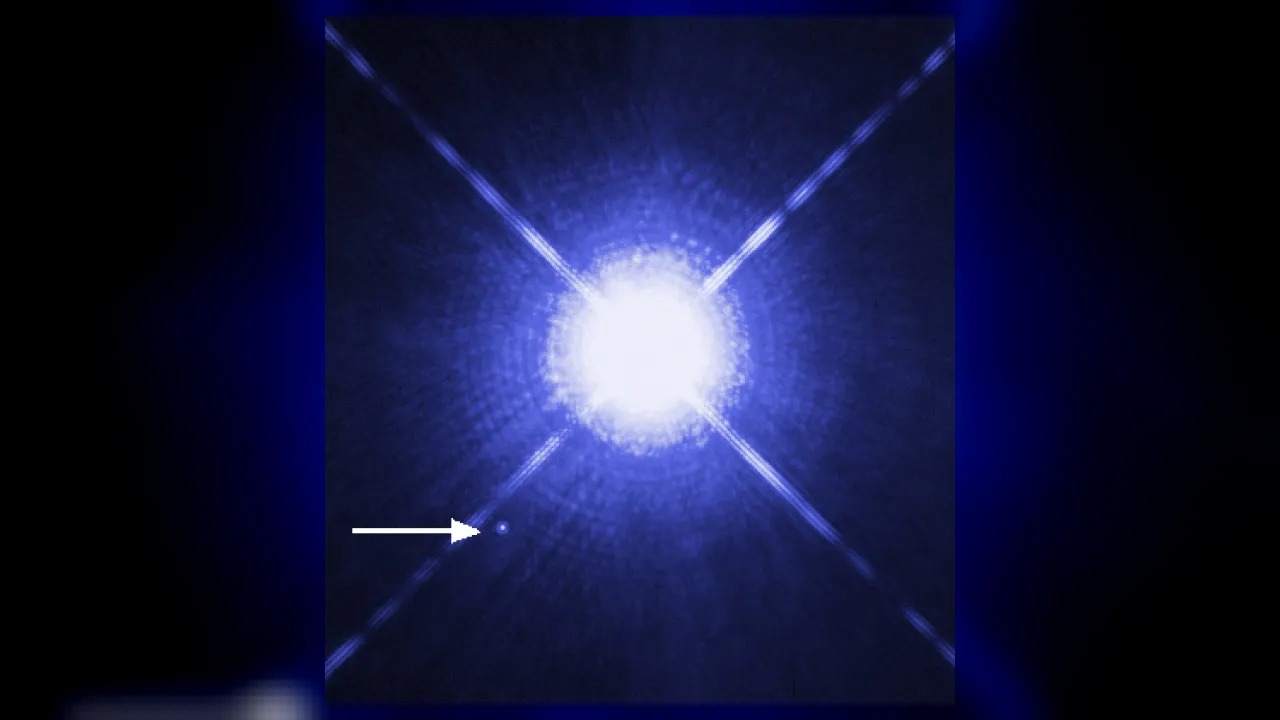
Sirius B
Famous white dwarf orbiting bright star Sirius
wobble
Side-to-side tug caused by an orbiting partner
dense
Packing huge weight into a small space
🪝
How did astronomers find a tiny hidden white dwarf next to the brightest star in the night sky?
1
The Pup Beside the Dog Star
Look up on a winter night at Sirius, the brightest star in Earth's sky. In 1844, astronomers noticed Sirius wobbling back and forth as it moved! Eighteen years later, a new telescope spotted a tiny, dim partner tugging on it—nicknamed 'The Pup,' or , the first white dwarf ever studied.
2
Leftover Star Hearts
When a red giant star puffs off its outer gas layers, its hot carbon-and-oxygen core stays behind as a white dwarf. Even without nuclear fuel burning inside, trapped heat keeps its surface blazing white-hot!
3
Gravity Times Three Hundred Thousand
Packing solar weight into an Earth-sized ball makes gravity 350,000 times stronger than Earth's—squashing any mountain flat!
1. How did astronomers first guess that Sirius had an invisible white dwarf partner?
2. Why does a white dwarf keep shining even after it runs out of nuclear fuel?
🤯 Mind-Blowing Fact • Grade 3
Astronomers nicknamed white dwarf BPM 37093 'Lucy' because vibrations showed its carbon core has crystallized into a cosmic diamond weighing ten billion trillion trillion carats!
✨ Word Sparks (Grade 3 Glossary)
Tap 🔊 to hear
degeneracy pressure
Quantum push stopping electrons from overlapping
Chandrasekhar limit
Maximum 1.44-Sun weight a white dwarf holds
black dwarf
Future white dwarf cooled completely dark
🪝
Why does adding MORE mass to a white dwarf actually make it SHRINK smaller?
1
Quantum Pushback
Normal stars stay puffed up because hot gas pushes outward against gravity. A white dwarf has no fusion furnace left! Instead, gravity crushes its carbon and oxygen atoms until electrons refuse to squeeze into the same tiny space—a quantum rule called electron that holds the star up forever.
2
The Upside-Down Size Rule
Everyday objects grow bigger when you add more stuff, like rolling snow onto a snowman. White dwarfs do the exact opposite! Adding more mass strengthens gravity, squeezing those electrons tighter so a heavier white dwarf actually shrinks smaller in width.
3
The Weight Limit
At age 19 during a sea voyage in 1930, physicist Subrahmanyan Chandrasekhar calculated a strict tipping point: no white dwarf can exceed 1.44 times the Sun's mass without collapsing or exploding!
4
Waiting for the First Black Dwarf
Once a white dwarf cools completely dark, astronomers call it a ''—yet cooling takes so long that not a single one exists in our 13.8-billion-year-old universe yet!
1. What weird thing happens to a white dwarf's width if you add extra mass to it?
2. Why hasn't anyone ever seen a 'black dwarf' anywhere in space?
🤯 Mind-Blowing Fact • Grade 4
Because Type Ia white dwarf explosions all shine with predictable peak brightness, astronomers used them in 1998 to discover that the expansion of the universe is speeding up!
✨ Word Sparks (Grade 4 Glossary)
Tap 🔊 to hear
Pauli exclusion
Quantum law keeping electrons in separate states
Type Ia supernova
Thermonuclear explosion of an overloaded white dwarf
standard candle
Object of known brightness used for distance
🪝
How can a retired white dwarf steal gas from a neighbor and detonate into a cosmic lighthouse visible billions of light-years away?
1
Destiny of Ninety-Seven Percent of Stars
Roughly 97 percent of all stars in the Milky Way—every star born under about eight solar masses—lack the crushing gravity needed to explode as core-collapse supernovae. Instead, after shedding glowing planetary nebulae, they leave behind bare carbon-oxygen (or occasionally helium or oxygen-neon) white dwarf cores with densities near one million grams per cubic centimeter.
2
Pauli Exclusion and Relativistic Collapse
Wolfgang Pauli's exclusion principle forbids two identical electrons from occupying the same quantum state, generating temperature-independent electron degeneracy pressure. Traveling from India to England in 1930, Subrahmanyan Chandrasekhar combined quantum mechanics with Einstein's special relativity, proving that above ~1.44 solar masses electrons approach light speed and can no longer resist gravity.
3
Type Ia Supernovae: Cosmic Yardsticks
If a binary white dwarf siphons hydrogen off a companion star—or merges with another white dwarf—and crosses the Chandrasekhar limit, runaway carbon fusion incinerates the entire star in seconds as a ! Because they blow up near the same critical mass, their peak brightness acts as a '' for measuring galaxy distances.
4
Forensics of Shredded Exoplanets
High-gravity white dwarfs quickly pull heavy elements inward, so spotting iron, silicon, and calcium polluting their pure hydrogen atmospheres proves ancient rocky asteroids and planets were tidally shredded onto the star!
1. Why are exploding white dwarfs (Type Ia supernovae) such useful 'standard candles' for cosmologists?
2. What does finding iron and rock-forming silicon in a white dwarf's outer atmosphere tell astronomers?
🤯 Mind-Blowing Fact • Grade 5
One bizarre white dwarf named J1912-4410 spins every 5.3 minutes while whipping a magnetic beam past a companion star like a miniature 'white dwarf pulsar'!
✨ Word Sparks (Grade 5 Glossary)
Tap 🔊 to hear
Fermi-Dirac statistics
Quantum math describing tightly packed electrons
gravitational redshift
Stretching of light escaping strong gravity
necroplanetology
Studying shattered planets falling onto dead stars
🪝
Why did early twentieth-century astronomers call white dwarfs 'impossible stars' until quantum mechanics rescued astrophysics?
1
The Riddle of 40 Eridani B and Sirius B
Between 1910 and 1915, astronomers Walter Adams and Henry Norris Russell obtained spectra of 40 Eridani B and Sirius B that seemed physically impossible: dim luminosities paired with scorching A-type white temperatures (25,000 K for Sirius B)! Small surface area was the only explanation, implying 0.98 solar masses crammed inside an Earth-sized radius at $10^6 \text{ g/cm}^3$—a riddle Arthur Eddington highlighted until Ralph Fowler applied Fermi-Dirac quantum statistics in 1926.
2
Relativistic Degeneracy and the Mass-Radius Law
Non-relativistic electron degeneracy follows an inverse mass-radius relation ($R \propto M^{-1/3}$): more massive white dwarfs pack smaller volumes. Incorporating special relativity at age nineteen, Subrahmanyan Chandrasekhar showed that as Fermi momentum approaches $mc$, pressure softens from $P \propto \rho^{5/3}$ to $\rho^{4/3}$, capping stable carbon-oxygen remnants near $1.44 M_\odot$—work honored with the 1983 Nobel Prize in Physics.
3
Gravitational Redshift Confirmation
Climbing out of a white dwarf's steep gravitational well ($\log g \approx 8$, hundreds of thousands of times Earth's surface gravity) drains energy from outgoing light photons, stretching their spectral lines toward redder wavelengths. Measuring this on Sirius B with Mount Wilson and Hubble spectrographs provided a landmark observational test of Einstein's general relativity while independently confirming the remnant's mass and compact radius.
4
Latent Heat of Core Crystallization
Predicted theoretically by Hugh Van Horn in 1968, Europe's Gaia space observatory surveyed over 15,000 nearby white dwarfs in 2019 and caught an unmistakable traffic jam on the Hertzsprung-Russell diagram! Cooling stalls for up to two billion years as super-dense liquid carbon and oxygen ions lock into a rigid body-centered cubic crystal lattice, releasing latent heat of fusion and turning dead stellar cores into Earth-sized cosmic crystals.
5
Necroplanetology Laboratories
Because intense white dwarf gravity drags heavier elements below a thin hydrogen or helium atmosphere within days, Hubble and James Webb ultraviolet/infrared spectra of 'polluted' DAZ white dwarfs act as cosmic mass spectrometers—measuring exact iron-core to silicate-mantle ratios of tidally shattered extrasolar rocky worlds.