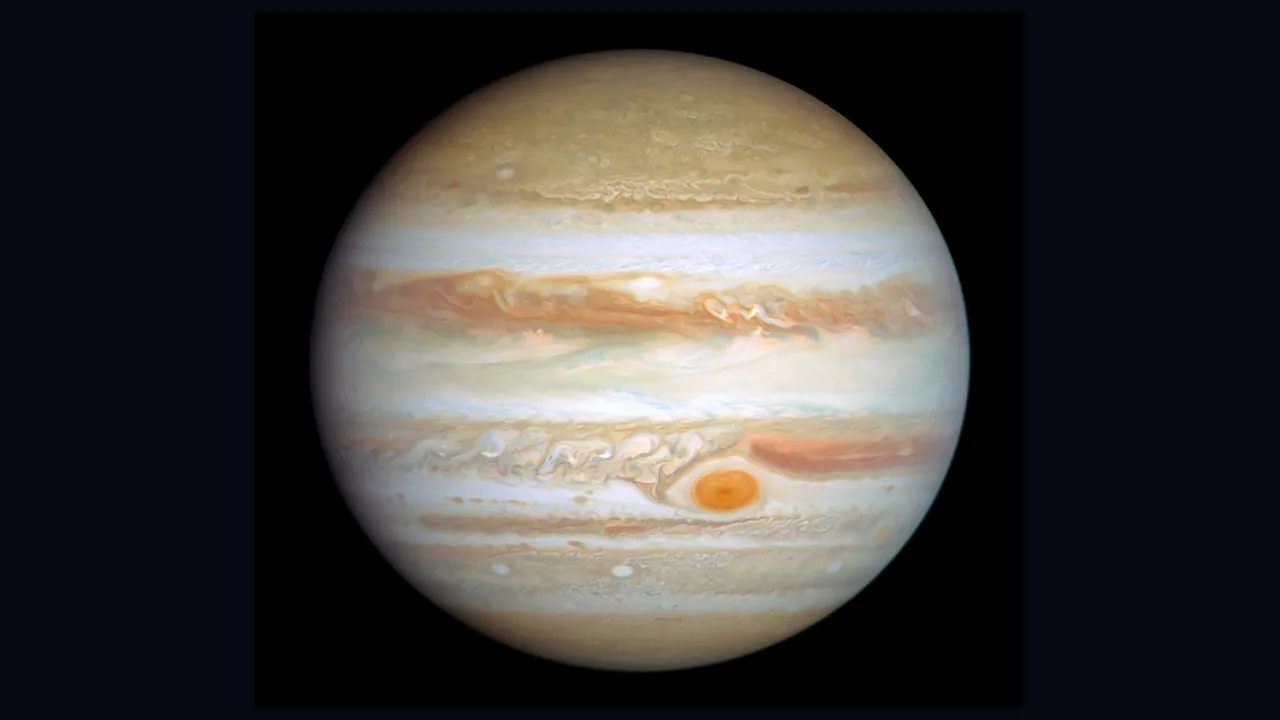
⚡ Cosmic SparkHome to the Earth-sized Great Red Spot storm and Solar System's fastest day
🤯 Mind-Blowing Fact • Grade 1
Even though Jupiter is the biggest planet, it spins super fast—one full Jupiter day lasts less than ten hours!
✨ Word Sparks (Grade 1 Glossary)
Tap 🔊 to hear
colossal
amazingly huge in size
stripes
long bands of different colors
swirl
move around in a twisting circle
🪝
Which giant planet has a storm bigger than our whole Earth?
1
King of the Planets!
, whoosh, roar! Past the rocky Asteroid Belt floats the biggest planet of all! Meet Jupiter, painted in orange, cream, and brown cloud . Over one thousand Earths could fit inside!
2
No Solid Ground
A spaceship could never land on Jupiter. Why? Because it is a gas giant made of swirling clouds instead of rock!
3
The Great Red Spot
Look at that giant oval ! Called the Great Red Spot, that mega-storm is wider than Planet Earth!
1. Why couldn't an astronaut land boots on Jupiter?
2. What is Jupiter's famous Great Red Spot?
🤯 Mind-Blowing Fact • Grade 2
If you put all seven other planets into one giant pile, Jupiter would still weigh more than twice as much as all of them combined!
✨ Word Sparks (Grade 2 Glossary)
Tap 🔊 to hear
ammonia
pungent gas forming icy clouds on Jupiter
binoculars
handheld twin lenses for seeing far away
confirmed
checked carefully and proven to be real
🪝
Did you know Jupiter has faint dusty rings AND ninety-five moons?
1
Twice All Other Planets Combined!
Imagine scooping Mercury, Venus, Earth, Mars, Saturn, Uranus, and Neptune onto one side of a giant cosmic balance scale—and putting Jupiter alone on the other side! Jupiter is more than TWICE as heavy as all the other planets put together!
2
Shortest Day of Any Planet
While Jupiter takes nearly twelve Earth years to travel once around the Sun, it spins like a turbo top! Turning once every 9 hours and 55 minutes whips its clouds into colorful east-west stripes.
3
A Mini Solar System
Circling Jupiter are faint dark dust rings and ninety-five moons—including four huge moons big enough to spot through backyard !
1. About how long does one full day-and-night spin last on giant Jupiter?
2. How does Jupiter's mass compare to the other seven planets?
🤯 Mind-Blowing Fact • Grade 3
Beneath its clouds, crushing pressure squeezes hydrogen gas into the Solar System's largest ocean—made of glowing, electricity-conducting liquid metallic hydrogen!
✨ Word Sparks (Grade 3 Glossary)
Tap 🔊 to hear
zones
bright rising cloud bands on Jupiter
belts
darker sinking cloud bands on Jupiter
conducting
carrying electric current easily like metal wire
🪝
What strange glowing liquid ocean hides beneath Jupiter's clouds?
1
Striped Zones and Belts
Astronomers have two names for Jupiter's stripes! Pale cream stripes called '' are high, cold ammonia clouds rising upward, while reddish-brown stripes called '' are warmer sinking air where deeper cloud layers peek through.
2
An Ocean of Liquid Metal!
Dive thousands of miles beneath Jupiter's clouds and crushing weight squeezes hydrogen gas so tightly that its electrons pop loose—turning hydrogen into a swirling ocean of electrically 'liquid metallic hydrogen'! Jupiter holds the biggest ocean in the Solar System, made of hydrogen instead of water!
3
Monster Magnetic Shield
Spinning that liquid metal ocean every ten hours creates a magnetic field twenty thousand times stronger than Earth's, painting bright blue X-ray and ultraviolet auroras across Jupiter's poles!
4
Four Galilean Worlds
In 1610, Galileo spotted Jupiter's four largest moons—volcanic Io, icy Europa, giant Ganymede, and cratered Callisto—proving not everything in space orbits Earth!
1. What creates Jupiter's super-powerful magnetic field?
2. Who discovered Jupiter's four largest moons in 1610?
🤯 Mind-Blowing Fact • Grade 4
NASA's Juno spacecraft discovered geometric clusters of giant blue cyclones circling both of Jupiter's poles like giant pinwheels!
✨ Word Sparks (Grade 4 Glossary)
Tap 🔊 to hear
cyclones
huge rotating storm systems of wind
friction
rubbing force that slows moving things down
rogue
wandering out of a normal safe path
🪝
What geometric surprise did NASA's Juno spacecraft find swirling right on top of Jupiter's poles?
1
Geometric Cyclone Bouquets at the Poles!
Before NASA's solar-powered Juno spacecraft swooped straight over Jupiter's poles in 2016, every spacecraft view came from near the planet's equator—so nobody knew what Jupiter's top and bottom looked like! Juno's cameras revealed a jaw-dropping surprise: stripes vanish at the poles, replaced by glowing blue-tinted clusters of giant arranged like neat geometric flowers—eight cyclones ringing a central storm at the north pole and five around a center storm at the south pole!
2
Why the Great Red Spot Keeps Spinning
On Earth, hurricanes weaken quickly once they cross dry land because steals their spin. Jupiter has zero continents or mountains underneath to slow storms down! Wedged like a spinning wheel between two 300-mile-per-hour jet streams blowing in opposite directions, the Great Red Spot reaches over two hundred miles deep—though historical telescope drawings show it has gradually shrunk from three Earths wide in the 1800s to roughly one Earth wide today!
3
Gossamer Dust Rings
In 1979, Voyager 1 looked back toward sunlight through Jupiter's shadow and discovered faint dark rings! Unlike Saturn's bright ice rings, Jupiter's rings consist of microscopic dust kicked off tiny inner moons Metis, Adrastea, Amalthea, and Thebe by meteoroids.
4
Cosmic Vacuum Cleaner—and Thrower!
Jupiter's immense gravity acts like a cosmic traffic cop, swallowing comets like Shoemaker-Levy 9 in 1994 while nudging asteroid orbits across the Solar System.
1. Why can storms like the Great Red Spot last for centuries on Jupiter while Earth hurricanes fade in days?
2. Where does the fine dust in Jupiter's faint rings come from?
🤯 Mind-Blowing Fact • Grade 5
NASA's Juno gravity measurements revealed Jupiter doesn't have a neat solid center—its heavy core is 'fuzzy' and dissolved across nearly half the planet's width!
✨ Word Sparks (Grade 5 Glossary)
Tap 🔊 to hear
contraction
slowly shrinking inward and releasing heat
dilute
spread out and mixed rather than concentrated
Lagrange
balanced gravity pockets sharing a planet's orbit
🪝
Why do astronomers call Jupiter 'almost a star, yet eighty times too light'—and why doesn't it have a crisp solid core?
1
Solar Composition Below the Ignition Limit
Accreting first among all Solar System planets roughly 4.6 billion years ago beyond the protoplanetary 'frost line,' Jupiter amassed 317.8 Earth masses of primordial hydrogen (~90% by atom count) and helium (~10%), mirroring the Sun's own chemical recipe! Yet calling Jupiter a 'failed star' needs quantitative perspective: igniting sustained hydrogen fusion requires roughly eighty Jupiter masses (or thirteen Jupiter masses even for brief deuterium fusion in brown dwarfs). Still, slow Kelvin-Helmholtz gravitational causes Jupiter to radiate nearly twice as much infrared heat into space as it absorbs from distant sunlight!
2
Juno's Discovery of a 'Fuzzy' Dilute Core
Textbooks long depicted Jupiter with a neat, compact ball of rock and ice at its exact center. Then millimeter-precision Doppler gravity tracking of NASA's polar-orbiting Juno probe overturned that tidy cartoon! Instead of a sharp boundary, heavy elements—roughly ten to twenty-five Earth masses of rock, metal, and ices—dissolve upward across nearly half of Jupiter's radius into the surrounding 2-million-bar liquid metallic hydrogen envelope, forming a 'fuzzy' or core likely stirred by a colossal head-on protoplanet collision during Jupiter's youth!
3
Helium Rain and Mushballs
Between the upper molecular hydrogen atmosphere and deep metallic sea, helium condenses into droplets that fall downward as 'helium rain,' carrying neon deeper inside! Higher in thunderheads, Juno microwave radiometers discovered violent updrafts lofting water ice until ammonia vapor melts it into slushy ammonia-water hailstones dubbed 'mushballs' alongside shallow lightning.
4
Colossal Magnetosphere and Trojan Asteroids
If Jupiter's magnetosphere glowed visibly in Earth's night sky, it would span wider than several full Moons—stretching its magnetotail clear past Saturn's orbit six hundred million kilometers downwind! Meanwhile, along Jupiter's 11.86-year solar orbit, gravitational balance points called L4 and L5 points herd over ten thousand ancient 'Trojan' asteroids visited by NASA's Lucy spacecraft.
5
Architect of Planetary Migration
Grand-Tack dynamical models suggest young Jupiter migrated inward toward Mars's orbit—stunting Mars's growth and scattering water-rich asteroids toward young Earth—before Saturn's resonant pull tugged Jupiter back out to 5.2 Astronomical Units, sculpting the architecture of our entire Solar System!