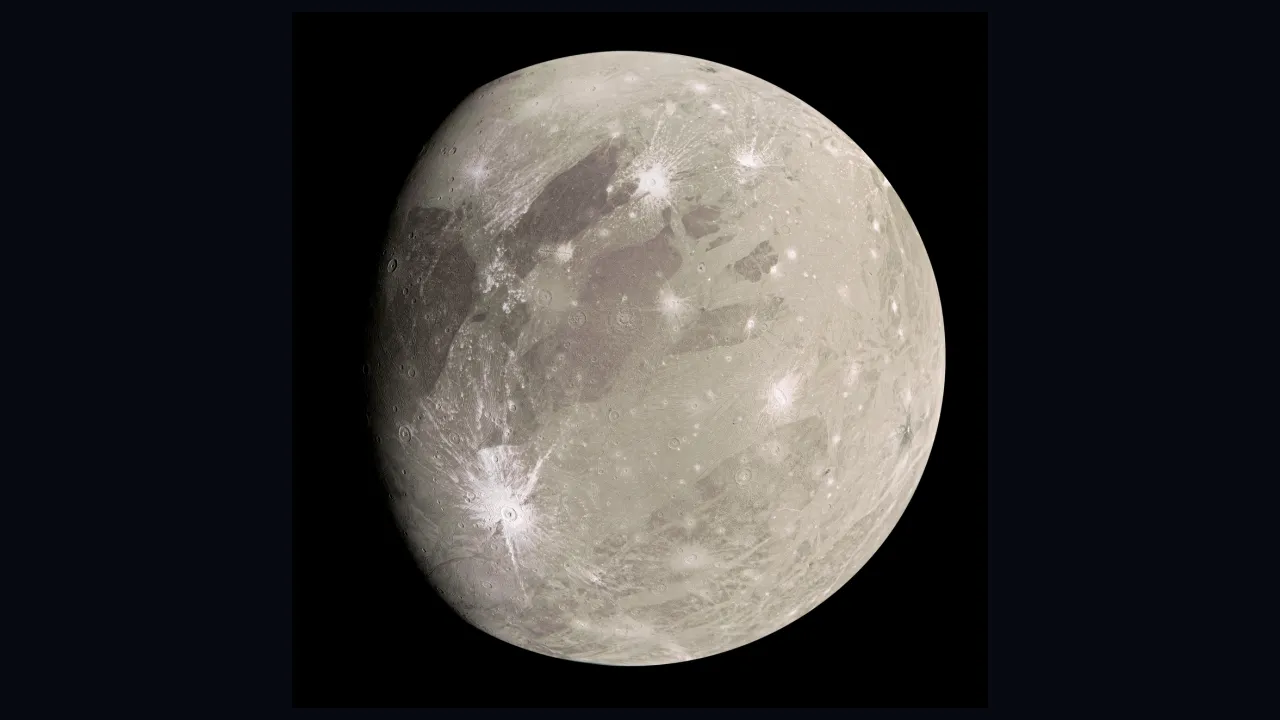
1. Which planet is actually smaller than the moon Ganymede?
2. Which giant planet does Ganymede orbit?
🤯 Mind-Blowing Fact • Grade 2
If Ganymede orbited the Sun by itself instead of circling Jupiter, astronomers would classify it as a full planet!
✨ Word Sparks (Grade 2 Glossary)
Tap 🔊 to hear
Magnetic field
An invisible force bubble made deep inside a world.
Aurora
Glowing ribbons of light high above icy poles.
Core
The hot metal center deep inside a moon.
🪝
Why does Jupiter's biggest moon glow with colorful lights at its poles?
1
A Giant Next to Jupiter
Look through a telescope at Jupiter on a clear night, and you might spot a tiny point of light beside it. Up close, Ganymede is a giant! Measuring 3,273 miles wide, it beats every other moon in our Solar System and even outgrows the planet Mercury.
2
Dark Craters and Bright Ice
Half of Ganymede is rock, and half is frozen water. Dark patches hold ancient craters, while lighter bands show long icy ridges stretched across the surface.
3
Glowing Space Ribbons
Liquid iron swirls inside Ganymede's and builds a real . No other moon can do that! This invisible bubble creates glowing ribbons of light called near its north and south poles.
1. What makes Ganymede unique among all moons in our Solar System?
2. What two main materials build Ganymede?
🤯 Mind-Blowing Fact • Grade 3
Ganymede's hidden underground ocean is estimated to be ten times deeper than the deepest parts of Earth's oceans!
✨ Word Sparks (Grade 3 Glossary)
Tap 🔊 to hear
Magnetosphere
A protective magnetic bubble surrounding a planet or moon.
Crust
The hard outer shell of ice or rock.
Conductive
Able to carry electric currents, like salty ocean water.
🪝
How did twinkling lights in space prove a giant ocean hides inside Ganymede?
1
Galileo's Historic Discovery
Back in January 1610, astronomer Galileo Galilei aimed his homemade telescope at Jupiter and spotted four moving stars. The brightest and largest was Ganymede! Orbiting Jupiter every seven days, this colossal moon stretches 3,273 miles across.
2
Two Very Different Terrains
Spacecraft photos show a patchwork world split into two surface types. Dark, heavily cratered regions are four billion years old. Brighter grooved zones formed later when underground water froze, expanded, and cracked the icy apart.
3
The Only Magnetic Moon
Deep at Ganymede's center sits a molten iron-rich core. As liquid metal churns inside, it generates a —an invisible magnetic shield carved right inside Jupiter's even larger magnetic bubble.
4
Clues From Shimmering Auroras
Scientists used the Hubble Space Telescope to watch glowing aurora belts above Ganymede's poles. Because those lights barely rocked when Jupiter's magnetism pulled on them, astronomers proved an electrically salty ocean 60 miles deep sloshes beneath the ice!
1. How did the Hubble Space Telescope detect Ganymede's underground ocean?
2. Who first spotted Ganymede through a telescope in 1610?
🤯 Mind-Blowing Fact • Grade 4
For every one lap Ganymede makes around Jupiter, Europa makes exactly two laps and Io makes four in a precise cosmic rhythm!
✨ Word Sparks (Grade 4 Glossary)
Tap 🔊 to hear
Resonance
A regular gravitational rhythm between orbiting moons.
Differentiated
Separated into distinct inner layers by weight and density.
Sulci
Long parallel grooves and ridges across an icy moon.
🪝
How can a moon outgrow Mercury in width yet weigh less than half as much?
1
A Low-Density Titan of Ice
Hovering 665,000 miles from Jupiter's swirling cloud tops, Ganymede reigns as the largest satellite in our Solar System. At 5,268 kilometers in diameter, it spans eight percent wider than the planet Mercury. Yet Ganymede contains less than half of Mercury's mass! The secret lies in density: while Mercury is packed with heavy iron, Ganymede is an equal blend of silicate rock and lightweight water ice.
2
A Cosmic Clockwork Dance
Ganymede participates in a remarkable gravitational rhythm called a Laplace orbital . For every single orbit Ganymede completes around Jupiter in 7.15 days, neighboring Europa completes exactly two orbits, and volcanic Io completes four. These repeating gravitational tugs gently flex Ganymede's interior and helped warm its early mantle.
3
Layered Like an Onion
Data from NASA's Galileo and Juno spacecraft reveal that Ganymede is fully into distinct layers. A convecting liquid iron-iron sulfide core powers its intrinsic magnetic field, surrounded by a rocky mantle, high-pressure ice layers, a vast saltwater ocean, and a 95-mile-thick frozen shell.
4
Tectonic Grooves and Future Explorers
Sixty percent of Ganymede's surface is covered in bright bands of parallel ridges and troughs called , sculpted when ancient crust stretched and faulted. Soon, the European Space Agency's JUICE spacecraft will enter orbit directly around Ganymede—becoming the first probe in history to orbit a moon other than Earth's!
1. Why does Ganymede have less than half the mass of Mercury despite being wider?
2. In the Laplace resonance, how many orbits does Io complete for every one orbit of Ganymede?
🤯 Mind-Blowing Fact • Grade 5
Ancient impact craters on Ganymede flatten over eons into bright circular 'ghost craters' called palimpsests because cold ice slowly flows like glacier putty!
✨ Word Sparks (Grade 5 Glossary)
Tap 🔊 to hear
Dynamo
Swirling molten metal inside a core generating magnetism.
Palimpsest
A flattened circular ghost scar from an ancient crater.
Lithosphere
The rigid outer rocky or icy shell of a world.
🪝
Could club-sandwich layers of exotic high-pressure ice and liquid oceans harbor habitable zones inside Ganymede?
1
Shattering Ancient Cosmology
When Galileo Galilei and Simon Marius independently observed Jupiter's moons in January 1610, Ganymede helped overturn centuries of geocentric belief by proving not everything revolved around Earth. Measuring 5,268 kilometers (3,273 miles) across with a bulk density of 1.936 grams per cubic centimeter, Ganymede stands as the ninth-largest object in the entire Solar System—surpassing both Mercury and Pluto in physical diameter.
2
An Intrinsic Planetary Dynamo
During multiple close flybys beginning in 1996, NASA's Galileo orbiter startled planetary scientists by recording a permanent dipole magnetic field of roughly 720 nanoteslas at Ganymede's equator. Unlike induced magnetic fields, Ganymede's magnetosphere is generated by thermal or compositional convection within a molten iron-sulfide core spanning up to 1,400 kilometers across, carving a distinct magnetospheric cavity inside Jupiter's fierce radiation environment.
3
Tectonic Resurfacing and Palimpsests
Ganymede's icy records billions of years of geologic upheaval. Ancient dark regions like Galileo Regio are saturated with flattened, ghost-like impact scars called , where viscous ice slowly slumped back down to erase crater rims. Brighter cross-cutting lanes of grooved terrain—such as Uruk Sulcus—formed through extensional tectonics as internal freezing caused volume expansion.
4
Stacked Oceans and Exotic Ice Phases
Beneath a frigid 150-kilometer ice I crust, pressures climb high enough to compress water molecules into denser crystalline phases—Ice III, Ice V, and Ice VI—that actually sink rather than float. Laboratory models suggest Ganymede's interior may resemble a multi-decker sandwich, alternating layers of salty liquid brine with dense high-pressure ice phases.
5
Astrobiology and the JUICE Orbiter
If the deepest liquid ocean layer contacts Ganymede's silicate mantle directly, water-rock chemical reactions could supply nutrients and energy for microbial life. Following NASA Juno's sharp 2021 reconnaissance flyby, ESA's Jupiter Icy Moons Explorer (JUICE) will use ice-penetrating radar and laser altimetry in the 2030s to map Ganymede's hidden ocean in unprecedented detail.