🌌 COSMOS
🔭 Innermost Terrestrial Planet • Solar System
VA Science SOL 1.6, 4.5, 4.6 (Solar System, Stars & Space Exploration)
Mercury
Swift Cratered World Closest to the Sun
Grade 5 • Advanced • 276 words
🌌 Cosmic Location & Distance1st Planet from Sun • Avg 36 million mi (58 million km) from Sun
🪐 Scale / Diameter3,032 mi (4,879 km) diameter • Slightly larger than Earth's Moon
☄️ Composition & OrbitOversized Iron Core (85% radius) • 88-Earth-day fast orbit
⚡ Cosmic SparkFastest planet at 29 miles per second with secret polar water ice
🤯 Mind-Blowing Fact • Grade 1
If you lived on Mercury, you would celebrate four birthdays during just one single year on Earth!
✨ Word Sparks (Grade 1 Glossary)
Tap 🔊 to hear
craters
bowl-shaped dents made by space rocks
planet
a large round world orbiting a star
swift
moving at a super fast speed
🪝
Which planet celebrates a birthday every eighty-eight Earth days?
1
Smallest and Fastest!
Zoom! Right next to the blazing Sun zips tiny Mercury! It is the smallest of all eight . Racing around the Sun takes Mercury just eighty-eight Earth days!
2
Covered in Craters
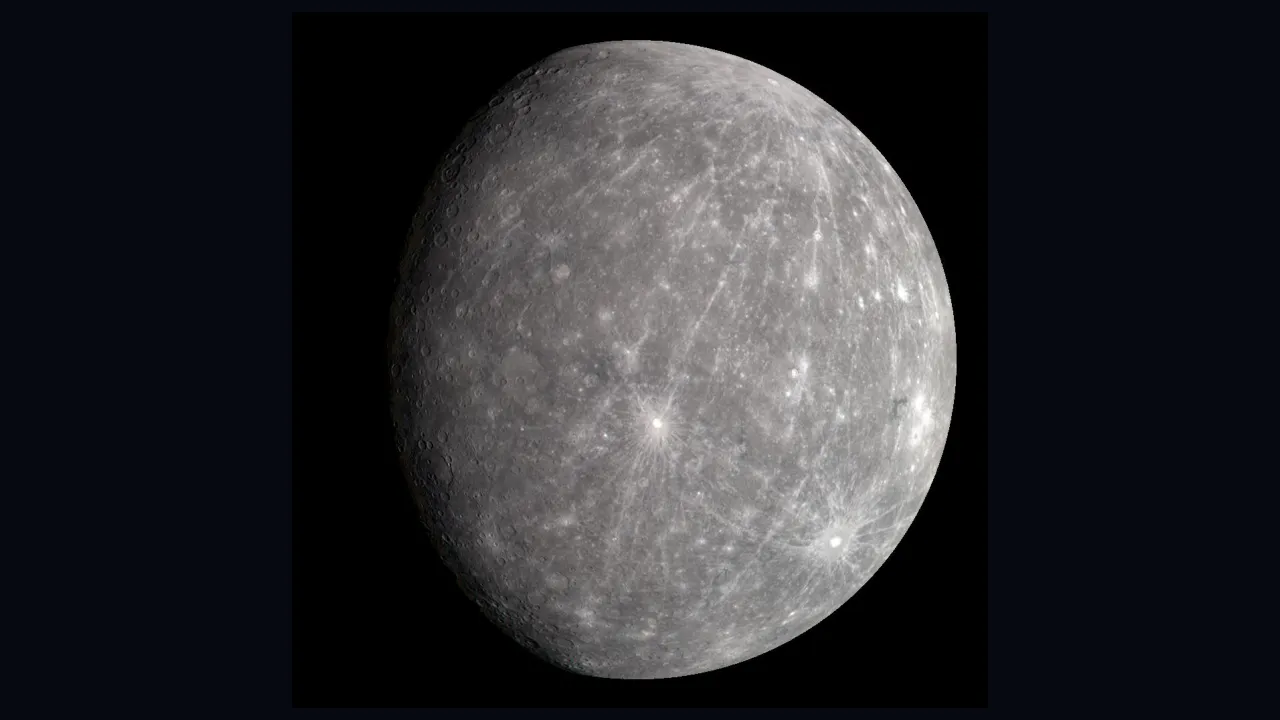
Gray rocks and round cover its dusty ground. Up close, Mercury looks a lot like our Moon!
3
Boiling and Freezing
Daytime bakes hotter than a pizza oven! Yet with no thick air blanket, nighttime turns freezing cold.
1. How long does Mercury take to travel once around the Sun?
2. Why does Mercury freeze at night even though it sits closest to the Sun?
🤯 Mind-Blowing Fact • Grade 2
Even though Mercury sits closest to the Sun, deep shadowed craters at its poles hold billions of tons of frozen water ice!
✨ Word Sparks (Grade 2 Glossary)
Tap 🔊 to hear
atmosphere
the layer of gases surrounding a planet
permanent
lasting forever without ever going away
poles
the very top and bottom points
🪝
How can the planet closest to the Sun hide frozen water ice?
1
Zero Moons, Zero Rings
Hop aboard a virtual spaceship and fly inward toward the Sun—three times bigger in Mercury's black sky than from Earth! Tiny Mercury travels all alone without a single moon or ring beside it.
2
800 Degrees to Minus 290!
No other planet has wilder temperature swings! Sunlit rocks sizzle at 800 degrees Fahrenheit, while the dark night side plunges to minus 290 degrees. Surprisingly, Mercury is only the SECOND hottest planet—cloudy Venus traps even more heat!
3
Secret Ice in Deep Shadows
Near Mercury's north and south , deep crater floors never see a single peek of sunlight. Inside those shadows sits real frozen water ice!
1. Where does real water ice hide on sizzling-hot Mercury?
2. Why isn't Mercury the very hottest planet in our Solar System?
🤯 Mind-Blowing Fact • Grade 3
On Mercury, a single sunrise-to-sunrise day lasts 176 Earth days—making one Mercury day twice as long as one Mercury year!
✨ Word Sparks (Grade 3 Glossary)
Tap 🔊 to hear
core
the dense center inside a planet
scarps
steep cliffs formed when crust wrinkles
exosphere
an ultra-thin halo of scattered gas atoms
🪝
Why is Mercury slowly shrinking and growing giant wrinkles across its rocky face?
1
A Giant Iron Cannonball Inside
Slice planet Mercury open like an apple and you would get a huge surprise! While Earth's metal takes up about half its width, Mercury's enormous iron core fills 85 percent of the planet's radius—leaving only a thin rocky shell outside!
2
Wrinkling Like a Raisin
As that giant iron slowly cools and hardens over billions of years, the whole planet contracts! Like a grape drying into a wrinkled raisin, Mercury's rocky crust buckles upward into mile-high cliffs called lobate .
3
Long Days and Fast Years
Mercury zips around the Sun at 29 miles per second, yet spins on its axis super slowly! One full sunrise-to-sunrise solar day on Mercury lasts 176 Earth days—twice as long as its 88-day year!
4
A Comet-Like Tail
Instead of thick air, Mercury wears a whisper-thin '' blasted off its rocks by sunlight and solar wind, streaming behind the planet like a faint glowing comet tail!
1. What causes mile-high cliffs called lobate scarps to form on Mercury?
2. How much of Mercury's radius is taken up by its metallic iron core?
🤯 Mind-Blowing Fact • Grade 4
Mercury is narrower in diameter than Jupiter's moon Ganymede and Saturn's moon Titan, yet weighs over twice as much because of its iron core!
✨ Word Sparks (Grade 4 Glossary)
Tap 🔊 to hear
densest
packing the most mass into small space
basin
an extra-wide crater from a huge impact
resonance
a locked mathematical rhythm between spins and orbits
🪝
How can a tiny planet smaller than Jupiter's moon Ganymede outweigh moons that are bigger than it?
1
Smaller Than Two Moons, Yet Way Heavier!
Line up Jupiter's icy moon Ganymede, Saturn's hazy moon Titan, and planet Mercury side by side: both moons actually measure wider across than Mercury! Yet put them on a cosmic scale and Mercury weighs more than twice as much. Because its metallic core spans roughly 2,500 miles inside a 3,032-mile body, Mercury is the second- planet in the Solar System, right behind Earth!
2
The Caloris Basin Mega-Impact
Nearly four billion years ago, a sixty-mile-wide asteroid slammed into Mercury and gouged out the Caloris —a crater 960 miles wide, big enough to cover Texas and California together! Shockwaves raced clear through the planet's core and jumbled hills on the exact opposite side into 'Weird Terrain.'
3
Why the Sun Appears to Dance Backward
Locked in a neat 3-to-2 spin-orbit , Mercury rotates exactly three times on its axis for every two egg-shaped orbits around the Sun. Stand on certain longitudes at noon and the giant Sun pauses overhead, drifts backward briefly, then marches forward again!
4
MESSENGER and BepiColombo
Visiting Mercury is tricky because spacecraft diving sunward speed up tremendously! NASA's MESSENGER orbited Mercury from 2011 to 2015, mapping polar ice and ancient volcanic plains, while Europe and Japan's joint BepiColombo mission carries next-generation sensors to explore its surprise magnetic field.
1. What happened on the exact opposite side of Mercury when the Caloris Basin impact occurred?
2. How many times does Mercury spin on its axis during every two orbits around the Sun?
🤯 Mind-Blowing Fact • Grade 5
NASA's MESSENGER mission discovered Mercury's dark surface is coated in ancient graphite—meaning the entire planet once wore a crust of pencil lead!
✨ Word Sparks (Grade 5 Glossary)
Tap 🔊 to hear
perihelion
the closest point to the Sun in orbit
sublimate
turn straight from solid into gas
eccentric
stretched into an oval rather than round circle
🪝
How did tiny Mercury help prove Albert Einstein's General Relativity AND surprise geophysicists with a live magnetic shield?
1
Proving Einstein in Curved Spacetime
Whip around the Sun along the Solar System's most planetary ellipse—swinging from 46 million kilometers at out to 70 million kilometers at aphelion at an average orbital speed of 47.4 kilometers per second! For decades in the nineteenth century, astronomers could not explain why Mercury's closest point to the Sun crept forward by an extra 43 arcseconds per century beyond Isaac Newton's gravity equations. In 1915, Albert Einstein solved the mystery cleanly: deep inside the Sun's gravitational well, warped spacetime itself precesses Mercury's orbit, providing the very first triumphant test of General Relativity!
2
A Molten Dynamo Defying Cooling Models
Before Mariner 10 flew past in 1974, scientists assumed tiny Mercury had frozen solid internally eons ago. Instead, magnetometers detected a global dipole magnetic field—about one percent as strong as Earth's—powered by a churning liquid iron-sulfide outer core! Radar measurements later confirmed slight wobbles in Mercury's spin that prove part of its enormous 2,020-kilometer-radius core remains molten today.
3
Graphite Crust and Mysterious 'Hollows'
Why is Mercury's surface darker than the Moon's highlands? Spectrometers aboard NASA's MESSENGER spacecraft revealed Mercury once swam in a global magma ocean where lightweight graphite—pure pencil-lead carbon—floated upward to form an ancient primordial crust! MESSENGER also discovered thousands of bright, rimless shallow pits called 'hollows,' where volatile minerals like sulfur directly into space under fierce solar baking.
4
Tectonic Contraction of Seven Kilometers
High-resolution mapping of thrust-fault scarps such as Enterprise Rupes shows Mercury's radius has contracted by up to seven kilometers since crustal solidification, with fresh miniature scarps hinting it may still trigger tiny 'mercuryquakes' today!
5
Why Such an Oversized Core?
Whether giant protoplanetary collisions stripped away Mercury's rocky mantle or solar magnetic sorting concentrated iron grains in the inner nebula remains an active mystery targeted by the ESA-JAXA BepiColombo dual orbiters.