🌌 COSMOS
🔭 4th Terrestrial Planet • Solar System
VA Science SOL 1.6, 4.5, 4.6 (Solar System, Stars & Space Exploration)
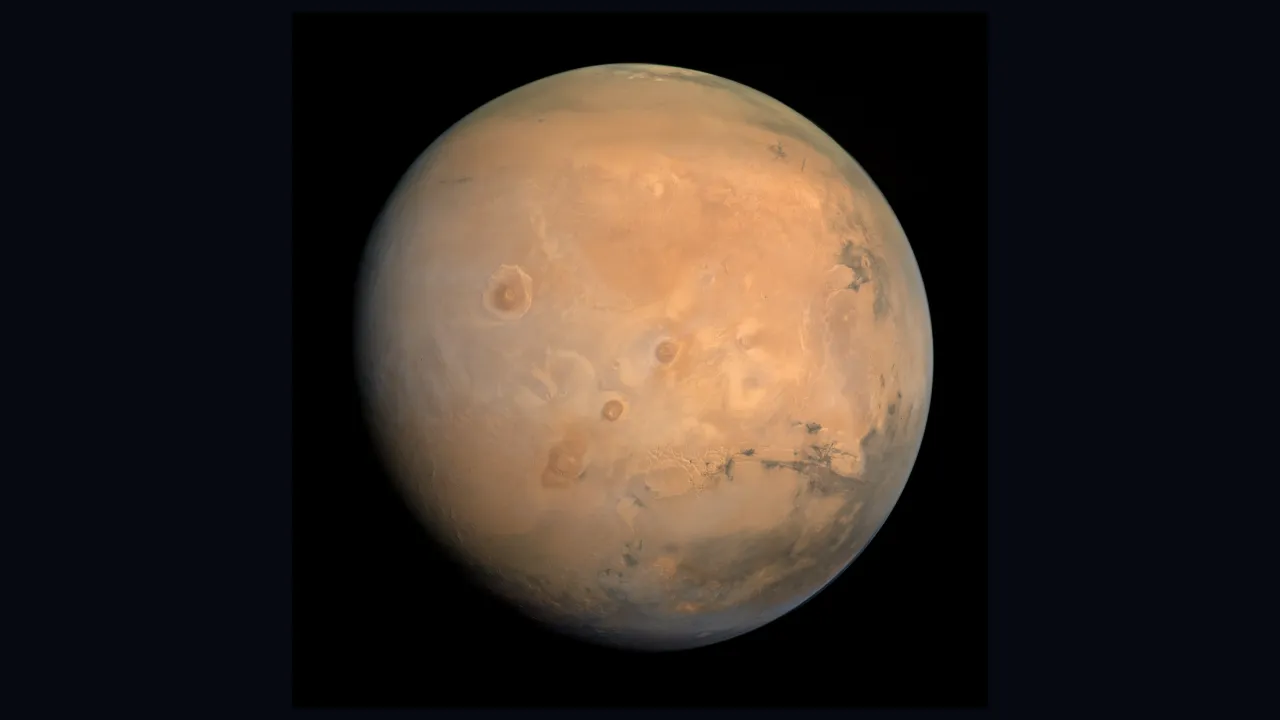
Mars
Rusty Red World of Rovers and Giant Volcanoes
Grade 5 • Advanced • 292 words
🌌 Cosmic Location & Distance4th Planet from Sun • Avg 142 million mi (228 million km) from Sun
🪐 Scale / Diameter4,212 mi (6,779 km) diameter • About half as wide as Earth
☄️ Composition & Orbit95% Carbon Dioxide Thin Air • 687-Earth-day orbit • 24.6-hr day
⚡ Cosmic SparkHome to Olympus Mons—the tallest volcano in the Solar System—and rolling NASA rovers
🤯 Mind-Blowing Fact • Grade 1
Mars is the only planet we know of inhabited completely by robots!
✨ Word Sparks (Grade 1 Glossary)
Tap 🔊 to hear
rusted
iron turned reddish-orange by oxygen
dunes
hills of sand shaped by wind
rovers
wheeled robot vehicles exploring other worlds
🪝
Why is Mars covered in rusty red dust?
1
Why Mars Is Red
Crunch across red pebbles and orange ! Welcome to Mars, the fourth planet from the Sun. Why does its dirt look so red? Tiny bits of iron in the soil —just like an old bicycle left out in rain!
2
Cold Desert World
Even though red looks warm, Mars is actually freezing cold! White caps of ice sit right on top of its north and south poles.
3
Robot Explorers!
No person has walked on Mars yet, only wheeled robot ! They snap pictures and test rocks for us.
1. What gives Mars its famous reddish-orange color?
2. Who explores the surface of Mars right now?
🤯 Mind-Blowing Fact • Grade 2
On Mars, daytime skies glow butterscotch-orange while sunsets around the Sun glow bright frosty blue!
✨ Word Sparks (Grade 2 Glossary)
Tap 🔊 to hear
canyon
a deep, steep valley carved in rock
sol
one 24-hour-and-37-minute day on Mars
extinct
no longer active or erupting lava
🪝
Which planet has a volcano three times taller than Mount Everest?
1
Giant Volcanoes and Canyons
Even though Mars is only half as wide as Earth, it holds the Solar System's biggest landforms! Olympus Mons is an volcano rising sixteen miles high—nearly three times taller than Mount Everest! Nearby stretches Valles Marineris, a long enough to cross the entire United States.
2
Days Called 'Sols'
One spin on Mars takes 24 hours and 37 minutes—almost identical to an Earth day! Scientists call a Martian day a ',' though a Martian year takes 687 Earth days.
3
Blue Sunsets!
Fine red dust floating in Mars's thin sky scatters light backward from Earth—turning daytime skies butterscotch-pink and sunsets a cool, glowing blue!
1. What is the name of the giant sixteen-mile-high volcano on Mars?
2. What color are sunsets on Mars?
🤯 Mind-Blowing Fact • Grade 3
NASA's tiny four-pound Ingenuity Mars Helicopter was built for five test flights—and amazed everyone by flying 72 times!
✨ Word Sparks (Grade 3 Glossary)
Tap 🔊 to hear
deltas
fan-shaped sediment deposits where rivers meet lakes
rotations
complete full spins around a center
orbiter
spacecraft circling high above a planet
🪝
How could a tiny helicopter fly on Mars where the air is 100 times thinner than Earth's?
1
Ancient Rivers and Lakes
Look down from a Mars and you will spot winding dried-up riverbeds, fan-shaped , and smooth rounded pebbles! Three and a half billion years ago, Mars wore a thicker blanket of air and sparkling liquid lakes where water flowed across rocky craters.
2
Ingenuity Takes Flight!
Because Martian air is 99 percent thinner than Earth's sky, flying there is super tough! In 2021, NASA's four-pound Ingenuity helicopter spun carbon-fiber blades at 2,500 per minute—making the first powered flights on another planet and completing 72 hops!
3
Planet-Wide Dust Storms
Every few Martian years, local winds whip powdery iron-oxide dust into giant storms that swallow the entire globe for weeks! Even though Martian gusts feel gentle because the air is so thin, swirling dust can dim sunlight across every valley and crater.
4
Two Potato-Shaped Moons
Circling overhead are two tiny, lumpy moons named Phobos and Deimos, named after mythological twin attendants. Unlike our big round Moon, both Martian moons are small bumpy space rocks covered in deep gray dust!
1. How did NASA's Ingenuity helicopter manage to fly in Mars's super-thin air?
2. What proves liquid water once flowed across ancient Mars?
🤯 Mind-Blowing Fact • Grade 4
Every Martian winter, air gets so cold at the dark pole that carbon dioxide gas freezes out of the sky as falling 'dry ice' snow!
✨ Word Sparks (Grade 4 Glossary)
Tap 🔊 to hear
plume
a rising column of super-hot mantle rock
dynamo
churning liquid core generating magnetic fields
arid
extremely dry with almost zero liquid moisture
🪝
Why did Olympus Mons grow three times taller than Everest—and where did Mars's ancient oceans go?
1
Why Martian Volcanoes Grew Colossal
On Earth, sliding tectonic plates carry crust steadily over underground magma hotspots, creating chains of smaller islands like Hawaii. Mars, however, lacks moving tectonic plates and has only 38 percent of Earth's surface gravity! Sitting stationary over one blazing mantle for hundreds of millions of years, lava piled up higher and higher without sinking under its own weight—building Olympus Mons 16 miles (25 kilometers) tall and 374 miles wide!
2
Losing Its Magnetic Shield
Why did warm, wet young Mars freeze into an desert? Because Mars is half Earth's width, its molten iron core cooled much faster. Roughly four billion years ago, Mars's global magnetic shut down! Unshielded from solar wind, charged particles gradually stripped most of its thick atmosphere into space while remaining water froze into polar caps and underground ice.
3
Dry Ice Snow at the Poles
Martian winters get so bitterly cold—minus 195 °F—that up to one-quarter of the entire carbon-dioxide atmosphere freezes right out of the sky onto the winter pole as 'dry ice' snow!
4
Making Oxygen on Mars With MOXIE
Aboard NASA's Perseverance rover in Jezero Crater, a toaster-sized golden box called MOXIE split Martian carbon dioxide into pure, breathable oxygen—paving the way for future human explorers!
1. What allowed Olympus Mons to grow three times taller than Earth's highest mountains?
2. What happened after Mars's inner core cooled and its global magnetic field shut down?
🤯 Mind-Blowing Fact • Grade 5
NASA's InSight lander recorded over 1,300 'marsquakes'—revealing that Mars hides a completely liquid iron-alloy core over 2,200 miles wide!
✨ Word Sparks (Grade 5 Glossary)
Tap 🔊 to hear
biosignatures
chemical or fossil clues of past life
dichotomy
sharp contrast between two very different halves
obliquity
the angle a planet's spin axis tilts
🪝
What did NASA's InSight lander hear rumbling deep inside Mars—and could ancient Martian lakes have hosted microbial life?
1
Noachian Lakes and Astrobiology in Jezero Crater
Touch down inside 45-kilometer-wide Jezero Crater alongside NASA's Perseverance rover, where a textbook river delta fans across clay-rich mudstones deposited 3.7 billion years ago during Mars's warm Noachian Era! Orbital spectrometers and rover drills at Gale and Jezero craters have identified phyllosilicates (water-formed clays), sulfates, carbonate minerals, and complex organic carbon molecules. By sealing cigar-sized titanium tubes of ancient lakebed cores for future Mars Sample Return laboratories on Earth, astrobiologists hope to check for microscopic from the exact era life first arose on Earth!
2
Listening to Marsquakes With InSight
Between 2018 and 2022, NASA's stationary InSight lander pressed an ultra-sensitive French-built seismometer onto Elysium Planitia, detecting over 1,300 'marsquakes' and meteoroid impacts! Seismic travel times revealed Mars's internal anatomy for the first time: a surprisingly thick 24-to-72-kilometer rigid crust, a silicate mantle lacking convective plate slabs, and a completely liquid iron-sulfur-oxygen core measuring roughly 1,830 kilometers in radius.
3
Crustal Dichotomy and Valles Marineris
Globe-spanning laser altimetry highlights Mars's dramatic 'crustal ': smooth northern lowlands sit five kilometers lower than ancient, cratered southern highlands—possibly the scar of an ocean-sized basin impact early in Solar System history! Cutting across the Tharsis volcanic bulge yawns Valles Marineris, a 4,000-kilometer tectonic rift trough up to seven kilometers deep opened when rising magma stretched the crust.
4
Triple-Point Physics of Martian Water
Why can't pure liquid puddles linger on Mars today? At an average surface atmospheric pressure of just 6 millibars—0.6 percent of Earth's sea-level pressure, hovering right at water's thermodynamic triple point—exposed ice sublimates or boils almost instantly into vapor, though vast glaciers of pure water ice remain buried beneath mid-latitude dust aprons and polar layered deposits!
5
Chaotic Axial Obliquity
Although Mars's current 25.19-degree axial tilt closely mirrors Earth's 23.44 degrees, tiny Phobos and Deimos provide zero tidal stabilization; over million-year cycles, Jupiter's gravity swings Mars's tilt past 45 degrees, repeatedly shifting polar ice sheets down toward the tropics!