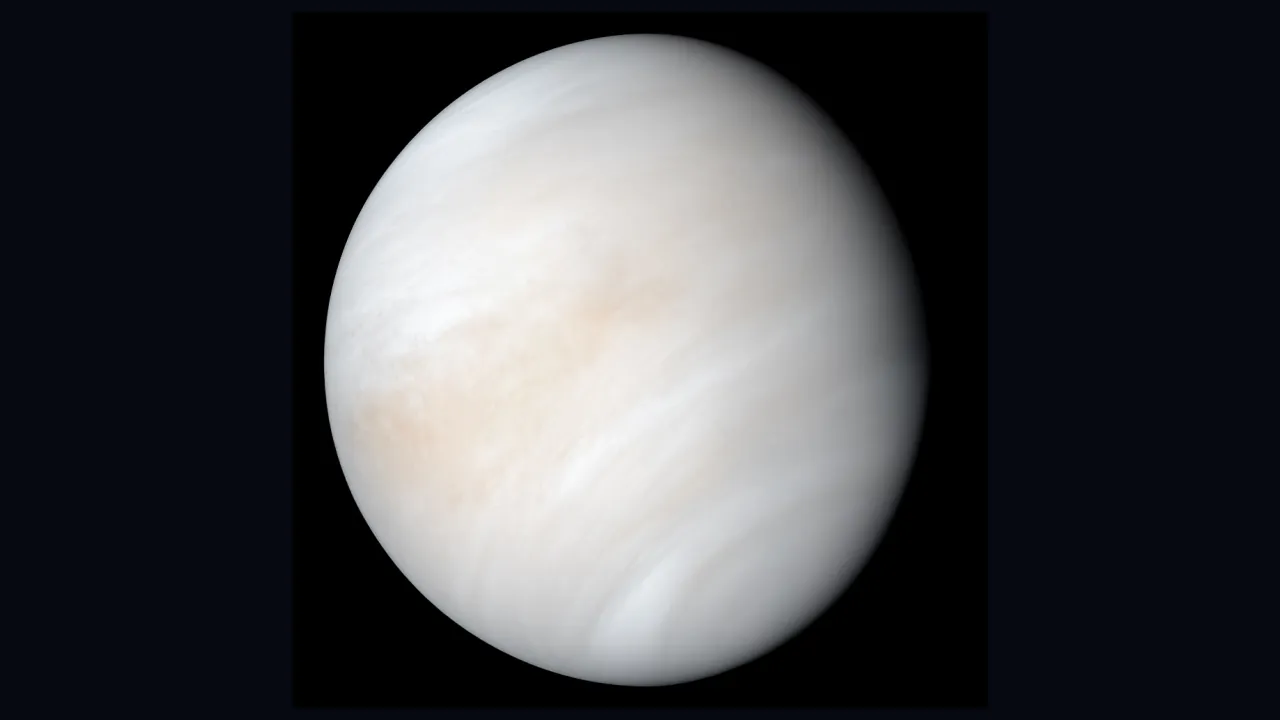
⚡ Cosmic SparkHottest planet at 900 °F (475 °C) and spins clockwise so the Sun rises west
🤯 Mind-Blowing Fact • Grade 1
One single slow spin of Venus takes longer than an entire Venus year around the Sun!
✨ Word Sparks (Grade 1 Glossary)
Tap 🔊 to hear
twilight
soft glowing sky right after sunset
neighbor
someone or something living right next door
reflect
bounce light back like a mirror
🪝
Which bright planet shines like a lantern at sunset?
1
Evening Star Glow
Look up at the sky just after sunset! Shining brighter than any star is our planet, Venus. Thick yellow-white clouds bounce bright sunlight back to our eyes!
2
Earth's Size Twin
Measured across the middle, Venus is almost the exact same size as Earth! Yet beneath those pretty clouds hides the hottest planet of all.
3
Backward Spin!
Most planets spin one way, yet Venus spins backward! On Venus, the Sun rises in the west and sets in the east.
1. Why does Venus shine so brightly in Earth's morning and evening skies?
2. Which way would you see the Sun rise if you stood on Venus?
🤯 Mind-Blowing Fact • Grade 2
Because Venus spins so slowly, you could walk briskly across its surface as fast as its spin!
✨ Word Sparks (Grade 2 Glossary)
Tap 🔊 to hear
greenhouse
trapping warmth inside like glass garden roofs
evaporate
turn from liquid drops into invisible gas
axis
imaginary center line a planet spins around
🪝
Why is Venus hotter than Mercury even though Venus sits farther from the Sun?
1
A Runaway Greenhouse Blanket
Imagine piling fifty heavy winter blankets on top of yourself on a sunny summer day! Venus sits twice as far from the Sun as Mercury, yet thick carbon-dioxide air traps heat underneath so none can escape. Day and night, its rocky ground bakes near 900 degrees Fahrenheit—hot enough to melt lead!
2
Crushing Heavy Air
Standing on Venus would feel like diving half a mile deep under Earth's ocean! Swirling clouds high overhead drop tiny droplets of sulfuric acid that before ever touching the scorching ground.
3
A Day Longer Than a Year
Venus circles the Sun in 225 Earth days, yet takes 243 Earth days to turn once on its !
1. What gas makes up almost all of Venus's heat-trapping atmosphere?
2. How long does it take Venus to spin once completely on its axis?
🤯 Mind-Blowing Fact • Grade 3
Scientists have mapped more than 85,000 volcanoes across Venus—more volcanoes than on any other planet in our Solar System!
✨ Word Sparks (Grade 3 Glossary)
Tap 🔊 to hear
radar
bouncing radio waves to map hidden shapes
basalt
dark volcanic rock formed from cooled lava
vent
an opening where volcanic lava escapes
🪝
How did scientists map mountains and volcanoes on Venus through clouds no camera can see through?
1
Peeking Through Clouds With Radar
Point an ordinary telescope at Venus and all you see is an unbroken blanket of pale yellow clouds! To uncover the hidden world underneath, NASA's Magellan spacecraft bounced invisible radio waves off the ground—revealing towering mountains, pancake-shaped lava domes, and more volcanoes than any other planet!
2
Over 85,000 Volcanoes!
From small shield cones to two-mile-high Maat Mons, scientists have counted more than 85,000 volcanoes dotting Venus's plains! Re-examining Magellan maps in 2023 even caught a volcanic changing shape, proving volcanoes still erupt there today.
3
Brave Robot Landers
In the 1970s and 1980s, armored Venera robot landers parachuted all the way to Venus's rusty-orange rocks. Before 900-degree heat cooked their electronics after about two hours, they snapped the only surface photos ever taken!
4
Super-Rotating Cloud Winds
While the solid planet barely creeps around below, hurricane-force winds whip Venus's upper clouds completely around the globe every four Earth days!
1. How did NASA's Magellan spacecraft map Venus's hidden surface?
2. About how long could armored Venera landers survive on Venus's 900 °F surface?
🤯 Mind-Blowing Fact • Grade 4
Mountain peaks on Venus are dusted not with cold ice snow, but with glittering metallic frost made of lead and bismuth minerals!
✨ Word Sparks (Grade 4 Glossary)
Tap 🔊 to hear
tectonics
movement of giant plates in planet crusts
limestone
sedimentary rock storing carbon on Earth
altitude
height measured high above a planet's ground
🪝
Could scorching-hot Venus once have sparkled with cool blue oceans like young Earth?
1
Twin Worlds That Took Opposite Paths
Hold a globe of Earth beside a radar globe of Venus and they look like planetary sisters: Venus has 95 percent of Earth's diameter and 81.5 percent of Earth's mass! Computer climate models suggest young Venus may even have held shallow liquid water oceans for hundreds of millions of years when the young Sun shone fainter. Yet sitting 30 percent closer to increasing solar heat eventually boiled any ancient water into steam—triggering a runaway greenhouse loop!
2
Why Carbon Dioxide Piled Up
On Earth, rainwater dissolves carbon dioxide out of the sky and plate locks it underground inside rocks. Without liquid oceans or sliding tectonic plates, volcanic eruptions on Venus pumped carbon dioxide straight into the atmosphere until air pressure reached 92 times Earth's sea-level pressure!
3
Metallic 'Snow' on Mountain Peaks
High atop Maxwell Montes—Venus's tallest mountain range rising seven miles above surrounding plains—radar echoes glitter brightly like shiny mirrors! Instead of icy water snow, scorching air deposits gleaming frost made of heavy metal minerals like lead sulfide and bismuthinite.
4
Cloud-Top Temperate Zone
Surprisingly, thirty miles up inside Venus's cloud deck, air pressure and temperatures match a pleasant Earth afternoon—making high- balloons an exciting future way to explore!
1. How much heavier is surface air pressure on Venus compared to sea level on Earth?
2. What coats the highest mountain peaks of Maxwell Montes on Venus?
🤯 Mind-Blowing Fact • Grade 5
In 1610, Galileo's discovery that Venus goes through Moon-like phases from crescent to full proved conclusively that planets orbit the Sun rather than Earth!
✨ Word Sparks (Grade 5 Glossary)
Tap 🔊 to hear
heliocentric
having the Sun at the center
retrograde
spinning or moving opposite the usual direction
coronae
crown-shaped volcanic ring structures on Venus
🪝
How did Galileo watching phases of Venus through a spyglass change humanity's map of the universe forever?
1
Galileo's Crescent Proof of Heliocentrism
Peer through Galileo Galilei's handmade telescope in autumn 1610 as brilliant Venus morphs week after week from a thin silver crescent into a full round disk! Under the ancient Earth-centered Ptolemaic model, Venus could never pass behind the Sun to show a nearly full phase. Galileo's simple observation proved decisively that Venus orbits the Sun—cementing Nicolaus Copernicus's Solar System in astronomy history!
2
Retrograde Rotation and Atmospheric Tides
Among the eight major planets, only Venus and sideways Uranus exhibit rotation: tilted 177.4 degrees effectively upside down, Venus takes 243 Earth days per sidereal spin while orbiting the Sun every 224.7 days, producing a 116.75-Earth-day sunrise-to-sunrise solar day! Geophysicists debate whether a primordial giant impact flipped young Venus or whether powerful solar thermal tides tugging its crushing 92-bar atmosphere gradually braked and reversed its spin.
3
Stagnant-Lid Volcanism and Tesserae
Counting fewer than 1,000 uniformly scattered impact craters across Magellan synthetic-aperture radar maps indicates Venus's basaltic plains were resurfaced volcanically within the past 300 to 700 million years! Lacking Earth-style subduction zones, Venus operates under 'stagnant-lid' or 'squishy-lid' tectonics: giant mantle plumes push up circular fractures called alongside ancient crumpled highlands named tesserae.
4
Induced Magnetosphere Without a Core Dynamo
Even though Venus shares Earth's iron-nickel core size, slow rotation or lack of core convection leaves it with no intrinsic magnetic dynamo; instead, solar wind slamming into its upper ionosphere drapes an induced magnetic tail downwind.
5
Next-Generation Missions: DAVINCI, VERITAS, and EnVision
Upcoming NASA and European Space Agency probes—DAVINCI, VERITAS, and EnVision—will plunge noble-gas mass spectrometers through sulfuric-acid clouds and map crustal deformation at meter-scale resolution to learn how habitable Earth-sized exoplanets avoid runaway greenhouse fates.