🌌 COSMOS
🔭 Mars I • Inner Natural Satellite of Mars
VA Science SOL 1.6, 4.5, 4.6 (Solar System, Stars & Space Exploration)
Phobos
Potato-Shaped Martian Moon Spiraling Closer
Grade 5 • Advanced • 299 words
🌌 Cosmic Location & DistanceInner Orbit Around Mars • Only 3,700 mi (6,000 km) above surface
🪐 Scale / Diameter17 × 14 × 11 mi (27 × 22 × 18 km) • Lumpy asteroid-sized moon
☄️ Composition & OrbitPorous Carbon-Rich Rock & Dust • 7 hr 39 min ultra-fast orbit
⚡ Cosmic SparkOrbits Mars faster than Mars spins—rising in the west twice every day!
🤯 Mind-Blowing Fact • Grade 1
Gravity on tiny Phobos is so weak that if you threw a baseball hard, it could fly straight off into outer space!
✨ Word Sparks (Grade 1 Glossary)
Tap 🔊 to hear
lumpy
bumpy and uneven instead of smooth round
dent
a hollow dip pressed into a surface
tiny
very small in size
🪝
Can a moon really look like a giant lumpy potato?
1
A Space Potato!
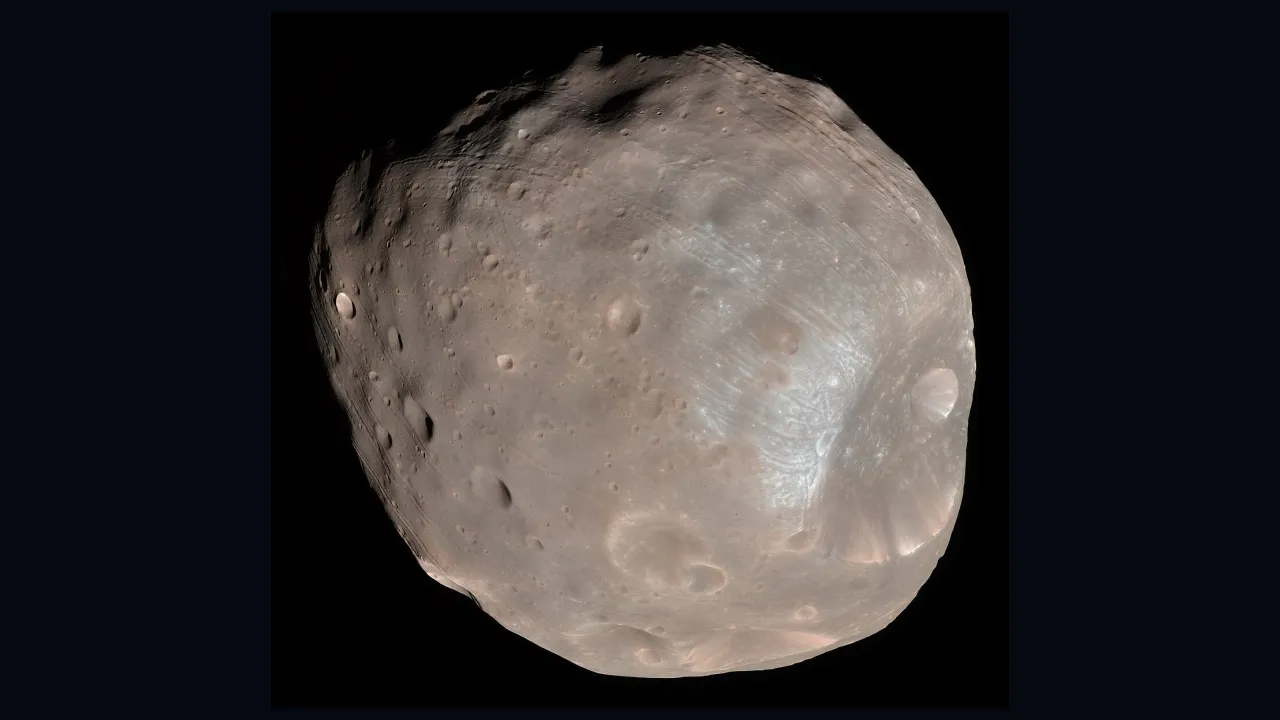
Zoom right past red planet Mars and look closely! Floating nearby is a gray rock shaped just like a baked potato! Meet Phobos, the bigger of Mars's two moons.
2
Super Fast Lap
Phobos hugs closer to its planet than any other moon! It races all the way around Mars three times every single day!
3
One Giant Dent
A huge bowl-shaped crater sits right on one end. Long ago, a space rock nearly cracked little Phobos apart!
2. How many times does Phobos zoom around Mars in a single Martian day?
🤯 Mind-Blowing Fact • Grade 2
Astronomer Asaph Hall almost quit searching Mars's glare in 1877 until his wife Angeline Stickney encouraged him one more night—when he spotted Mars's moons!
✨ Word Sparks (Grade 2 Glossary)
Tap 🔊 to hear
glare
dazzling bright light hard to look past
astronomer
a scientist who studies moons, stars, and planets
horizon
line where sky seems to meet ground
🪝
Which moon rises in the west and sprints across the sky in just four hours?
1
Outrunning Mars's Spin!
Stand on the rusty plains of Mars and watch a wild sky trick! Because Phobos zips around Mars every 7 hours and 39 minutes—much faster than Mars's 24.6-hour spin—Phobos actually rises in the WEST, races across the sky in about four hours, and sets in the east twice a day!
2
Stickney Crater
Measuring nearly six miles wide on a moon only seventeen miles long, Stickney Crater covers almost half of Phobos's face! Asaph Hall named it after his wife, Chloe Angeline Stickney Hall, who encouraged him not to give up searching for Martian moons in 1877.
3
Featherweight Gravity
A 70-pound kid standing on Phobos would weigh less than one single penny!
1. Why does Phobos rise in the west instead of the east as seen from Mars?
2. Who was giant Stickney Crater on Phobos named after?
🤯 Mind-Blowing Fact • Grade 3
In about 30 to 50 million years, Mars's gravity will gently pull crumbling Phobos apart to give Mars its very own Saturn-style ring!
✨ Word Sparks (Grade 3 Glossary)
Tap 🔊 to hear
rubble
loose pile of broken rocks and gravel
grooves
long narrow trenches across a rocky surface
equator
imaginary circle halfway between north and south poles
🪝
Why will Mars wear rocky rings like Saturn fifty million years from now?
1
Skimming the Martian Treetops
Our Moon orbits nearly a quarter-million miles above Earth, yet Phobos skims only 3,700 miles above the Martian ground—closer to its parent planet than any other known moon in the Solar System! From Phobos's surface, red Mars fills nearly half the entire sky!
2
Inching Closer Every Century
Because Phobos orbits so low and fast, Mars's gravity slowly drags it inward by about six feet every hundred years! In roughly thirty to fifty million years, tidal pull will stretch Phobos apart into a dazzling rocky ring around Mars!
3
Mysterious Parallel Grooves
Long, straight, shallow crisscross Phobos like rake marks in a garden. Scientists realized many are 'stretch marks' opening inside its loose interior as Mars tugs on it!
4
Invisible From Mars's Poles
Because Phobos hugs so tightly above Mars's , astronauts standing near Mars's north or south poles will never see Phobos peek above the curve of the horizon!
1. What will happen to Phobos in about 30 to 50 million years?
2. Why can't you see Phobos if you stand at Mars's north or south pole?
🤯 Mind-Blowing Fact • Grade 4
NASA's Perseverance rover filmed high-definition video from Mars's surface showing potato-shaped Phobos eclipsing the Sun like a giant googly eye!
✨ Word Sparks (Grade 4 Glossary)
Tap 🔊 to hear
porous
full of tiny air spaces or gaps
debris
scattered rock pieces left after a collision
dynamicists
scientists calculating orbits and gravitational motion
🪝
Did Mars kidnap Phobos from the Asteroid Belt—or build it from an ancient Martian splash?
1
A Rubble Pile Full of Empty Spaces
Weigh Phobos using spacecraft flybys and a fascinating puzzle pops out: Phobos has a density of just 1.88 grams per cubic centimeter—barely heavier than sand! Rather than one solid chunk of rock, twenty-five to thirty-five percent of Phobos's interior consists of empty gaps or buried ice pockets between boulders, making it a cosmic 'rubble pile' wrapped in three hundred feet of powdery regolith.
2
Two Competing Origin Detective Stories
Look at Phobos's dark, charcoal-gray surface and it matches carbon-rich C-type asteroids from the outer Asteroid Belt! Yet capture physics raises a tough problem: captured asteroids normally swing in wild, tilted ovals, whereas Phobos and Deimos travel in nearly perfect circles right above Mars's equator! Many planetary now suspect a giant protoplanet slammed into young Mars billions of years ago, tossing a ring of Martian into orbit that clumped into moons.
3
Solar Eclipses Captured by Rovers
Even though Phobos is too small to blot out the whole Sun, Perseverance's Mastcam-Z camera filmed crisp video of potato-shaped Phobos crossing directly across the Sun's bright disk like a giant googly eye!
4
Japan's MMX Sample Return
To settle Phobos's origin once and for all, Japan's Martian Moons eXploration (MMX) mission is designed to touch down on Phobos, scoop up surface grains, and fly them home to Earth!
1. Why do many orbital scientists doubt Phobos is simply a captured asteroid?
2. What did spacecraft gravity measurements reveal about the inside of Phobos?
🤯 Mind-Blowing Fact • Grade 5
Asteroid impacts on Mars have blasted ancient Martian rocks right up onto low-orbiting Phobos—turning Phobos's dust into a free sample box of early Mars!
✨ Word Sparks (Grade 5 Glossary)
Tap 🔊 to hear
synchronous
orbiting in the exact time a planet spins
porosity
percentage of empty pore spaces inside rock
triaxial
measured across three unequal length-width-height axes
🪝
What happens when a rubble-pile moon crosses inside its planet's synchronous orbit AND approaches the Roche limit?
1
Sub-Synchronous Orbital Decay
Discovered on August 18, 1877, by American astronomer Asaph Hall through the 26-inch refractor at the U.S. Naval Observatory—six nights after spotting outer sibling Deimos—Phobos ('Fear' in Greek mythology) occupies a precarious gravitational perch! Orbiting at a semi-major axis of just 9,376 kilometers from Mars's center (roughly 6,000 km above the plains), Phobos lies well inside Mars's altitude of 20,428 kilometers. Whereas Earth's tidal bulge leads our slower Moon and boosts it outward, Phobos outpaces Mars's rotation—meaning the tidal bulge it raises in Mars lags behind Phobos, steadily draining orbital energy and pulling it inward at 1.8 centimeters per year!
2
Approaching the Tidal Roche Limit
In orbital mechanics, the Roche limit marks the critical distance inside which a planet's differential tidal pull exceeds a moon's self-gravity! Because Phobos exhibits a low bulk density of 1.876 g/cm³ and 25 to 35 percent macro-, cohesive dust and friction barely hold its fractured rubble blocks together. Geodynamic models published by NASA Goddard researchers demonstrate that parallel 100-to-200-meter-wide grooves radiating across Phobos aren't merely secondary ejecta chains from nine-kilometer Stickney Crater, but active tidal 'stretch marks' buckling its cohesive regolith shell—heralding breakup into a planetary ring within 30 to 50 million years!
3
Hydrostatic Equilibrium Threshold
With dimensions of 27 × 22 × 18 kilometers and surface gravity averaging just 0.0057 m/s² (1/1,700th of Earth's), Phobos falls far below the ~400-to-600-kilometer diameter threshold where rocky bodies crush themselves into spherical hydrostatic equilibrium.
4
Martian Ejecta Library on Phobos
Over four billion years, asteroid impacts on Mars blasted millions of tons of ancient Martian crust skyward—meaning Phobos's upper regolith preserves a natural museum of early Noachian Martian rocks alongside Phobos's own building blocks!
5
Spectroscopy vs. Orbital Dynamics and JAXA's MMX
While visible/near-infrared reflectance spectra resemble dark carbonaceous D- or C-type asteroids, thermal infrared observations detect phyllosilicates and feldspars consistent with pulverized Martian crust. JAXA's Martian Moons eXploration (MMX) sample-return spacecraft aims to resolve this grand planetary mystery in Earth laboratories.