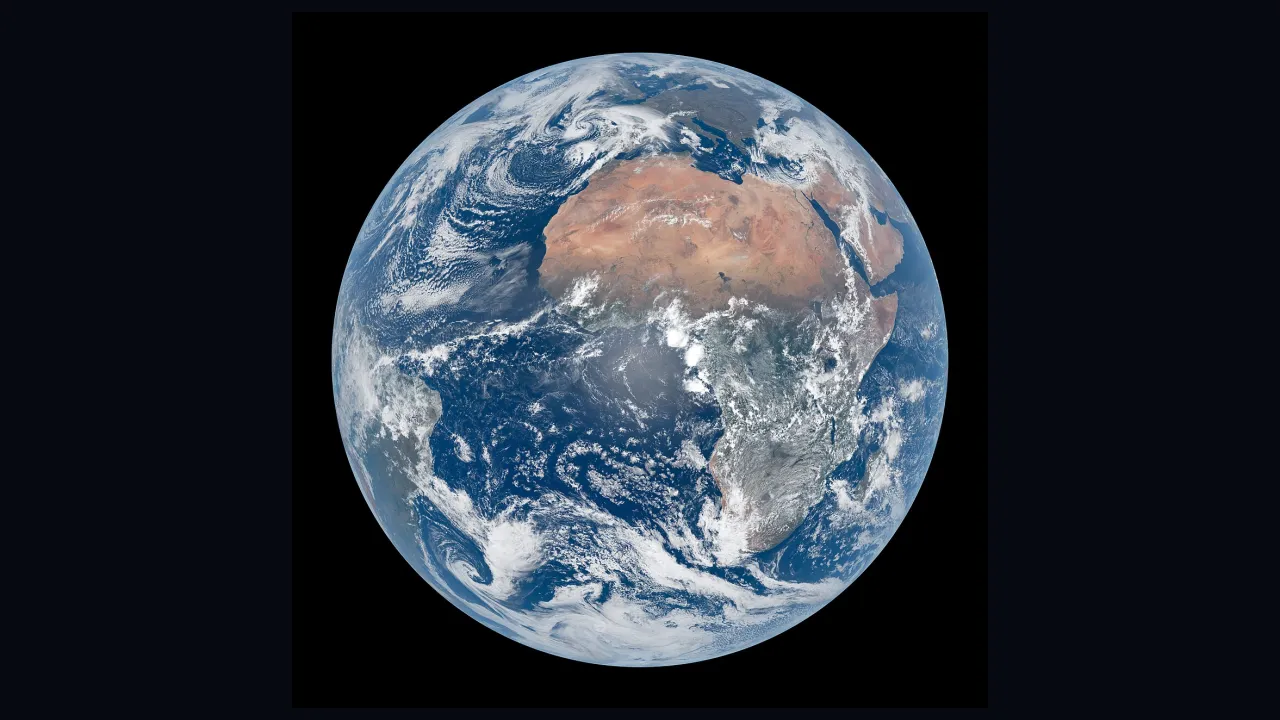
1. Why does Planet Earth look mostly blue from outer space?
2. What causes daytime and nighttime on Earth?
🤯 Mind-Blowing Fact • Grade 2
Planet Earth is the only planet in our Solar System not named after an ancient Greek or Roman god!
✨ Word Sparks (Grade 2 Glossary)
Tap 🔊 to hear
tilted
leaning slightly to one side
oxygen
life-giving gas made by green plants
meteor
a tiny space pebble streaking as light
🪝
Why do we have snowy winters and warm summers during the year?
1
The Goldilocks Zone
Just like the bowl of porridge that was neither too hot nor too cold, Planet Earth orbits inside the Sun's 'Goldilocks Zone'! At ninety-three million miles out, water stays liquid so whales, redwoods, and kids can thrive.
2
A Friendly Tilt for Seasons
Rather than standing straight up and down, Earth leans slightly to one side at 23.5 degrees! During our 365-day trip around the Sun, whichever half leans toward the Sun enjoys long summer days while the other half has winter.
3
Our Breathable Blanket
Wrapping around us is a cozy atmosphere of nitrogen and that gives us fresh air to breathe and burns up tiny space rocks as shooting stars!
1. What gives Planet Earth its four changing seasons?
2. How did Planet Earth get its name?
🤯 Mind-Blowing Fact • Grade 3
Continent plates beneath your feet drift a few inches every year—the exact same speed that your fingernails grow!
✨ Word Sparks (Grade 3 Glossary)
Tap 🔊 to hear
mantle
thick hot rock layer beneath Earth's crust
magnetosphere
Earth's protective magnetic shield in space
continents
giant landmasses riding on tectonic plates
🪝
How does molten metal thousands of miles beneath your shoes protect you from outer space?
1
Four Layers Beneath Your Feet
Peel Planet Earth like a giant peach! Under our thin rocky crust—only three to forty miles thick—sits a warm, slowly creeping rocky , a churning liquid iron-nickel outer core, and a solid metal inner core as hot as the Sun's surface!
2
An Invisible Force Field
As liquid metal swirls inside the outer core, it generates a giant magnetic shield called the ! Reaching far into space, this invisible shield deflects harsh solar wind so our air and oceans aren't stripped away.
3
Moving Puzzle Continents
Earth is the only rocky planet known to have active plate tectonics! Giant slabs of crust drift a few inches per year—about as fast as your fingernails grow—building mountains like the Himalayas and recycling carbon.
4
Why Leap Year Exists
Because one full orbit actually takes 365 days and about six extra hours, calendars save up those four quarter-days to add February 29 every four years!
1. Which inner layer of Earth swirls to create our protective magnetic field?
2. Why do calendars add an extra Leap Day on February 29 every four years?
🤯 Mind-Blowing Fact • Grade 4
Because Earth bulges slightly at its equator from spinning, Mount Chimborazo in Ecuador sticks farther out into space from Earth's center than Mount Everest!
✨ Word Sparks (Grade 4 Glossary)
Tap 🔊 to hear
cyanobacteria
ancient ocean microbes that first made oxygen
ozone
high sky gas blocking harmful sun rays
spheroid
a ball shape slightly flattened at poles
🪝
Where did all the breathable oxygen in Earth's sky originally come from?
1
How Tiny Microbes Transformed the Sky
Travel back three billion years on young Planet Earth and you would need a spacesuit to breathe! Early skies held nitrogen, carbon dioxide, and methane, with almost zero free oxygen. Then microscopic ocean bacteria called invented photosynthesis—turning sunlight and water into food and bubbling oxygen gas into the sea! Around 2.4 billion years ago, during the Great Oxidation Event, oxygen filled the atmosphere and formed the high layer that shields land life from ultraviolet rays.
2
Densest World in the Solar System
Put equal buckets of every planet on a scale and Earth wins the heavyweight crown! At 5.51 grams per cubic centimeter, Earth is the densest of all eight planets, packed with heavy iron, nickel, and silicate rock.
3
Slightly Squished at the Poles
Spinning at 1,037 miles per hour at the equator makes Earth bulge outward slightly around its middle! Geodesists call this shape an 'oblate ,' making Earth twenty-seven miles wider across the equator than from pole to pole.
4
Measuring Space With Earth's Yardstick
Astronomers use Earth's average distance from the Sun—92.96 million miles—as the official cosmic ruler called 1 Astronomical Unit (AU) to measure distances across the Solar System!
1. What created the first breathable oxygen in Earth's ancient atmosphere?
2. What does 1 Astronomical Unit (1 AU) measure in astronomy?
🤯 Mind-Blowing Fact • Grade 5
In 1936, Danish seismologist Inge Lehmann discovered that Earth has a solid inner core inside its liquid outer core by studying earthquake waves!
✨ Word Sparks (Grade 5 Glossary)
Tap 🔊 to hear
solstice
longest or shortest sunlit day of year
zircons
tiny ancient crystals preserving early Earth clues
seismologists
scientists who map interiors using earthquake waves
🪝
How did an ancient librarian in Egypt measure Earth's circumference with sticks and shadows two thousand years before rockets?
1
Eratosthenes' Shadow Experiment
Around 240 BCE in Alexandria, Egypt, Greek scholar Eratosthenes read a curious traveler's note: at noon on the summer in southern Syene, sunlight shone straight down a deep well without casting any shadow! Measuring a 7.2-degree shadow cast by a vertical stick in Alexandria at that exact same hour—one-fiftieth of a 360-degree circle—and multiplying the 5,000-stadia distance between the two cities by fifty, Eratosthenes calculated Earth's 40,075-kilometer circumference within a few percent of modern satellite laser altimetry!
2
Coupled Geosphere, Hydrosphere, Atmosphere, and Biosphere
Radiometric lead-isotope dating of ancient meteorites and Jack Hills from Western Australia places Earth's birth at 4.54 billion years ago. What sustained liquid oceans across four billion years even as the Sun brightened by 30 percent—a puzzle Carl Sagan dubbed the 'Faint Young Sun Paradox'? Earth's carbonate-silicate cycle acts as a planetary thermostat: warmer air boosts rainfall that weathers silicate rocks and locks CO2 into ocean-floor carbonate, whereas icy periods let volcanic CO2 accumulate to warm the globe back up!
3
Seismic Tomography of the Deep Interior
Because earthquake P-waves pass through liquids while S-waves stop dead at fluid boundaries, like Danish pioneer Inge Lehmann mapped our 1,220-kilometer solid iron inner core spinning inside a 2,260-kilometer convective liquid outer core geodynamo.
4
Stabilized by a Giant Moon
Without our unusually large Moon tugging steadily on Earth's equatorial bulge, gravitational nudges from Jupiter would tip Earth's axial tilt chaotically between zero and eighty-five degrees—preventing stable climate zones!
5
The Overview Effect From Orbit
Viewing our paper-thin blue troposphere from Apollo 8's 1968 'Earthrise' and Voyager 1's 1990 'Pale Blue Dot' four billion miles away inspired modern Earth-observing satellites that monitor ocean currents, ice sheets, carbon cycles, and biodiversity every hour.