🌌 COSMOS
🔭 Grand-Design Spiral Galaxy • Messier 51a (NGC 5194)
VA Science SOL 1.6, 4.5, 4.6 (Solar System, Stars & Space Exploration)
Whirlpool Galaxy
Two Cosmic Neighbors Dancing in Space
Grade 5 • Advanced • 306 words
🌌 Cosmic Location & DistanceCanes Venatici Constellation • 31 million light-years from Earth
🪐 Scale / Diameter76,000 light-years (447 quadrillion mi / 719 quadrillion km) wide • 160 billion solar masses
☄️ Composition & Orbit100+ billion stars, glowing hydrogen gas & cosmic dust • Interacting with companion NGC 5195
⚡ Cosmic SparkFirst galaxy ever seen with spiral arms, sculpted by a tug-of-war with its smaller neighbor
🤯 Mind-Blowing Fact • Grade 1
You can spot the Whirlpool Galaxy from a dark backyard using strong binoculars!
✨ Word Sparks (Grade 1 Glossary)
Tap 🔊 to hear
galaxy
A huge family of stars and gas in space
spiral
A shape that winds around a center point
star
A giant ball of hot glowing gas
🪝
Have you ever seen bath water spin into a giant swirl?
1
A Giant Pinwheel in Space
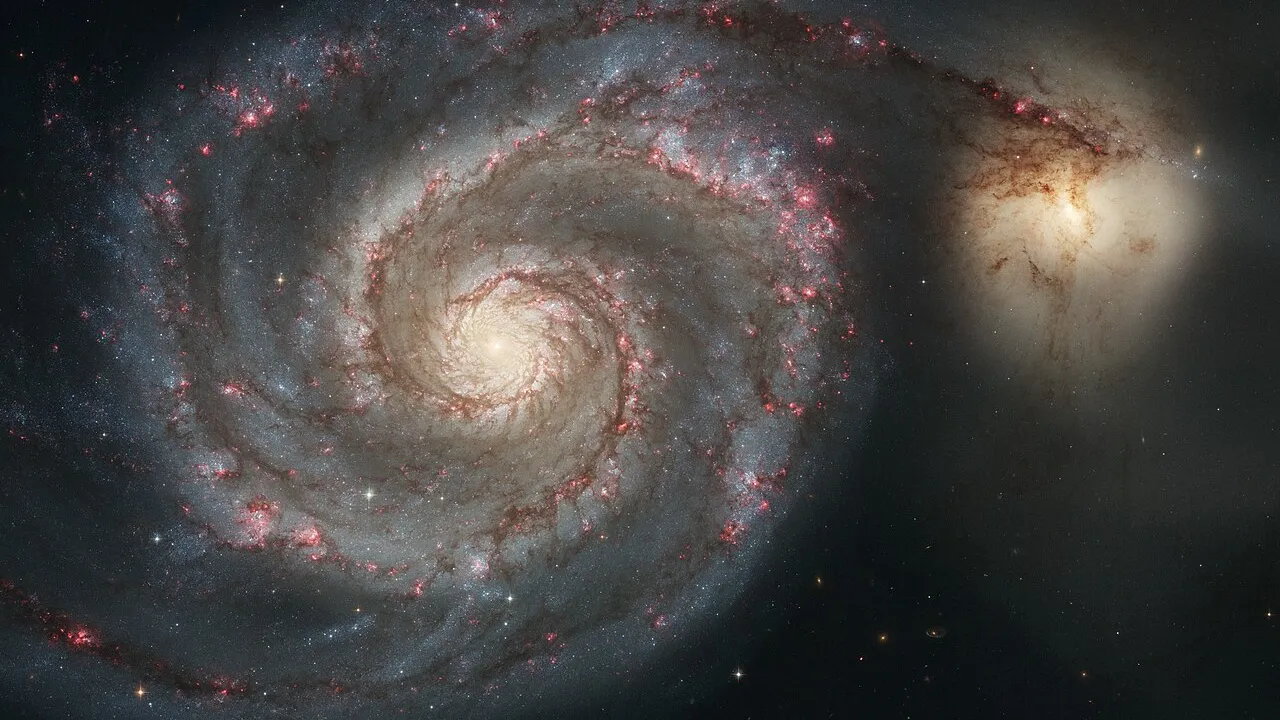
Look deep into the dark night sky! Far away, billions of spin in a bright pinwheel. Astronomers call this giant star city the Whirlpool . Long curving arms wrap around its warm golden center.
2
Glowing Pink Star Nurseries
Pink clouds of gas glow along each curved arm. Brand-new baby light up inside those clouds! Blue stars shine like tiny diamonds beside dark lanes of space dust.
3
A Little Cosmic Buddy
A smaller yellow sits right at the tip of one arm. These two space neighbors tug on each other as they drift past.
1. What shape do the arms of the Whirlpool Galaxy make?
2. What is born inside the glowing pink clouds along the galaxy's arms?
🤯 Mind-Blowing Fact • Grade 2
Light from the Whirlpool Galaxy travels for 31 million years before reaching your eyes!
✨ Word Sparks (Grade 2 Glossary)
Tap 🔊 to hear
gravity
An invisible pull between objects in space
companion
A neighbor or partner traveling close nearby
cluster
A close group of stars shining together
🪝
What happens when two whole galaxies brush past each other in deep space?
1
Sweeping Spiral Arms
Imagine peering through a giant telescope and seeing a glowing cosmic whirlpool! Millions of light-years from Earth, the Whirlpool Galaxy turns slowly in the darkness. Unlike fuzzy blob galaxies, it displays two clear, sweeping arms that wind outward from a bright yellow core.
2
Rivers of Dust and Light
Each long arm is packed with sparkling blue stars and ribbons of dark cosmic dust. When thick gas clouds get squeezed inside the arms, fresh of young stars burst into light and paint the gas rosy pink.
3
A Tugging Neighbor
Look closely at the end of one spiral arm and you will spot a golden neighbor galaxy! As this smaller glides nearby, its pulls on the Whirlpool Galaxy and makes its spiral shape extra bold.
1. Why are the Whirlpool Galaxy's spiral arms so bold and clear?
2. What color is the central core of the Whirlpool Galaxy?
🤯 Mind-Blowing Fact • Grade 3
In 1845, Irish astronomer Lord Rosse sketched Messier 51 through a giant mirror telescope, proving for the first time that spiral galaxies exist!
✨ Word Sparks (Grade 3 Glossary)
Tap 🔊 to hear
grand-design
Having two long, clear, matching spiral arms
constellation
A mapped region of stars in the sky
hydrogen
The lightest gas that fuels shining stars
🪝
Why do astronomers call the Whirlpool Galaxy a 'grand-design' masterpiece?
1
Face-On View of a Cosmic Giant
Picture floating high above a swirling hurricane, looking straight down into its calm eye. From Earth, we get that exact face-on view of the Whirlpool Galaxy, also known by its catalog name Messier 51. Located 31 million light-years away in the Canes Venatici, it stretches 76,000 light-years from edge to edge.
2
What Makes It 'Grand-Design'
Many spiral galaxies have patchy, broken arms that look like scattered feathers. Astronomers classify Messier 51 as a spiral galaxy because two continuous, symmetrical arms coil cleanly all the way from its central bulge to its outer rim.
3
Star-Forming Assembly Lines
Those graceful arms work like cosmic assembly lines. Invisible pressure ripples called density waves sweep through the disk, squeezing gas and dark dust lanes together until thousands of brilliant, hot blue stars ignite.
4
The Neighbor Behind the Swirl
At the tip of one arm gleams a smaller yellowish dwarf galaxy named NGC 5195. Hundreds of millions of years ago, this companion plunged past the Whirlpool's disk, stirring up waves of fresh star birth.
1. Why can telescopes on Earth see the Whirlpool Galaxy's full spiral pattern so clearly?
2. How do density waves help build new stars inside the Whirlpool Galaxy?
🤯 Mind-Blowing Fact • Grade 4
Astronomers spotted three separate supernovae explode inside the Whirlpool Galaxy within just seventeen years—in 1994, 2005, and 2011!
✨ Word Sparks (Grade 4 Glossary)
Tap 🔊 to hear
density wave
A slow pressure ripple squeezing galactic gas clouds
tidal force
Stretching pull caused by a neighbor's gravity
infrared
Heat light invisible to human eyes
🪝
How did a galactic traffic jam 31 million light-years away ignite billions of newborn stars?
1
A Cosmic Laboratory in Canes Venatici
Sweep a powerful telescope just below the handle of the Big Dipper into the constellation Canes Venatici, and a breathtaking double spectacle appears. Thirty-one million light-years from Earth spins Messier 51a, the Whirlpool Galaxy, spanning roughly 76,000 light-years across—slightly smaller than our own Milky Way, yet packed with an estimated 100 billion stars. Because its disk tilts nearly face-on toward our Solar System, astronomers use it as a natural laboratory for studying galactic architecture.
2
How Density Waves Build Star Factories
Contrary to how a whirlpool in water behaves, the Whirlpool Galaxy's arms are not rigid spokes of always-identical stars. Instead, they are spiral —slow-moving zones of stronger gravity that travel around the disk like a highway slowdown. Orbiting clouds of cold molecular gas pile up as they enter a wave, compressing until gravity collapses pockets of hydrogen into dazzling clusters of massive blue stars. Intense ultraviolet radiation from these young giants ionizes surrounding gas, creating the crimson nebulae strung like rubies along each arm.
3
Gravitational Choreography with NGC 5195
What pumped so much energy into Messier 51a's spiral waves? Look at the golden companion galaxy, NGC 5195, perched beside an outer arm. Computer simulations show this dwarf galaxy has plunged through the Whirlpool's main disk at least twice over the past 500 million years, triggering that amplified the arms.
4
Eyes Across the Spectrum
While visible-light cameras highlight glowing pink hydrogen and blue star clusters, the James Webb Space Telescope's sensors pierce dark dust lanes to reveal intricate skeletal webs of warm soot and hidden stellar nurseries.
1. How does a spiral density wave work inside Messier 51a?
2. What special detail did the James Webb Space Telescope reveal in the Whirlpool Galaxy using infrared light?
🤯 Mind-Blowing Fact • Grade 5
Chandra X-ray Observatory spotted a dip in X-rays from a star system in the Whirlpool Galaxy that may be the very first planet candidate ever detected in another spiral galaxy!
✨ Word Sparks (Grade 5 Glossary)
Tap 🔊 to hear
active galactic nucleus
Ultra-bright galaxy core fueled by a black hole
H II region
Glowing cloud of ionized hydrogen around hot stars
supernova
Massive star explosion shining brighter than billions of suns
🪝
How did a 19th-century stone castle telescope and a colliding pair of galaxies unlock the secret structure of our universe?
1
From Faint Smudge to Historic Discovery
On an autumn night in October 1773, French comet hunter Charles Messier recorded a faint, misty patch of light in the constellation Canes Venatici as the 51st entry in his famous catalog. For more than seventy years, astronomers assumed such 'nebulae' were shapeless clouds of glowing vapor. Then, in spring 1845, Anglo-Irish astronomer William Parsons, the Third Earl of Rosse, aimed his six-foot-wide Leviathan mirror telescope at Messier 51 from his castle grounds in Birr, Ireland. His meticulous pencil drawing revealed an astonishing cosmic vortex—making the Whirlpool Galaxy the first object in history recognized to possess spiral structure.
2
Anatomy of a Grand-Design Disk
Modern measurements place Messier 51a roughly 31 million light-years from Earth, with a luminous disk measuring 76,000 light-years in diameter and holding roughly 160 billion solar masses. At its heart lurks an powered by a supermassive black hole surrounded by a dense ring of dust. Radiating outward are two remarkably symmetrical spiral arms laced with dark polycyclic aromatic hydrocarbon dust lanes, ionized , and brilliant OB associations of short-lived blue supergiants.
3
Tidal Encounters with Messier 51b
The secret behind such textbook symmetry lies at the northern arm's tip: NGC 5195 (Messier 51b), a lenticular dwarf galaxy containing roughly half the mass of its larger host. Astrophysical N-body simulations indicate NGC 5195 pierced the Whirlpool's disk from behind tens of millions of years ago and currently sits slightly behind the bridge of dust silhouetted across its core.
4
Wave Mechanics and Rapid Stellar Lifecycles
Gravitational torques from those repeated flybys excited powerful quasi-stationary spiral density waves. As molecular hydrogen clouds enter these shock fronts, rapid star formation ignites massive stars that burn through their nuclear fuel in just a few million years before detonating as core-collapse supernovae.
5
Perhaps the First Extragalactic Planet
In 2020, astronomers analyzing Chandra X-ray Observatory data detected a brief, symmetrical dimming of an X-ray binary system designated M51-ULS-1b—tantalizing evidence of a Saturn-sized candidate planet orbiting a stellar remnant outside our Local Group.