1. What did Viking 1 photograph first right after landing?
2. How many Viking landers touched down safely on Mars in 1976?
🤯 Mind-Blowing Fact • Grade 2
At Viking 2's snowy northern landing site, cameras photographed thin white frost coating Martian boulders during winter mornings!
✨ Word Sparks (Grade 2 Glossary)
Tap 🔊 to hear
orbiter
Spacecraft that circles a planet from high above
nutrient
Food substance living things need to grow
frost
Thin layer of ice crystals on cold surfaces
🪝
Why were astronomers surprised when Mars's sky turned out to be salmon-pink instead of blue?
1
Twins Bound for the Red Planet
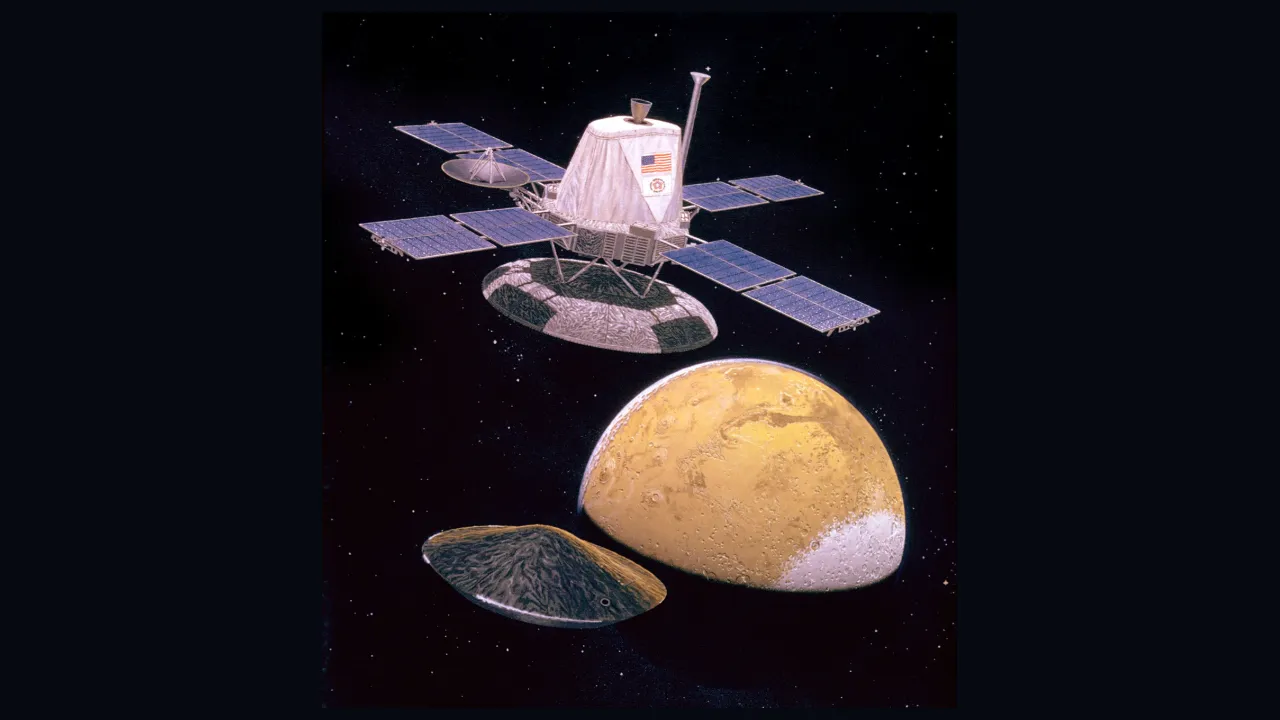
Before 1976, nobody had ever seen a clear picture from the surface of Mars! NASA sent twin pairs—Viking 1 and Viking 2—each carrying an to map from space and a three-legged lander to touch the ground.
2
Pink Skies and Rusty Plains
When the first color photos arrived on Earth, people gasped at rust-colored boulders scattered under a butterscotch-pink sky caused by fine floating dust.
3
Feeding Martian Dirt
Each lander unrolled a ten-foot metal arm, scooped red soil into miniature labs, and added drops of soup to test if microscopic Martians were breathing inside.
1. What gives the daytime Martian sky its pinkish-tan color?
2. How did the Viking landers move soil into their test chambers?
🤯 Mind-Blowing Fact • Grade 3
To stop Earth germs from hitchhiking to Mars, engineers baked each entire Viking lander inside a giant oven at 233 degrees Fahrenheit for forty hours before launch!
✨ Word Sparks (Grade 3 Glossary)
Tap 🔊 to hear
sterilize
To clean completely so zero living germs remain
reactive
Quick to fizz or change chemically when mixed
miniaturize
To engineer complex machines at very small sizes
🪝
How do you pack three whole biology laboratories into a box no bigger than a microwave?
1
Orbiter Eyes Pick Safe Sites
Charging toward Mars in the summer of 1976, NASA's Viking spacecraft discovered from orbit that their planned landing spot looked far rougher than expected! Mission controllers patiently studied thousands of crisp orbiter photos until they found smoother plains at Chryse Planitia for Viking 1 on July 20 and Utopia Planitia for Viking 2 on September 3.
2
Baking and Feeding the Soil
Inside each stationary lander sat a marvel of miniaturization: forty thousand tiny parts crammed into a one-cubic-foot biology box! When nutrient drops touched Martian dirt, one test suddenly fizzed with radioactive gas—exciting scientists worldwide.
3
A Chemical Plot Twist
Yet a separate oven test found zero organic carbon molecules, suggesting soil chemicals—not living microbes—caused the fizzing.
4
First Martian Weather Stations
Meanwhile, wind booms measured freezes down to minus 190 degrees Fahrenheit and tracked giant dust storms sweeping across the globe.
1. Why did engineers bake both Viking landers inside giant ovens before launching them from Earth?
2. Why did Viking 1 delay its original July 4, 1976 landing date by sixteen days?
🤯 Mind-Blowing Fact • Grade 4
Thanks to Viking's atmospheric gas measurements, scientists proved we already had real pieces of Mars sitting inside museum meteorite collections on Earth!
✨ Word Sparks (Grade 4 Glossary)
Tap 🔊 to hear
regolith
Loose layer of dust and broken rock covering bedrock
perchlorate
Reactive chlorine-oxygen salt common in Martian soil
meteorite
Space rock that survives falling onto Earth's surface
🪝
Why did one Viking experiment shout 'life!' while the others whispered 'lifeless desert'?
1
Engineering Soft Touchdowns Without Wheels
Touching down intact on Mars had defeated multiple early Soviet attempts before NASA's Viking 1 succeeded on July 20, 1976—seven years to the day after Apollo 11 landed on the Moon. After an aeroshell heat shield and parachute slowed descent, each lander ignited three terminal rocket engines fitted with shower-head-style eighteen-nozzle exhausts designed not to stir up blinding clouds or gouge craters into the soil.
2
The Famous Labeled Release Puzzle
Each nuclear-powered lander carried three biology experiments alongside a gas chromatograph-mass spectrometer (GCMS). In the Labeled Release test, moistening Martian with carbon-14-tagged nutrients released a burst of radioactive gas, whereas pre-baked control soil stayed quiet—matching the signature expected of breathing microbes! However, the GCMS detected no organic carbon down to parts per billion.
3
Perchlorates Reopen the Case Decades Later
Most scientists concluded harsh ultraviolet light creates oxidizing chemicals in Martian dust that break nutrients apart non-biologically. Intriguingly, when NASA's Phoenix lander discovered salts in 2008, chemists realized heating soil with perchlorates during Viking's oven test could actually burn up delicate organic molecules—helping inspire Curiosity and Perseverance's deeper rock drills!
4
Unlocking Meteorites From Mars
Viking also measured exact ratios of noble gases in Mars's atmosphere, later proving that certain rare found in Antarctica were genuine rocks blasted off Mars!
1. Why did each Viking engine split its exhaust through eighteen tiny nozzles like a shower head?
2. How did Viking's measurements of Martian air help geologists studying Antarctica?
🤯 Mind-Blowing Fact • Grade 5
Viking 1 measured Martian air pressure dropping by up to thirty percent each southern winter because trillions of tons of carbon dioxide air literally freeze solid onto the polar ice cap!
✨ Word Sparks (Grade 5 Glossary)
Tap 🔊 to hear
sol
One full solar day on Mars, 24 hours 39 minutes
oxidation
Chemical reaction stripping electrons, often breaking organic molecules
vesicular
Pitted with small cavities left by ancient gas bubbles
🪝
How did two stationary 1970s robots transform Mars from a blurry telescope dot into a mapped geological world?
1
Dual Architecture of Orbiters and Landers
Launched weeks apart atop Titan IIIE-Centaur rockets in late summer 1975, NASA's Viking 1 and Viking 2 represented the most ambitious planetary venture of the twentieth century. Each 3,527-kilogram spacecraft paired a high-resolution mapping orbiter with an encapsulated 576-kilogram lander sterilized by dry heat to prevent forward biological contamination. Entering Mars orbit first allowed mission directors at Langley and JPL to certify safe touchdown ellipses at Chryse Planitia (July 20, 1976) and Utopia Planitia (September 3, 1976).
2
Scanning Cameras, X-Rays, and Seismometers
Powered by twin radioisotope thermoelectric generators shielded behind windscreens, the hexagonal aluminum landers deployed mechanical facsimile cameras that scanned landscapes vertical line by vertical line, revealing basalt boulders, wind-sculpted drifts, and seasonal carbon-dioxide and water-ice frosts. X-ray fluorescence spectrometers showed iron-rich, clay-like silts remarkably consistent between landing sites 4,000 miles apart, while Viking 2's working seismometer listened for Martian tremors.
3
Orbiters Reveal Catastrophic Flood Channels
High overhead, the two Viking Orbiters photographed over 52,000 images covering the entire planet—unveiling Valles Marineris, towering Olympus Mons, polar ice caps, and giant teardrop-shaped islands carved by ancient mega-floods that rewrote planetary geology.
4
Ambiguity and Insight in the Biology Suite
Inside the one-cubic-foot TRW biology instrument, Pyrolytic Release, Gas Exchange, and Gilbert Levin's Labeled Release experiments probed surface regolith alongside Klaus Biemann's GCMS. While superoxides and perchlorates explained the rapid of labeled nutrients on UV-drenched plains, the results taught astrobiologists that future missions must drill into shielded ancient sedimentary rocks rather than loose surface dust.
5
Enduring Record of Mutch Memorial Station
Renamed the Thomas A. Mutch Memorial Station, Viking 1 transmitted continuous meteorological pressure cycles—discovering that a quarter of Mars's entire atmosphere freezes onto the winter pole each year—until a faulty battery-charging command silenced it in November 1982 after 2,245 Martian .