1. Why did the landers on Venus need super-thick metal shells?
2. What color did the sky look in photos taken from the surface of Venus?
🤯 Mind-Blowing Fact • Grade 2
On Venus, the air presses down ninety times harder than on Earth—the same squeeze you would feel swimming half a mile deep in the ocean!
✨ Word Sparks (Grade 2 Glossary)
Tap 🔊 to hear
hull
Strong outer body shell of a ship or probe
submarine
Vessel built to travel deep underwater safely
parachute
Fabric canopy that slows down a falling object
🪝
Why did early space probes get squashed flat before they even touched the ground on Venus?
1
Mystery Under the Clouds
For centuries, astronomers wondered whether lush jungles hid beneath Venus's bright clouds. When Soviet engineers dropped early probes into that sky in the 1960s, heavy air crushed them like soda cans miles above the ground!
2
Built Like Deep-Sea Submarines
Refusing to give up, engineers built later landers with round titanium as strong as deep-ocean . After shedding their , wide metal collars used the thick air itself as a cushion to brake gently.
3
Two Hours to Explore
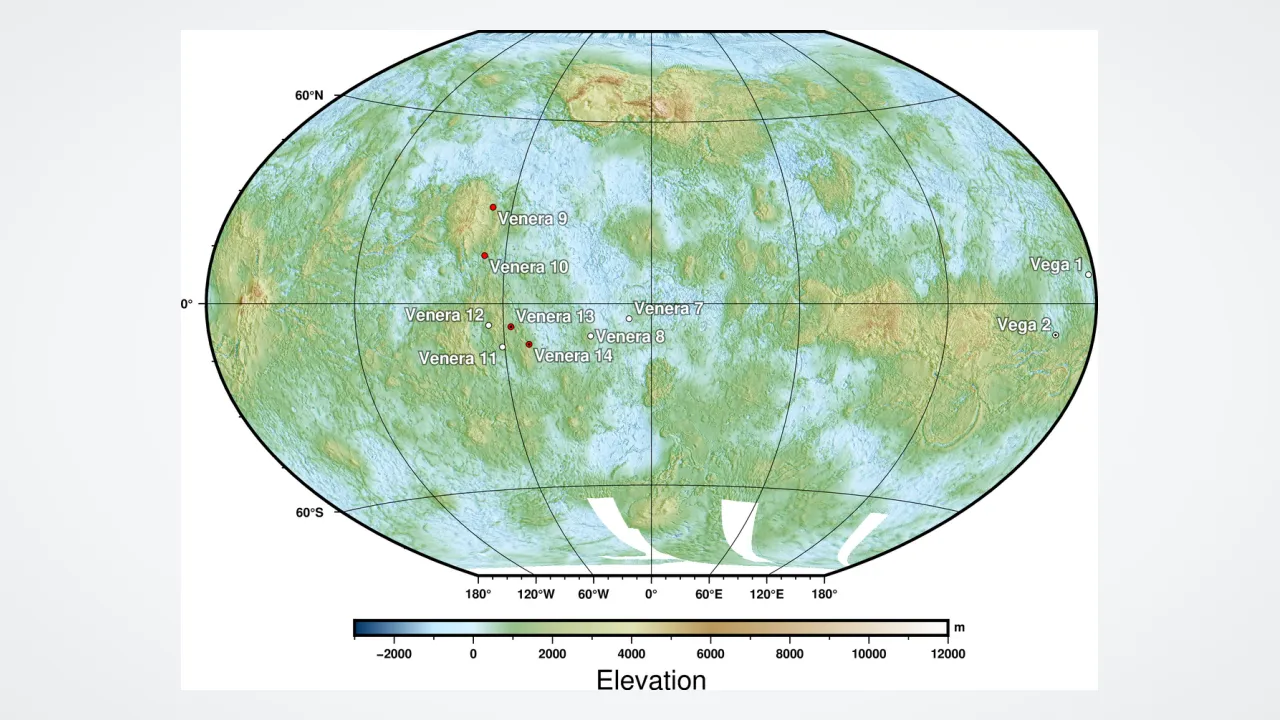
In 1982, Venera 13 survived more than two hours in 900-degree heat, snapping color panoramas and recording the whistle of Venusian wind!
1. How did later landers slow down near the ground after dropping their parachutes?
2. How long did Venera 13 survive on the scorching surface of Venus?
🤯 Mind-Blowing Fact • Grade 3
Venera 13 and 14 carried tiny microphones that recorded the very first sounds ever heard from another planet: howling wind, crunching rock drills, and lander clicks!
✨ Word Sparks (Grade 3 Glossary)
Tap 🔊 to hear
greenhouse effect
Heat trapped by thick gases blanketing a planet
basalt
Dark volcanic rock common on Earth, Mars, and Venus
quartz
Tough mineral crystal that withstands extreme heat
🪝
How do you take a crystal-clear photograph when ordinary glass camera lenses would melt or crack?
1
Into a Runaway Greenhouse
Imagine stepping onto a world where rain made of sulfuric acid evaporates before hitting ground hot enough to melt lead! Between 1961 and 1984, the Soviet Venera fleet bravely unlocked the secrets of Venus's runaway greenhouse atmosphere.
2
Pre-Chilled Titanium Spheres
Before dropping into the clouds, later landers chilled their insides below freezing so electronics had extra time before overheating. Thick windows protected periscope cameras that scanned cracked slabs stretching toward a hazy amber horizon.
3
Drilling Scorching Lava Rock
Even in crushing ninety-bar pressure, Venera 13 and 14 swung mechanical drills down to sample volcanic crust, pulling pinches inside sealed chambers for X-ray chemical tests.
4
Popped Lens Caps and Funny Luck
On Venera 14, a spring-loaded camera lens cap popped off and landed right beneath the soil-testing arm—so the probe accidentally measured the bounce of its own titanium cap!
1. What funny accident happened when Venera 14 popped off its protective camera lens cap?
2. Why did engineers chill the inside of the landers before dropping them toward Venus?
🤯 Mind-Blowing Fact • Grade 4
To date, the Soviet Venera and Vega probes remain the only spacecraft in human history to transmit photographs from the scorching surface of Venus!
✨ Word Sparks (Grade 4 Glossary)
Tap 🔊 to hear
aerobraking
Using atmospheric drag to slow a spacecraft down
implode
To collapse inward violently under heavy outside pressure
radar
Radio waves bounced off surfaces to map hidden terrain
🪝
Why did ditching its parachute thirty miles up actually help a Venus lander reach the ground safely?
1
Trial by Fire and Crushing Air
Exploring Earth's twin sister proved far harder than reaching Mars. Covered in reflective sulfuric-acid clouds and blanketed by 96.5 percent carbon dioxide, Venus traps solar energy in a ferocious greenhouse effect reaching 870 to 900 degrees Fahrenheit—hotter even than sunlit Mercury! Early descent capsules Venera 4, 5, and 6 radioed back shocking pressure readings before imploding midair, giving engineers the exact numbers needed to forge Venera 7's victorious 1970 landing.
2
Aerobraking Through Soup-Thick Gas
If a lander drifted slowly on a big parachute all the way to the ground, it would cook internally before touching a single pebble! Engineers solved this puzzle cleanly: at about thirty miles altitude, the parachute detached completely, letting the heavy lander plunge swiftly until a wide horizontal metal aerobrake ring caught the dense lower carbon dioxide—slowing touchdown to a gentle seventeen miles per hour.
3
Seeing and Sampling Volcanic Plains
Venera 9 and 10 transmitted humanity's first black-and-white landscapes from another planet in 1975, followed by Venera 13 and 14's famous 1982 color panoramas, acoustic wind recordings, and X-ray fluorescence rock analyses matching oceanic basalts on Earth.
4
Radar Orbiters Unveil Hidden Mountains
Completing the program in 1983, orbiters Venera 15 and 16 pierced the clouds with synthetic-aperture to map vast craters, lava domes, and mountain ranges.
1. Why did Venera landers release their parachutes thirty miles above the ground?
2. How did Venera 15 and 16 map Venus's mountains from orbit through thick, opaque clouds?
🤯 Mind-Blowing Fact • Grade 5
Because Venus's lower air is about sixty-five times denser than Earth's sea-level air, even a lazy two-foot-per-second Venusian breeze pushes pebbles like a flowing river current!
✨ Word Sparks (Grade 5 Glossary)
Tap 🔊 to hear
telemetry
Automated radio measurements transmitted from a distant probe
heat sink
Material that absorbs excess thermal energy to protect electronics
tholeiitic
Iron-rich volcanic basalt similar to Earth's ocean crust
🪝
How did twenty-three years of relentless engineering turn catastrophic atmospheric implosions into humanity's only postcards from a 900-degree world?
1
Iterative Mastery of an Alien Furnace
Few spaceflight sagas illustrate engineering persistence better than the Soviet Venera program, led across two decades by the Lavochkin Design Bureau. When Venera 4 became the first probe to measure another planet's atmosphere directly in October 1967, scientists realized Venusian surface pressure dwarfed early estimates. Armed with incrementally tougher hulls, Venera 7 survived 92 atmospheres of crushing pressure and 475 degrees Celsius (887 °F) to radio twenty-three minutes of surface on December 15, 1970—humanity's first soft landing on another planet.
2
Thermodynamics of the Spherical Pressure Vessel
Beginning with the five-ton Proton-launched Venera 9 in 1975, designers housed avionics inside a spherical titanium pressure hull insulated with honeycomb composite, phase-change lithium nitrate trihydrate , and pre-entry refrigeration to minus 10 degrees Celsius. Rather than piercing the hull with vulnerable wide windows, telephoto scanning photometers peered from safe inside through thick quartz portholes and gold-alloy periscope mirrors.
3
Geochemistry Under Ninety Bars
Touching down at Phoebe Regio in March 1982, Venera 13 and 14 drilled a millimeter into slabby bedrock, drawing crushed grains through decompression airlocks so X-ray fluorescence spectrometers could identify potassium-rich leucite basalt and ocean-floor-like basalt.
4
Acoustics, Lightning, and Noble Gases
During descent and surface operations, atmospheric mass spectrometers measured heavy argon and neon isotopes, lightning detectors logged electromagnetic crackles inside sulfuric-acid cloud decks, and acoustic sensors calculated gentle one-mile-per-hour breezes pushing dense gas with the force of brisk Earth winds.
5
Enduring Benchmark for Future Missions
More than forty years later, Venera's panoramic mosaics and chemical baselines remain humanity's sole ground truth from Earth's greenhouse twin, guiding next-generation silicon-carbide electronics designed to endure weeks instead of hours.