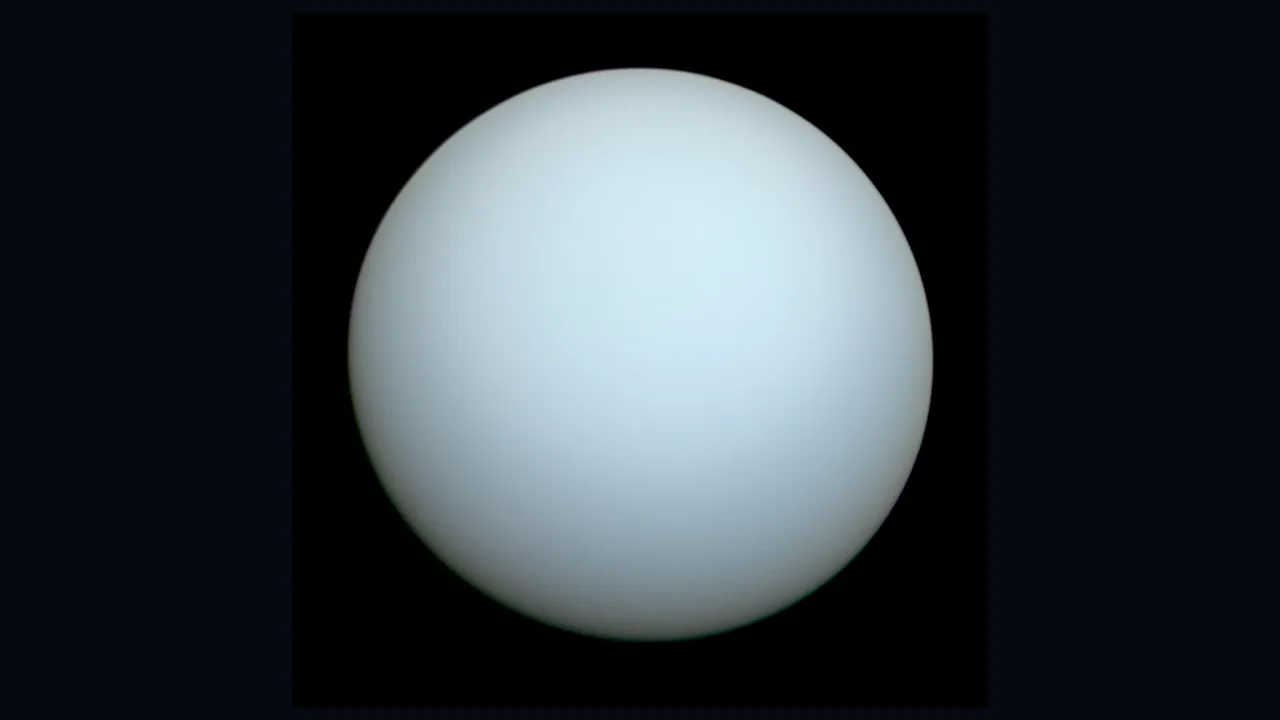
1. How does Uranus spin compared to the other planets?
2. What color does Uranus look through space cameras?
🤯 Mind-Blowing Fact • Grade 2
Scientists think an Earth-sized proto-planet slammed into young Uranus billions of years ago and knocked the whole giant planet onto its side!
✨ Word Sparks (Grade 2 Glossary)
Tap 🔊 to hear
Cyan
A calm greenish-blue color like tropical lagoon water.
Axis
Imaginary line through poles that a planet spins around.
Proto-planet
A young growing world in the early Solar System.
🪝
What would happen if summer daylight lasted forty-two years without a single sunset?
1
First Telescope Planet
People knew about Mercury through Saturn since ancient times, because you can see them with just your eyes. Then in 1781, William Herschel peered through his homemade telescope and discovered Uranus—doubling the known size of our Solar System overnight!
2
Wild 84-Year Seasons
Uranus takes 84 Earth years to circle the Sun once. Because it lies tipped sideways at 98 degrees, its north pole faces the Sun for 42 straight years of sunshine while its south pole freezes in 42 years of darkness!
3
Why Is It Blue-Green?
Methane gas high in Uranus's hydrogen sky soaks up red sunlight and bounces soothing blue light back to our eyes.
2. How many Earth years does Uranus take to orbit the Sun one time?
🤯 Mind-Blowing Fact • Grade 3
Deep inside Uranus, crushing pressure squeezes carbon atoms out of methane gas to create literal rainstorms of solid diamonds!
✨ Word Sparks (Grade 3 Glossary)
Tap 🔊 to hear
Ammonia
A pungent nitrogen-hydrogen compound common inside ice giants.
Mantle
Thick middle layer between outer clouds and core.
Crystallize
To lock atoms neatly into a solid crystal.
🪝
Why do scientists call Uranus an 'Ice Giant' instead of a 'Gas Giant' like Jupiter?
1
Inside an Ice Giant
Jupiter and Saturn are built almost entirely of lightweight hydrogen and helium gases. Uranus is different! Beneath its chilly outer clouds, eighty percent of Uranus's mass is a hot, soupy ocean of compressed water, , and methane—materials astronomers call planetary 'ices.'
2
Storybook Moons and Dark Rings
Instead of Greek or Roman gods, Uranus's twenty-eight moons are named after characters from plays by William Shakespeare and poems by Alexander Pope, like Titania, Oberon, Ariel, Umbriel, and Miranda! Thirteen narrow, coal-dark rings circle its tilted equator.
3
Colder Than Farther Neptune
Even though Neptune sits a billion miles farther from the Sun, Uranus reaches colder temperatures! Unlike other giant planets, Uranus gives off almost zero leftover internal heat.
4
Diamond Rain Deep Down
Lab experiments show that crushing pressures thousands of miles down squeeze carbon out of methane and real sparkling diamonds that hail toward Uranus's rocky core!
2. Why is Uranus colder than Neptune even though Uranus is closer to the Sun?
🤯 Mind-Blowing Fact • Grade 4
High clouds on Uranus are made of hydrogen sulfide ice—meaning if you could sniff Uranus's upper sky, it would smell strongly like rotten eggs!
✨ Word Sparks (Grade 4 Glossary)
Tap 🔊 to hear
Equinox
Orbit point when sunlight shines straight onto the equator.
Superionic ice
Hot pressurized ice conducting electricity via fast hydrogen ions.
Spectroscopy
Splitting light into colors to identify hidden gases.
🪝
Why is Uranus's magnetic field tilted crooked AND pushed off-center from the middle of the planet?
1
Voyager 2's Lopsided Magnetic Surprise
In January 1986, NASA's Voyager 2 became the only spacecraft in history to fly past Uranus. Its instruments uncovered a baffling magnetic field: not only is Uranus's magnetic axis tilted 59 degrees away from its sideways spin axis, it is also offset one-third of the way from the planet's center toward the south pole! As Uranus rotates every 17 hours and 14 minutes, its magnetosphere tumbles and corkscrews wildly, opening and closing to the solar wind every single day.
2
Superionic Water Dynamo
Why is the field so off-center? Rather than forming inside a deep metallic core, Uranus's magnetic dynamo churns inside a shallower shell of ionic water, ammonia, and exotic ''—where oxygen atoms lock into a crystal lattice while hydrogen protons zip freely like electricity!
3
Waking Storms at Equinox
Voyager 2 saw a calm, featureless cyan globe during southern summer. Yet when Uranus reached in 2007 and sunlight hit its equator for the first time in 42 years, Hubble and the James Webb Space Telescope spotted bright methane cloud bands, polar hoods, and 560-mile-per-hour winds!
4
Rotten-Egg Cloud Tops
from Hawaii's Gemini North telescope confirmed Uranus's upper cloud deck consists of frozen hydrogen sulfide—the exact chemical that gives rotten eggs their stink!
1. What makes Uranus's magnetic field behave like a tumbling corkscrew every 17 hours?
2. Which smelly molecule forms the main upper cloud deck of Uranus?
🤯 Mind-Blowing Fact • Grade 5
Astronomers discovered Uranus's dark rings completely by accident in 1977 when a distant background star blinked on and off five times just before Uranus passed in front of it!
✨ Word Sparks (Grade 5 Glossary)
Tap 🔊 to hear
Occultation
When a moving planet blocks light from a star.
Tropopause
Cold boundary layer topping a planet's weather zone.
Exoplanet
A planet orbiting another star beyond our Sun.
🪝
Why did planetary scientists rank a dedicated Uranus Orbiter and Probe as NASA's highest-priority flagship mission?
1
Accidental Discovery and Astrometric Legacy
On March 13, 1781, musician-turned-astronomer William Herschel spotted a resolved greenish disk in Gemini that he initially mistook for a comet. Orbital calculations by Anders Lexell soon proved it orbited nearly circularly at 19.2 astronomical units—the first newly identified planet since antiquity. Decades later, tiny gravitational tugs perturbing Uranus's orbit enabled Urbain Le Verrier and John Couch Adams to mathematically predict the existence of Neptune!
2
Thermal Paradox and Stratified Convection
Spanning 50,724 kilometers across and 14.54 Earth masses, Uranus exhibits a profound thermal anomaly: its ratio of emitted infrared energy to absorbed solar flux is merely 1.06 plus or minus 0.08, letting its chill to 49 kelvins (-224°C). Leading models propose either a giant oblique impact by a two-to-three-Earth-mass protoplanet expelled primordial heat or sharp compositional density gradients trap primordial heat inside a stagnant core.
3
Occultation Discovery of Narrow Dark Rings
In 1977, astronomers watching Uranus pass in front of star SAO 158687 saw the starlight blink five times before and after the disk—discovering nine narrow, low-albedo rings! James Webb Space Telescope infrared imagery in 2023 brilliantly resolved eleven of Uranus's thirteen rings, including the dusty inner Zeta ring and bright outer Epsilon ring.
4
Archetype for Galaxy-Wide Exoplanets
Kepler and TESS surveys revealed that sub-Neptune and ice-giant-sized worlds are among the most common planets in the Milky Way, turning nearby Uranus into our closest laboratory for understanding volatile-rich planetary interiors.
5
The Uranus Orbiter and Probe Flagship
Endorsed as the top flagship priority of the Planetary Science Decadal Survey, a future Uranus Orbiter and atmospheric entry probe aims to measure noble-gas abundances, map multipolar magnetic harmonics, and check whether moons like Ariel and Miranda conceal oceans.