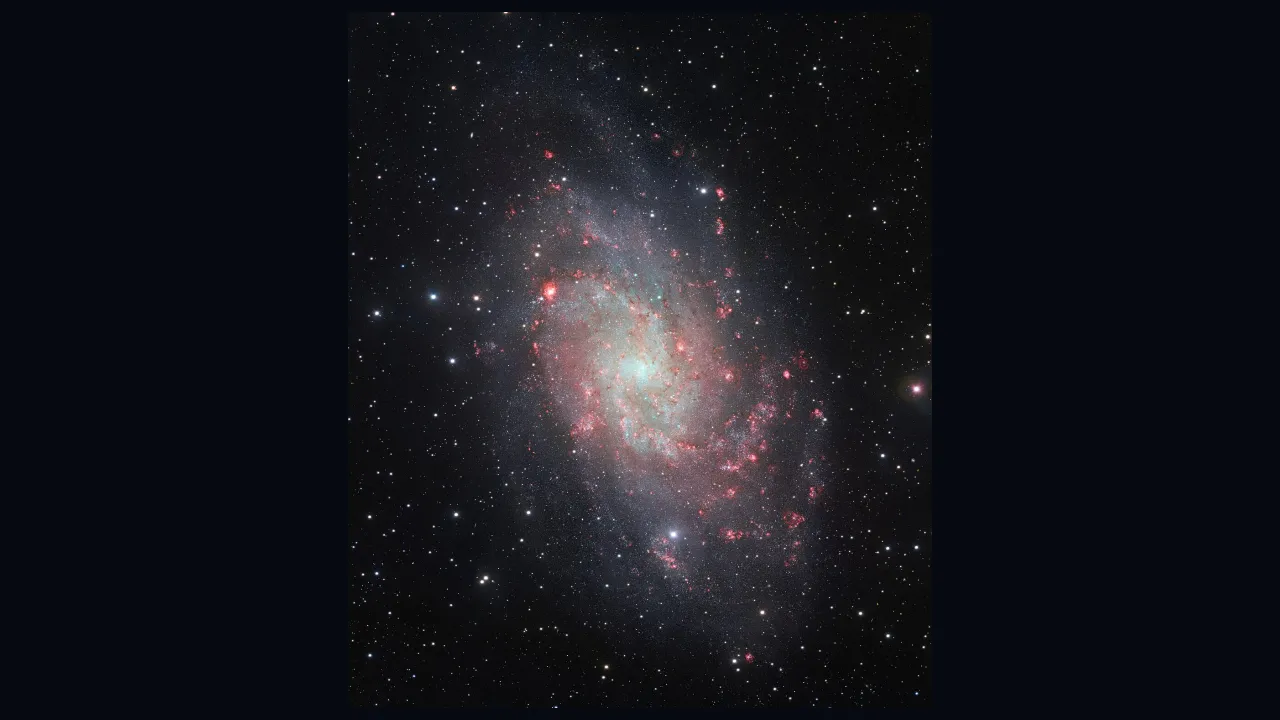
1. Where does the Triangulum Galaxy rank in size inside our Local Group neighborhood?
2. Why is it so easy for telescopes to see all of Triangulum's spiral arms clearly?
🤯 Mind-Blowing Fact • Grade 2
If giant star-nursery NGC 604 swapped places with our nearby Orion Nebula, it would shine brighter than Venus and cast shadows on Earth at night!
✨ Word Sparks (Grade 2 Glossary)
Tap 🔊 to hear
constellation
Named sky pattern made of bright stars
hydrogen
Lightest gas in space that builds stars
challenge
Exciting test that takes skill to pass
🪝
Why do sharp-eyed stargazers use the Triangulum Galaxy as the ultimate dark-sky eyesight test?
1
Third Giant of Our Neighborhood
Floating 2.73 million light-years away in the triangle-shaped Triangulum spins Messier 33, the Triangulum Galaxy! Measuring 60,000 light-years wide with 40 billion stars, it is roughly half as wide as our Milky Way—ranking third largest in our Local Group.
2
The Ultimate Stargazer Test
Even though Triangulum sits only a bit farther away than Andromeda, its light spreads softly across a wide patch of sky. Only stargazers under pitch-black mountain skies can spot it with unaided eyes—making it astronomy's ultimate vision !
3
Monster Cloud NGC 604
Inside one spiral arm blazes NGC 604, a gargantuan pink cloud 1,500 light-years wide where over two hundred giant blue stars shine together!
1. About how wide is the Triangulum Galaxy compared to our Milky Way?
2. What is NGC 604 inside the Triangulum Galaxy?
🤯 Mind-Blowing Fact • Grade 3
Even though Triangulum has no giant supermassive black hole at its center, its core blazes as the brightest X-ray source in our entire Local Group thanks to a smaller stellar black hole gobbling gas from a companion star!
✨ Word Sparks (Grade 3 Glossary)
Tap 🔊 to hear
unbarred
Spiral galaxy whose arms wind straight inward
X-ray
High-energy invisible light from ultra-hot space gas
tendril
Slender curling ribbon of glowing space dust
🪝
What famous giant object found inside the Milky Way and Andromeda seems to be completely missing from Triangulum's center?
1
Pure Spiral Without a Bar
Spotted by Italian astronomer Giovanni Battista Hodierna before 1654 and independently cataloged by Charles Messier in 1764 as M33, the Triangulum Galaxy sits just fifteen degrees away from Andromeda in our autumn sky. Unlike barred-spiral Milky Way, Triangulum is a pure '' spiral whose feathery arms wind straight to the center!
2
Missing Supermassive Black Hole!
Almost every large galaxy hides a supermassive black hole weighing millions of Suns at its core. Yet when Hubble measured star speeds inside Triangulum's compact central star cluster, astronomers found a shock: Triangulum appears to have NO supermassive black hole at all!
3
Packed With Star Fuel
Instead, huge reserves of cool hydrogen gas fuel nonstop star birth—creating new stars ten times faster per square light-year than neighbor Andromeda!
4
Webb Peers Inside NGC 604
In 2024, NASA's James Webb Space Telescope zoomed into Triangulum's giant nebula NGC 604, revealing fiery orange and cavernous bubbles blown by two hundred monster stars.
1. What surprising discovery did Hubble make when measuring star motions at the exact center of the Triangulum Galaxy?
2. Why does the Triangulum Galaxy form new stars at such a rapid pace for its size?
🤯 Mind-Blowing Fact • Grade 4
If you lived on a planet inside the Triangulum Galaxy and looked up at night, giant neighbor Andromeda would span twenty times wider than Earth's full Moon right across your sky!
✨ Word Sparks (Grade 4 Glossary)
Tap 🔊 to hear
maser
Natural space cloud beaming microwave laser light
proper motion
Sideways drift of a distant object across sky
eclipse
Passing directly in front of another shining body
🪝
Is the Triangulum Galaxy an ancient companion of giant Andromeda, or a newcomer arriving for the very first time?
1
A Hydrogen Bridge Between Neighbors
Separated from giant Andromeda by only about 750,000 light-years in 3D space, Messier 33 (Triangulum) was long assumed to have orbited Andromeda multiple times in the past. Radio telescopes even detected a faint stream of neutral hydrogen gas bridging the gap between the two spirals, fueling debates over whether a close ancient pass warped Triangulum's outer gaseous disk!
2
Gaia Rewrites Triangulum's Travel Log
In 2019, ESA's Gaia space observatory teamed up with radio arrays tracking glowing water inside Triangulum's star nurseries to clock M33's sideways speed across the sky at 118 miles per second! Running that precise 3D velocity backward in computer models revealed a surprise: Triangulum is likely plunging into Andromeda's gravitational neighborhood for the very first time—explaining why its delicate, unbarred disk remains unscarred by giant tidal collisions!
3
Joining the Three-Galaxy Dance
Four billion years from now, as Andromeda and the Milky Way merge, Triangulum will join the cosmic waltz—either swinging closely around the newly merged giant galaxy or merging right in later!
4
Record-Breaking Stellar Black Hole M33 X-7
Inside Triangulum orbits M33 X-7, one of the heaviest 'stellar-mass' black holes ever weighed—15.7 times our Sun's mass—eclipsed every 3.45 days by a monster 70-solar-mass blue companion star!
1. What did ESA's Gaia satellite and radio maser tracking suggest about Triangulum's history with Andromeda?
2. What makes binary system M33 X-7 inside the Triangulum Galaxy famous among astrophysicists?
🤯 Mind-Blowing Fact • Grade 5
In 2005, astronomers measured the sideways spin of the Triangulum Galaxy directly across 2.73 million light-years by tracking tiny microwave 'maser' clouds—like watching a pinwheel turn from across an entire continent!
✨ Word Sparks (Grade 5 Glossary)
Tap 🔊 to hear
H II region
Cloud of ionized hydrogen glowing around hot stars
Wolf-Rayet star
Evolved monster star blowing fierce stellar winds
baryonic
Ordinary visible matter made of protons and neutrons
🪝
How can a 40-billion-star spiral build a dense nuclear cluster yet completely skip growing a supermassive black hole?
1
Archetype of a Pure Bulge-Free SA(s)cd Spiral
Located 2.73 million light-years (837 kiloparsecs) away at a favorable 54-degree inclination, Messier 33—the Triangulum Galaxy—is the Local Group's third-largest member (~50 billion solar masses including dark matter; ~40 billion stars across 60,000 light-years). Morphologically classified as SA(s)cd, M33 lacks both a central bar and a classical merger-built stellar bulge! Hubble Space Telescope spectroscopy of its compact, luminous nuclear star cluster placed the tightest upper limit ever measured on a missing central black hole: fewer than 1,500 solar masses, proving pure-disk galaxies can evolve over cosmic time without seeding a supermassive black hole.
2
Star-Formation Efficiency and Giant H II Region NGC 604
Rich in atomic and molecular hydrogen gas (~10 to 20 percent of its disk mass), Triangulum sustains an area-normalized star-formation rate an order of magnitude higher than Andromeda's! Anchoring its northeastern arm glows NGC 604, a 460-parsec (1,500-light-year) giant H II complex ionized by more than 200 O-type and totaling ~100,000 solar masses. In 2024, James Webb NIRCam and MIRI images resolved polycyclic aromatic hydrocarbon tendrils framing evacuated stellar-wind superbubbles.
3
VLBA Water Masers + Gaia Proper Motion
In 2005, Very Long Baseline Array (VLBA) phase-referencing of two H2O maser complexes on opposite sides of M33 achieved a landmark geometric measurement of both its internal rotation and transverse sky motion—refined in 2019 by ESA's Gaia satellite (~190 km/s 3D velocity relative to M31). Orbital integrations favor a 'first-infall' trajectory into Andromeda's virial halo rather than an ancient close pericenter passage, preserving M33's unperturbed stellar disk despite mild warping in its outermost neutral-hydrogen envelope.
Resolving 22 million individual stars across M33's inner disk, Hubble's PHATTER survey coupled with Chandra observations of eclipsing X-ray binary M33 X-7 illuminates how low-metallicity massive stars evolve and collapse.
5
Three-Body Fate of the Local Group
Across the next five billion years, M33's ~50-billion-solar-mass dark-matter halo will gravitationally steer the exact timing and impact parameter of the Milky Way–Andromeda collision before ultimately merging into the future giant elliptical remnant.