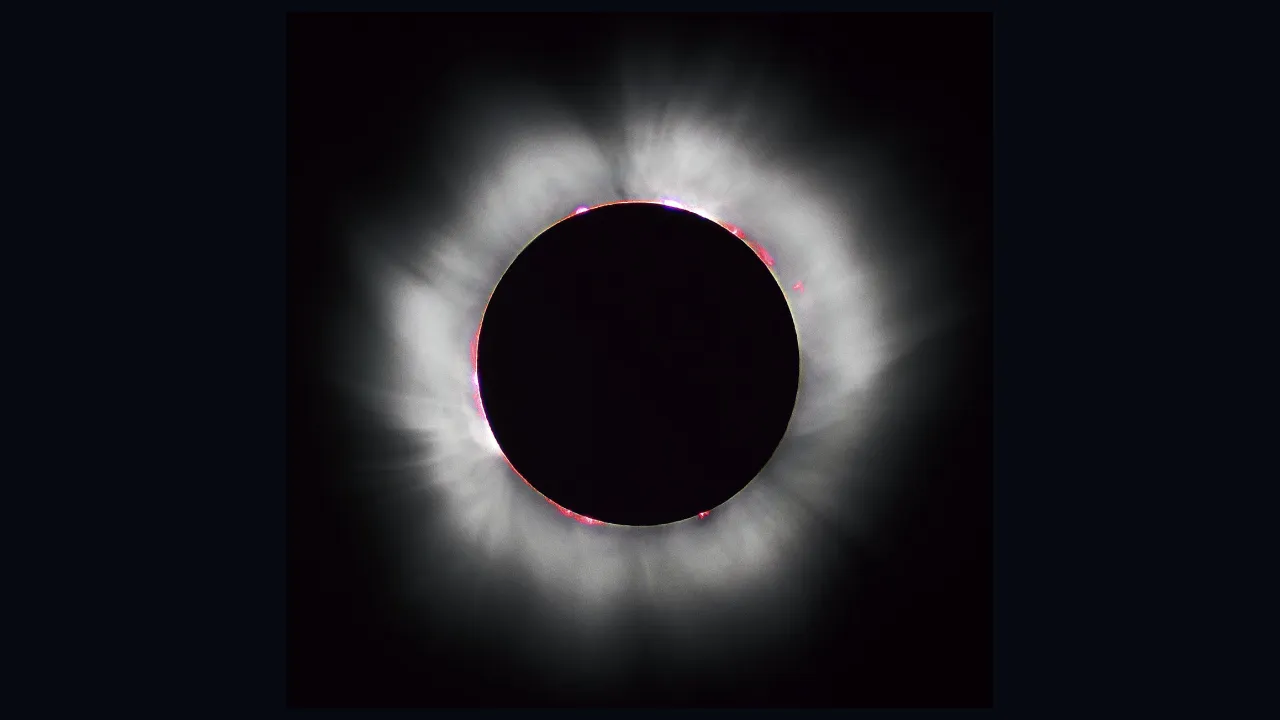
1. What moves directly between Earth and the Sun during a total solar eclipse?
2. Why do the tiny Moon and giant Sun look the same size in our sky?
🤯 Mind-Blowing Fact • Grade 2
Just before and after totality, sunlight shining through deep valleys on the Moon's edge flashes like a sparkling 'diamond ring' in the sky!
✨ Word Sparks (Grade 2 Glossary)
Tap 🔊 to hear
totality
Brief minutes when the Moon hides the Sun
New Moon
Moon phase with its dark side facing Earth
coincidence
Surprising match that happens just by chance
🪝
How can our tiny Moon completely hide a star that could hold a million Earths?
1
The 400-to-1 Coincidence
Hold your thumb up at arm's length and close one eye—your tiny thumb can hide a huge tree across the yard! Space plays the exact same trick. The Sun is about 400 times wider than the Moon, and it also sits about 400 times farther away, making them match in our sky.
2
Racing Inside the Path
When the lines up squarely in front of the Sun, its darkest shadow—the umbra—sweeps across Earth faster than a jet plane! Only people standing inside that narrow path of see the Sun vanish completely.
3
Safety Glasses On and Off
Viewers wear special eclipse glasses while any sliver of Sun peeks out, taking them off ONLY during brief to admire the pearly corona!
1. What creates the famous 'diamond ring' flash right before totality begins?
2. When is the ONLY safe moment to look without solar eclipse glasses?
🤯 Mind-Blowing Fact • Grade 3
The element helium—used to float party balloons—was discovered in sunlight during an 1868 total solar eclipse nearly thirty years before anyone found it on Earth!
✨ Word Sparks (Grade 3 Glossary)
Tap 🔊 to hear
annular eclipse
Eclipse leaving a bright ring around the Moon
Baily's beads
Drops of sunlight shining between Moon mountains
prominence
Pink loop of glowing gas on the Sun
🪝
If the Moon orbits Earth every single month, why don't we get a total solar eclipse every month?
1
The Five-Degree Tilt
Once a month at New Moon, the Moon passes roughly between Earth and the Sun. Yet most months its shadow misses Earth completely, sailing just above our North Pole or below our South Pole! That happens because the Moon's orbit tilts five degrees compared to Earth's orbit, lining up squarely only at special crossing points.
2
Total Versus Annular
Even a dead-center lineup doesn't guarantee totality. Because the Moon travels an oval orbit, sometimes it sits slightly farther from Earth and looks a tiny bit smaller than the Sun—leaving a blazing 'ring of fire' called an instead of total darkness!
3
Baily's Beads and Prominences
Seconds before totality, sunlight breaks into ruby drops called between jagged lunar mountains. Once covered, pink loops of hydrogen plasma called dance inside the silky white corona.
4
360-Degree Sunset
Look all around the horizon during totality and orange sunset colors glow in every compass direction at once!
1. Why doesn't a solar eclipse happen at every single New Moon?
2. Which chemical element was discovered in the Sun's spectrum during an 1868 eclipse before it was found on Earth?
🤯 Mind-Blowing Fact • Grade 4
During the April 8, 2024 total solar eclipse across North America, NASA launched three sounding rockets straight into the Moon's shadow to measure sudden ripples in Earth's electrically charged ionosphere!
✨ Word Sparks (Grade 4 Glossary)
Tap 🔊 to hear
syzygy
Straight-line alignment of three celestial bodies
perigee
Closest point in the Moon's oval orbit
spacetime
Four-dimensional fabric of space and time combined
🪝
How did four minutes of eclipse darkness in 1919 prove Albert Einstein's wild theory that gravity bends starlight?
1
Geometry of Syzygy
Astronomers use the delightful word '' whenever three celestial bodies align in a straight line. When the Moon crosses an orbital node near —its closest approach to Earth—its dark conical umbra reaches Earth's surface as a narrow track roughly 110 to 260 kilometers wide, racing eastward faster than 1,600 kilometers per hour while a wider penumbra casts a partial eclipse across whole continents.
2
Solving the Coronal Heating Mystery
Normally, the Sun's photosphere shines a million times brighter than its outer corona, drowning it in blue sky glare. Totality acts as nature's ultimate coronagraph, unveiling magnetic streamers stretching millions of kilometers outward and letting physicists probe why the tenuous corona blazes past two million kelvins above a 5,800-kelvin surface.
3
Eddington's 1919 Relativity Test
Albert Einstein predicted in 1915 that the Sun's immense mass warps , bending starlight grazing its edge by 1.75 arcseconds. On May 29, 1919, Sir Arthur Eddington photographed Hyades cluster stars beside the eclipsed Sun from Príncipe Island—confirming their positions shifted exactly as Einstein calculated!
4
A Temporary Miracle in Geologic Time
Laser reflectors left by Apollo astronauts show tidal friction pushes the Moon 3.8 centimeters farther away every year—meaning in about 600 million years, Earth will witness its very last total solar eclipse!
1. Why did Arthur Eddington need a total solar eclipse in 1919 to test Einstein's theory of general relativity?
2. Why will total solar eclipses eventually stop happening on Earth in about 600 million years?
🤯 Mind-Blowing Fact • Grade 5
Supersonic Concorde jetliners in 1973 raced alongside the Moon's shadow at twice the speed of sound over Africa, stretching totality for scientists onboard to an astonishing 74 minutes!
✨ Word Sparks (Grade 5 Glossary)
Tap 🔊 to hear
Saros cycle
Eighteen-year pattern of repeating solar and lunar eclipses
angular diameter
Apparent width of a sky object in degrees
aphelion
Farthest point in Earth's orbit from the Sun
🪝
How did ancient Babylonian astronomers predict eclipses centuries in advance without knowing Earth orbited the Sun?
1
The Saros Cycle and Orbital Nodes
Long before telescopic mechanics, Chaldean astronomers in Babylon discovered that eclipses repeat with astonishing regularity every 18 years, 11 days, and 8 hours—an interval called the (223 synodic months). That rhythm harmonizes three distinct lunar periods: the Moon's phase cycle, its elliptical perigee-to-perigee cycle, and its return to the ecliptic nodes where its 5.14-degree inclined orbit intersects Earth's orbital plane.
2
Angular Diameter Precision
Earth enjoys the Solar System's premier eclipse geometry because both the Sun and Moon subtend an near 0.5 degrees (roughly 31 to 32 arcminutes). Depending on whether Earth sits near and the Moon near perigee, totality can endure up to a theoretical maximum of 7 minutes 32 seconds, while the extra 8 hours in each Saros shifts successive eclipse tracks 120 degrees westward in longitude.
3
Spectroscopic Birth of Astrophysics
During the August 18, 1868 eclipse, Pierre Janssen and Norman Lockyer independently detected a vivid yellow emission line at 587.49 nanometers in solar prominences—revealing helium decades before terrestrial isolation. Later eclipses exposed 'coronium' green emission lines, ultimately identified as iron stripped of thirteen electrons ($Fe\text{ XIV}$), proving multi-million-kelvin coronal temperatures.
4
Atmospheric Gravity Waves
As the Moon's supersonic umbral shadow cone hurtles across continents at more than 2,500 kilometers per hour, surface air temperatures plunge up to 10°C within minutes. That moving cold spot acts like a ship's prow plowing through the atmosphere, launching bow-like atmospheric gravity waves while cutting off extreme ultraviolet sunlight high overhead—triggering sudden electron-ion recombination ripples across the electrically charged ionosphere.
5
Spacecraft Formation-Flying Eclipses
Even spaceborne coronagraphs suffer slight light diffraction around small internal occulting disks that blurs the innermost solar corona. Inspired directly by lunar geometry, the European Space Agency's Proba-3 mission flies two independent spacecraft 150 meters apart in millimeter-precise laser formation—casting an artificial total solar eclipse across space for six uninterrupted hours every orbit to watch coronal mass ejections lift off!