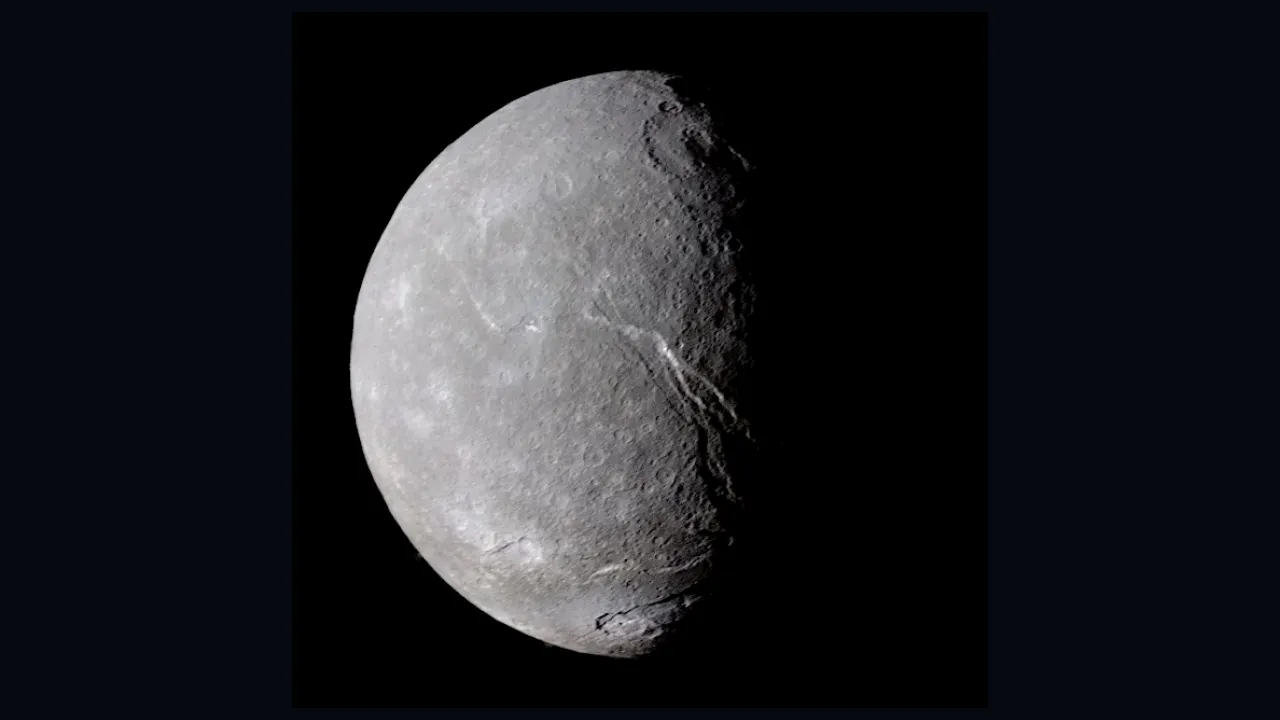
1. Which planet does Titania orbit as its biggest moon?
2. How long does daytime last at Titania's north pole during summer?
🤯 Mind-Blowing Fact • Grade 2
If Messina Chasmata sat on Earth, that single canyon would stretch all the way from Chicago to Miami!
✨ Word Sparks (Grade 2 Glossary)
Tap 🔊 to hear
Expand
To puff outward and take up more space.
Chasm
A deep, wide split in a moon's crust.
Astronomer
A scientist who studies stars, planets, and moons.
🪝
What happens when a moon's insides freeze and puff up like an ice cube tray?
1
Spotted by Herschel
Six years after William Herschel discovered Uranus, he aimed his big telescope back at the pale blue planet in 1787 and spotted its two largest moons: Titania and Oberon! Measuring 981 miles across, Titania ranks eighth largest among all moons in our Solar System.
2
Splitting at the Seams
Half rock and half water ice build Titania. Long ago, liquid water deep inside began to freeze and , stretching Titania's outer shell until giant canyons cracked open!
3
Messina Chasmata
Its longest canyon, Messina Chasmata, runs almost a thousand miles—farther than driving from New York to Florida!
1. Why did giant canyons crack open across Titania's icy surface?
2. Who discovered Titania in 1787?
🤯 Mind-Blowing Fact • Grade 3
Even though Titania and Saturn's moon Rhea are almost twins in size, Titania is much heavier because half of its body is solid rock!
✨ Word Sparks (Grade 3 Glossary)
Tap 🔊 to hear
Silicate
Common hard rock mineral found in planets and moons.
Dry ice
Solid frozen carbon dioxide gas at ultra-cold temperatures.
Basin
A wide circular hollow made by a big impact.
🪝
Why is Titania heavier for its size than Saturn's icy moons?
1
Packed With Heavy Rock
Titania is nearly the exact same width as Saturn's moon Rhea, yet Titania weighs thirty-five percent more! While Rhea is mostly lightweight ice, Titania is an even fifty-fifty blend of dense rock and frozen water.
2
Smooth Icy Floods
When Voyager 2 photographed Titania's southern half in 1986, geologists noticed smooth plains with very few craters alongside battered like 200-mile-wide Gertrude. Ancient icy volcanoes likely flooded low valleys with slushy water that froze smooth!
3
Frosty Dry Ice Patches
Powerful infrared telescopes on Earth detected frozen carbon dioxide—also known as —coating large parts of Titania's trailing hemisphere while staying absent from its sunlit pole.
4
A Warm Core Layer?
Natural radioactive heat radiating from Titania's large rocky core may still keep a thin, salty ocean mixed with natural ammonia antifreeze liquid thirty miles beneath the frozen outer crust today!
1. Why does Titania weigh significantly more than Saturn's moon Rhea despite being nearly the same size?
2. What frozen gas did infrared telescopes spot on Titania's surface alongside water ice?
🤯 Mind-Blowing Fact • Grade 4
When Titania crossed in front of a distant star in 2001, backyard and professional telescopes teamed up to measure its width from nearly two billion miles away!
✨ Word Sparks (Grade 4 Glossary)
Tap 🔊 to hear
Stellar occultation
A moon passing in front of a distant star.
Cross-cutting
Younger cracks slicing right through older surface craters.
Radiogenic
Heat produced naturally by decaying elements inside rock.
🪝
How did a rare star eclipse help astronomers measure Titania down to a fraction of a mile?
1
Pinpointing Titania by Starlight
In September 2001, Titania passed directly in front of a bright background star—an event astronomers call a . Observatories across Europe timed the exact seconds the star winked out and reappeared! That shadow trace measured Titania's diameter at precisely 1,578 kilometers and proved any seasonal carbon dioxide atmosphere is thinner than ten-trillionths of Earth's surface air.
2
Differentiated Core and Mantle
With a bulk density of 1.71 grams per cubic centimeter—the highest among all five major Uranian satellites—Titania holds enough rock to have separated early into a compact rocky core roughly 1,000 kilometers wide wrapped inside a 270-kilometer icy mantle.
3
Late Tectonic Resurfacing
Notice how Messina Chasmata slices clean across older craters like Ursula and giant 200-mile-wide Gertrude Basin! In planetary geology, fault canyons prove Titania's interior froze and expanded hundreds of millions of years after early heavy asteroid bombardment ended.
4
Ammonia Antifreeze Ocean
If just a few percent dissolved ammonia or salt mixes into liquid water at the boundary right above Titania's warm rocky core, an underground ocean up to 50 kilometers thick could still survive beneath its icy shell today!
1. How do geologists know Messina Chasmata formed later than Titania's large craters?
2. What did the 2001 stellar occultation reveal about Titania's atmosphere?
🤯 Mind-Blowing Fact • Grade 5
Fault measurements show that the entire moon of Titania puffed outward and grew up to four miles wider when part of its ancient underground ocean froze into ice!
✨ Word Sparks (Grade 5 Glossary)
Tap 🔊 to hear
Obliquity
The angle a planet or moon tilts sideways.
Clathrate
Ice crystal cage trapping gas molecules inside it.
Space weathering
Surface darkening caused by radiation and tiny meteoroids.
🪝
Why does Titania sit at the forefront of NASA's upcoming search for habitable oceans in the outer Solar System?
1
Reddish Regolith and Radiolytic Organics
Orbiting Uranus synchronously at 435,910 kilometers every 8.706 days, Titania displays a muted, slightly reddish-gray surface with a Bond albedo near 0.17—far darker than Saturn's icy moons! Planetary spectroscopists attribute this tint to : solar ultraviolet photons and magnetospheric charged particles irradiate native methane , polymerizing dark carbonaceous residues across impact ejecta while leaving brighter fresh water ice exposed inside crisp craters and fault scarps.
2
Extensional Stress and Global Volume Expansion
Voyager 2 imaged roughly forty percent of Titania's globe at resolutions suitable for geologic mapping during its January 1986 flyby. Across that southern expanse, steep normal-fault scarps bounding grabens like Messina and Belmont Chasmata rise two to five kilometers high, indicating Titania's global radius expanded by roughly 0.4 to 0.8 percent as an ancient subsurface ocean progressively crystallized.
3
Polar Volatile Migration Over 84-Year Cycles
Because Titania shares Uranus's extreme 97.8-degree , each pole endures forty-two continuous years of zenith sunlight followed by forty-two years of cryogenic night. Near-infrared spectroscopy with the Very Large Telescope shows carbon dioxide frost depleted near sunlit poles and concentrated at low latitudes on the trailing hemisphere via radiolytic synthesis and seasonal cold-trapping.
4
Porous Core Heat Retention and Brine Survival
Recent thermal-evolution simulations from NASA's Jet Propulsion Laboratory demonstrate that low thermal conductivity in an insulating outer shell, paired with radiogenic heating from a 66-percent-mass rocky core and dissolved ammonia-chloride brines, can sustain a thin basal ocean fewer than 50 kilometers thick.
5
Magnetic Induction Target for a Uranus Orbiter
Because Uranus's wildly tilted magnetic field sweeps across Titania every seventeen hours, a future Uranus flagship orbiter can use magnetometers to detect induced electrical currents—confirming once and for all whether Titania's hidden sea endures.