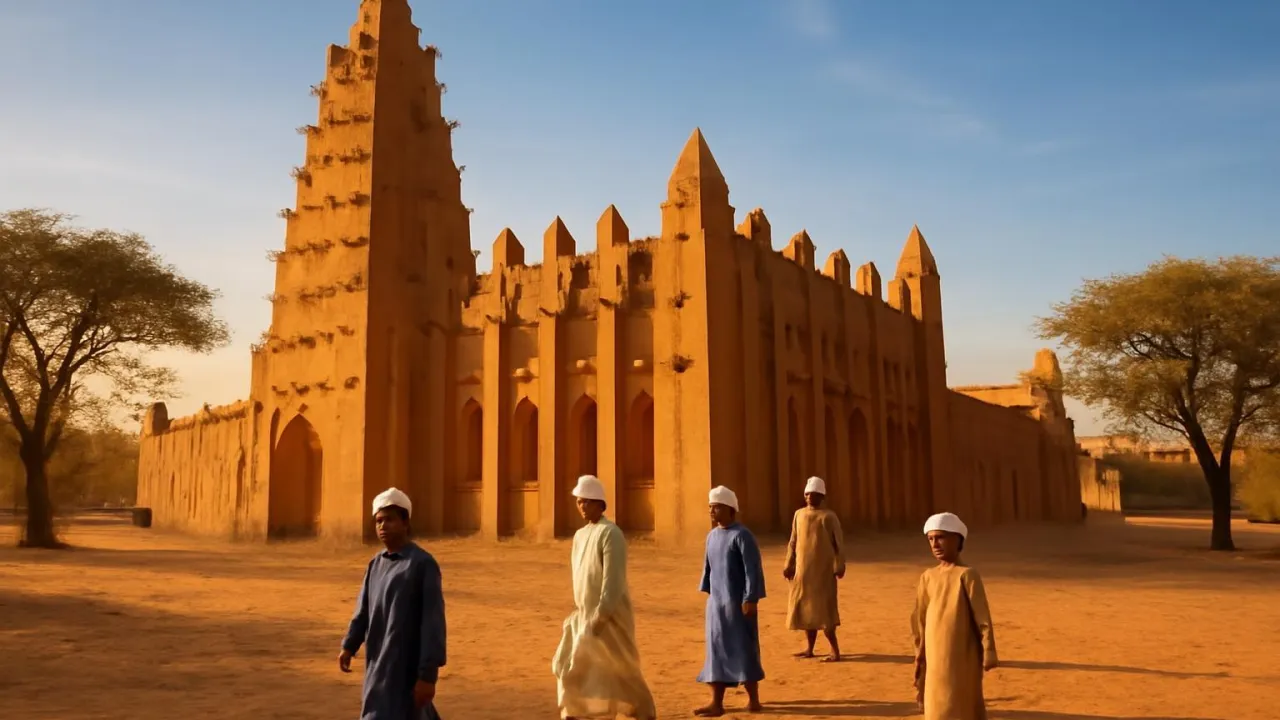
Sankore Madrasah once held over 25,000 students and thousands of books.
✨ Word Sparks (Grade 2 Glossary)
Tap 🔊 to hear
madrasah
A school for learning and reading
mat
A flat piece to sit on
brick
A block used to build walls
🪝
Can you imagine reading under a bright desert sky?
1
A School Built of Earth
Sankore looks like a giant sandcastle in the desert. Its walls are made from sun-dried mud , which keep the classrooms cool. Students and teachers gather here to read and learn together.
2
Learning in the Desert
Long ago, students from many lands came to study at Sankore. They sat on in the shade, listening to teachers share stories and lessons. The school was a special place for learning and friendship.
3
A Place That Lasts
The has stood for hundreds of years, even in the hot sun. Its thick walls protect everyone inside from the desert heat. People still visit to see its beautiful, strong design.
Some ancient Sankore books are still read by scholars today.
✨ Word Sparks (Grade 3 Glossary)
Tap 🔊 to hear
arch
A curved shape that supports a building
scholar
A person who studies and learns a lot
erosion
When wind or water wears things away
🪝
What secrets might ancient desert walls hold for curious minds?
1
A Desert University
Sankore Madrasah rises from the sandy city of Timbuktu, shining in the morning sun. Its thick earth-brick walls keep the classrooms cool even when the desert is blazing hot. Students and teachers gather beneath pointed , sharing knowledge in the shade. The madrasah was once famous across Africa for its wisdom.
2
How It Was Built
Workers shaped bricks from local mud, then dried them in the sun. These bricks are stacked to form strong, tall walls that resist the harsh desert winds. The building’s and towers create shade and let breezes flow through. This clever design uses both engineering and nature’s help.
3
A Place of Learning
Long ago, Sankore was a center for science, math, and poetry. Students traveled from faraway lands to study with wise teachers called . They learned by listening, reading, and discussing ideas together. The madrasah’s library once held thousands of handwritten books.
4
Lasting Through Time
Sankore Madrasah has survived for centuries, thanks to its smart design. Its thick walls fight from wind and sand, keeping the inside safe. Today, it stands as a monument to learning in West Africa. Visitors come from around the world to see its beauty and history.
Sankore’s library once held over 700,000 handwritten manuscripts in many languages.
✨ Word Sparks (Grade 4 Glossary)
Tap 🔊 to hear
manuscript
A book or paper written by hand
ventilation
How fresh air moves through a space
insulation
Material that keeps heat or cold out
🪝
What would it feel like to study in a sun-baked city of scholars?
1
The Heart of Ancient Timbuktu
In the golden light of the Sahara, Sankore Madrasah stands as a symbol of learning and culture. Built from sun-dried mud bricks, its thick walls and pointed towers rise above the sandy streets. The madrasah’s design uses arches, courtyards, and shaded halls to create a cool, welcoming space for study. For centuries, it was the heart of a city famous for knowledge and trade.
2
Ingenious Earth-Brick Engineering
Builders used local river clay to form bricks, which were dried in the intense sun. These earth bricks were stacked to make walls over three feet thick, providing from the desert’s extreme heat. The pointed arches and open courtyards allowed air to circulate, creating natural and comfort for scholars. This sustainable design has helped Sankore withstand centuries of harsh weather and erosion.
3
A Global Center of Knowledge
During its golden age, Sankore attracted thousands of students and teachers from across Africa and beyond. Scholars studied science, mathematics, law, and poetry, and the madrasah’s library held countless handwritten . Knowledge was shared through lively discussions, lectures, and debates held in the shaded courtyards. The influence of Sankore’s scholars reached distant lands, making Timbuktu a legendary name in world history.
4
Legacy in the Modern World
Today, Sankore Madrasah is protected as a UNESCO World Heritage site and remains a powerful symbol of Africa’s scholarly traditions. Its architecture continues to inspire modern builders in hot climates, who study its natural cooling techniques. Visitors from around the globe come to see its unique earth-brick structure and learn about its remarkable past. The madrasah’s are still studied by researchers, preserving the wisdom of ancient Timbuktu.
1. How do thick earth-brick walls help Sankore last?
2. Why did students come from far away to Sankore?
🤯 Mind-Blowing Fact • Grade 5
Sankore’s library manuscripts cover topics from astronomy and medicine to law, poetry, and advanced mathematics.
✨ Word Sparks (Grade 5 Glossary)
Tap 🔊 to hear
alluvial
Soil or clay left by river floods
minaret
A tall tower used for calls to prayer
conservator
A person who protects old books and art
🪝
If you stepped into Sankore’s courtyard centuries ago, what sounds and sights would greet you?
1
A Beacon of Learning in the Sahara
As the sun rises over Timbuktu, golden light glows on the mud-brick towers of Sankore Madrasah. This medieval university, founded around 989 CE and rebuilt in the 14th century, became a beacon for scholars across Africa and beyond. The madrasah’s architecture, with its pointed and intricate earth-brick patterns, stands out against the endless sands. In its prime, the air would hum with the sounds of recitation, debate, and the gentle sweep of reed pens on parchment.
2
Engineering Marvel: Earth-Brick Sustainability
Sankore’s builders used local clay to mold sun-dried bricks, creating walls over one meter thick. These massive walls provided insulation, keeping the interior cool during scorching days and warm at night. The pointed arches, open courtyards, and ventilation slots allowed natural airflow, reducing the need for artificial cooling. This sustainable design protected the structure from erosion, sandstorms, and the extreme temperature swings of the Sahara.
3
Intellectual Life and Scholarly Legacy
During its golden age, Sankore Madrasah was one of the world’s leading centers of learning, rivaling European universities of the time. Scholars and students from as far as Egypt, Morocco, and Spain came to study mathematics, astronomy, law, medicine, and literature. The madrasah’s vast library, estimated to have once held over 700,000 manuscripts, included works in Arabic, Songhai, and other languages. Knowledge was transmitted through oral debate, written commentary, and the copying of precious manuscripts.
4
Cultural and Global Impact
Sankore’s influence reached far beyond Timbuktu, shaping Islamic scholarship and trade networks across West Africa. The city became a hub for the exchange of ideas, goods, and culture, contributing to the region’s prosperity and intellectual reputation. Many of Sankore’s manuscripts have survived, offering insight into medieval African science, law, and philosophy. Today, researchers and work to preserve these fragile documents and share their wisdom with the world.
5
Preservation and Modern Inspiration
Now recognized as a UNESCO World Heritage site, Sankore Madrasah stands as a testament to sustainable architecture and the enduring power of education. Its earth-brick construction inspires architects seeking eco-friendly solutions for hot, arid climates. International efforts are underway to digitize and protect the remaining manuscripts, ensuring that the legacy of Sankore’s scholars endures. Visitors to Timbuktu are still awed by the madrasah’s beauty, history, and the spirit of learning that once filled its halls.