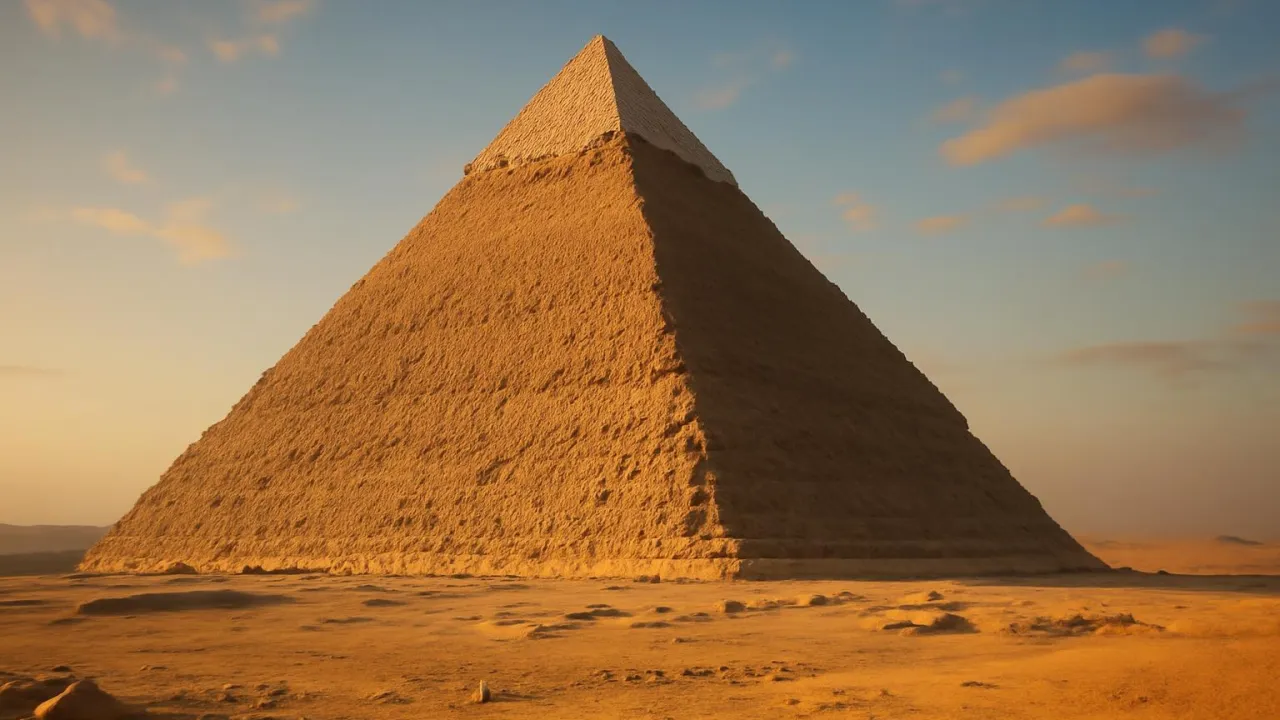
Each limestone block can weigh as much as an elephant!
✨ Word Sparks (Grade 2 Glossary)
Tap 🔊 to hear
limestone
A type of pale, hard rock
ramp
A sloped path for moving things
king
A ruler of a country or land
🪝
Can you imagine climbing a mountain made of giant stones?
1
Stone Steps to the Sky
The Great Pyramid rises from the sand, shining bright in the sun. It is made from huge blocks stacked high. Long ago, workers built it for an Egyptian .
2
Building a Wonder
People used and tools to move heavy stones. Each block was placed carefully to make the pyramid strong. Visitors today walk around and wonder how it was built.
3
A Place of Mystery
The pyramid has hidden rooms and long tunnels inside. Some people think there are secret treasures buried deep within. Many tourists come to see this amazing wonder every year.
The pyramid’s base is almost exactly level, with less than an inch of difference across 756 feet!
✨ Word Sparks (Grade 3 Glossary)
Tap 🔊 to hear
pharaoh
An ancient Egyptian king
erosion
Wearing away by wind or water
chamber
A special room inside something
🪝
What secrets would you find if you could step inside an ancient stone giant?
1
A Monument of Mystery
The Great Pyramid stands on the Giza Plateau, glowing gold in the desert sun. Its four sides form perfect triangles, meeting at a sharp point on top. Built as a tomb for Khufu, it has amazed people for thousands of years. The pyramid's smooth limestone casing once made it shine brightly.
2
Building with Precision
Workers used levers, ramps, and sledges to move massive limestone blocks. Each block fits tightly, showing the builders' skill and careful planning. The pyramid’s structure uses gravity and balance to stay strong. Its shape helps it resist from wind and sand.
3
Inside the Pyramid
Hidden inside are passageways, , and mysterious shafts. The King's Chamber sits deep inside, built with granite for extra strength. Some believe the pyramid’s design has special meaning or secret codes. Archaeologists use tools to explore its hidden spaces and learn more every year.
4
A Wonder for the World
Millions of people visit the pyramid to see its size and beauty. It is the last standing Ancient Wonder of the World. The pyramid inspires architects and engineers with its design and endurance. Its story connects us to ancient Egypt and the power of human imagination.
1. Why did the builders use granite for some rooms?
2. What helps the pyramid resist wind and sand?
🤯 Mind-Blowing Fact • Grade 4
The pyramid’s sides are aligned almost exactly to true north, south, east, and west.
✨ Word Sparks (Grade 4 Glossary)
Tap 🔊 to hear
alignment
How something lines up with directions
granite
A very hard, strong rock
symbolic
Stands for something important
🪝
If you could travel back in time, how would you help build a monument taller than a football field?
1
Engineering an Ancient Marvel
The Great Pyramid of Giza rises from the desert, its sides once gleaming with polished limestone. Built over 4,500 years ago as a tomb for Pharaoh Khufu, it required the labor of thousands of skilled workers. The pyramid’s base covers more than 13 acres, and its original height reached 481 feet—taller than a 40-story building. Its precise with the cardinal directions demonstrates the Egyptians’ advanced knowledge of astronomy and engineering.
2
How Did They Build It?
Engineers and laborers used ramps, levers, and sledges to move and place over two million limestone and blocks. Each block weighed between 2.5 and 15 tons, and workers organized into teams to speed construction. The pyramid’s core blocks were stacked in layers, while the outer casing stones fit so tightly that even a knife blade could not slide between them. This careful construction allowed the pyramid to withstand centuries of earthquakes and erosion.
3
Inside the Pyramid’s Hidden World
Within the pyramid, a network of passageways leads to burial chambers and mysterious shafts. The King’s Chamber, built from massive blocks, sits at the heart of the structure. Some shafts may have served as air vents or held meaning connected to the stars. Archaeologists use advanced technology, like ground-penetrating radar, to discover new rooms and learn more about ancient Egyptian beliefs.
4
A Legacy That Inspires
The Great Pyramid is the only surviving Ancient Wonder of the World, drawing millions of visitors each year. Its construction influenced architecture and engineering for centuries, inspiring buildings around the globe. The pyramid remains a symbol of ancient Egyptian power, creativity, and scientific achievement. Today, it reminds us that human imagination and teamwork can create wonders that last for ages.
1. How did workers make sure the pyramid was so well aligned?
2. Why do archaeologists use radar inside the pyramid?
🤯 Mind-Blowing Fact • Grade 5
The ratio of the pyramid’s perimeter to its height closely matches the mathematical constant pi (π), revealing ancient Egyptians’ advanced math skills.
✨ Word Sparks (Grade 5 Glossary)
Tap 🔊 to hear
cardinal points
The four main compass directions: north, south, east, and west
corbelled roof
A roof made by overlapping stones to form an arch
muon tomography
A scanning method using cosmic particles to see inside structures
🪝
Imagine standing at the base of a monument so massive, its shadow once stretched across the desert for centuries—how did ancient engineers achieve such a feat?
1
A Monumental Achievement in Stone
The Great Pyramid of Giza, constructed around 2560 BCE for Pharaoh Khufu, is the oldest and only surviving Ancient Wonder of the World. Rising to an original height of 481 feet (146.6 meters) and covering 13 acres, it dominated the Giza Plateau for millennia. Over 2.3 million limestone and granite blocks, each weighing between 2.5 and 15 tons, were meticulously quarried, transported, and set into place. The pyramid’s base measures 756 feet (230 meters) on each side and is almost perfectly level, with less than an inch of variation. Its four sides are oriented with remarkable precision to the , demonstrating the Egyptians’ advanced understanding of geometry and astronomy.
2
Engineering Ingenuity and Labor Organization
To accomplish this colossal project, ancient engineers designed straight and circular ramps, levers, and sledges to move and position the massive stones. Teams of skilled laborers, not enslaved workers as once believed, lived in nearby villages and worked in shifts to complete the pyramid over approximately 20 years. The outer casing of polished Tura limestone reflected sunlight, making the pyramid shine like a beacon across the desert. The interlocking stones and inward-leaning walls provided stability, allowing the structure to withstand earthquakes and erosion for thousands of years. The use of copper tools, wooden sledges, and water to reduce friction exemplifies early engineering innovation.
3
Complex Interior and Symbolic Design
Inside, the pyramid contains a network of passageways, including the Grand Gallery, King's Chamber, and Queen's Chamber, all precisely aligned. The King's Chamber is constructed from enormous granite blocks and features a to distribute weight and prevent collapse. Narrow shafts extend from the chambers, possibly serving as air vents or aligning with specific stars for religious purposes. The pyramid’s dimensions encode mathematical relationships, such as the ratio of its perimeter to its height approximating 2π, hinting at the Egyptians’ mathematical sophistication. Recent discoveries using have revealed hidden voids, suggesting there are still secrets to uncover.
4
Historical Significance and Enduring Influence
The pyramid was part of a vast funerary complex, including temples, smaller pyramids, and the iconic Sphinx. It symbolized the pharaoh’s divine power and the Egyptians’ belief in the afterlife, serving as a model for later monumental architecture. Its construction techniques influenced civilizations across the Mediterranean and beyond, inspiring countless generations of architects, engineers, and historians. Today, the Great Pyramid is a UNESCO World Heritage site and a symbol of ancient ingenuity, attracting millions of visitors and researchers from around the world.
5
Modern Exploration and Preservation
Contemporary archaeologists use advanced technologies such as 3D scanning, ground-penetrating radar, and muon imaging to map the pyramid’s internal structure without causing damage. Preservation efforts focus on protecting the limestone blocks from pollution, tourism, and natural weathering, ensuring the pyramid’s survival for future generations. The Great Pyramid continues to spark debates about ancient construction methods, labor organization, and the mathematical knowledge of its builders. Its enduring presence challenges us to imagine what humanity can accomplish through creativity, collaboration, and scientific inquiry. As we continue to unlock its mysteries, the Great Pyramid stands as a testament to the enduring power of human achievement.