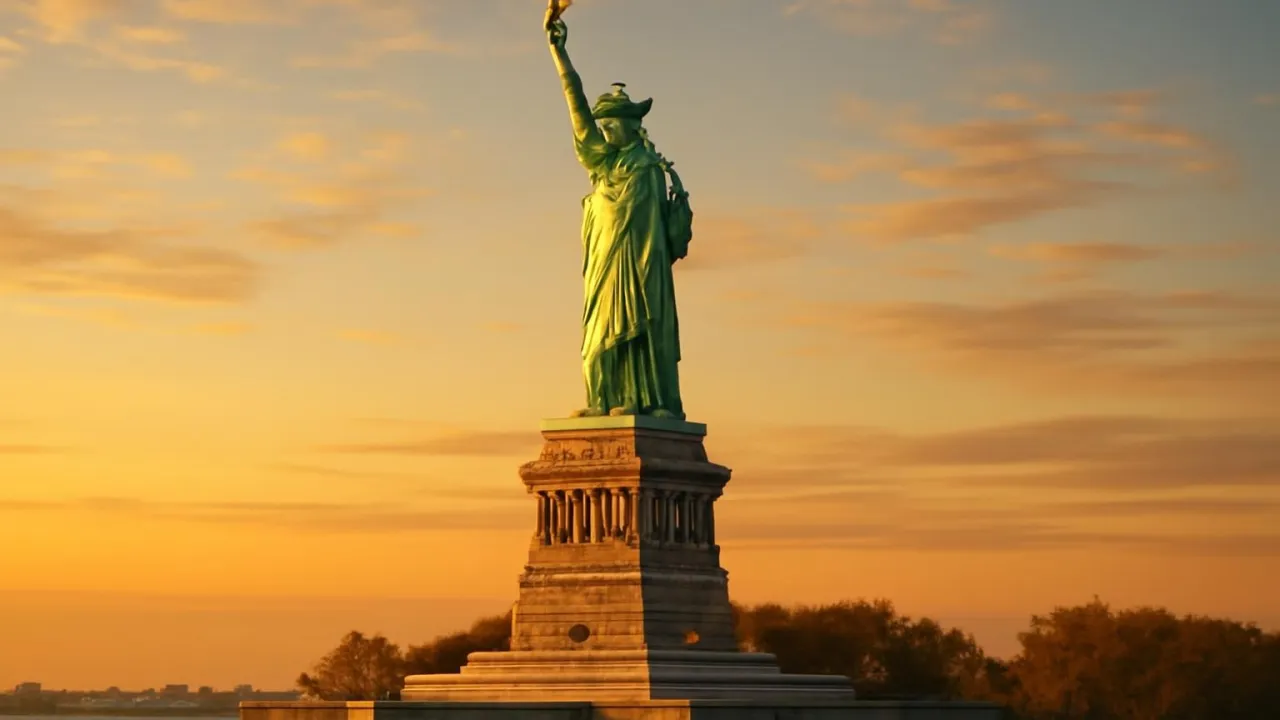
The Statue of Liberty came from France as a special . She crossed the ocean in big pieces and was rebuilt in New York. People cheered when she was finished.
2
A Tall Green Lady
She is taller than most buildings and stands on her own . Her green color comes from turning green over time. She holds a torch that shines for all to see.
3
Climbing to the Top
Visitors can climb up inside her and look out from her crown. The stairs are long and twisty, but the view is amazing. You can see the city and the water all around.
Her full name is 'Liberty Enlightening the World.'
✨ Word Sparks (Grade 3 Glossary)
Tap 🔊 to hear
patina
A green layer on old copper
framework
A strong inside structure
immigrants
People who move to a new country
🪝
What secrets would you find inside a giant copper statue?
1
A Symbol of Freedom
When ships enter New York Harbor, they see the Statue of Liberty first. She was given by France to celebrate freedom and friendship between countries. Her torch symbolizes hope shining for everyone. Many saw her as their first welcome to America.
2
How She Was Built
The statue was built in France, then taken apart and shipped across the Atlantic Ocean. Workers used huge iron beams to support her copper skin. Over time, the copper reacted with air, causing a green to form. This patina protects her from wind and rain.
3
Climbing to the Crown
Inside, a spiral staircase winds up to her crown. Visitors must climb 354 steps to reach the top. Through the crown’s windows, you can see the city and harbor below. The statue’s strong skeleton keeps her standing tall in storms.
4
Amazing Engineering
The Statue of Liberty uses an iron for strength and flexibility. Gustave Eiffel, who designed the Eiffel Tower, helped create her inner skeleton. The statue’s copper skin is hammered into thin sheets and shaped to fit. This engineering lets her withstand strong winds and salty sea air.
1. Who helped design the statue’s inside skeleton?
2. What protects the statue from rain and wind?
🤯 Mind-Blowing Fact • Grade 4
Her torch was once used as a lighthouse, shining light for ships at night.
✨ Word Sparks (Grade 4 Glossary)
Tap 🔊 to hear
corrosion
When metal slowly breaks down
resonance
Vibrations that can shake things apart
monument
A famous structure that honors something
🪝
How did engineers make a giant copper statue stand through storms and centuries?
1
A Beacon of Hope and Freedom
For millions of immigrants arriving by ship, the Statue of Liberty was the first sight of America. She was given by France in 1886 to celebrate the end of slavery and the friendship between nations. Her torch represents enlightenment, and the tablet in her hand shows the date of American independence. The statue became a symbol of hope for people seeking new lives.
2
Building a Colossal Monument
French sculptor Frédéric Auguste Bartholdi designed the statue, and Gustave Eiffel engineered her iron skeleton. The copper skin was hammered into shape and attached to the iron frame with flexible metal bars. After being shipped in 350 pieces, workers reassembled her on a pedestal on Liberty Island. The entire project took over 20 years from idea to completion.
3
Engineering Against Nature
The statue’s copper skin is only as thick as two pennies, yet her iron framework gives her strength. Over time, the copper reacted with oxygen and water, creating a green patina that shields her from . Engineers designed her to sway in strong winds and withstand salty sea air, using to prevent damage from vibrations.
4
A Lasting Global Symbol
The Statue of Liberty is recognized worldwide as a to freedom and democracy. She is a UNESCO World Heritage site and a powerful symbol in art, literature, and history. Millions visit each year to climb her stairs and gaze from her crown. Her image inspires people everywhere to value liberty and welcome newcomers.
If you melted her copper skin, it would make 30 million pennies!
✨ Word Sparks (Grade 5 Glossary)
Tap 🔊 to hear
oxidation
When metal changes color from air
armature
A metal frame that holds up shapes
fatigue
When metal gets tired and weak
🪝
What scientific secrets and global stories are hidden in Lady Liberty’s copper skin?
1
A Vision of Liberty for the World
Imagine arriving in New York Harbor after weeks at sea, and the first thing you see is a towering green figure holding a torch high above the water. The Statue of Liberty, officially named 'Liberty Enlightening the World,' was conceived by French sculptor Frédéric Auguste Bartholdi as a gift to the United States, celebrating the abolition of slavery and the enduring ideals of freedom and democracy. Dedicated in 1886, she quickly became a universal symbol for hope, opportunity, and new beginnings, especially for millions of immigrants entering America through Ellis Island.
2
Engineering a Colossal Marvel
Bartholdi designed the statue’s copper exterior to be only 3/32 of an inch thick—about the same as two stacked pennies—while Gustave Eiffel engineered the iron pylon and that support her. The internal framework allows the statue to flex during high winds, using principles of resonance to prevent destructive vibrations. The 151-foot-tall statue stands atop a 154-foot granite pedestal, making the total height from ground to torch an impressive 305 feet. Assembly required riveting 350 copper sheets to the iron skeleton, a feat of 19th-century engineering.
3
The Science of Copper and Patina
The statue’s green color is due to a chemical process called , which forms a patina—a protective layer that shields the copper from corrosion caused by rain, wind, and salty air. This patina, which took about 30 years to develop, is essential for the statue’s longevity, as it prevents further decay of the metal underneath. Engineers monitor the statue for structural vibrations and metal , ensuring that both her copper skin and iron skeleton remain stable despite harsh weather and millions of visitors each year.
4
A Lighthouse and a Global Icon
From 1886 to 1902, the Statue of Liberty’s torch actually served as a working lighthouse, with electric lights visible for 24 miles across the harbor. Over time, her image has appeared on coins, stamps, and in countless works of art, literature, and film. As a UNESCO World Heritage site, she is protected for future generations, representing not only American ideals but also the universal human quest for freedom and dignity. Her presence has inspired movements for civil rights and democracy around the world.
5
Visiting and Preserving Lady Liberty
Today, visitors can take a ferry to Liberty Island, explore the museum, and climb 354 narrow steps to the crown for breathtaking views of New York City and the harbor. Preservation efforts include regular inspections, restoration of her torch and flame, and advanced monitoring systems to detect structural changes. The statue’s design and construction continue to be studied by engineers and historians as a masterpiece of both art and science. Lady Liberty stands as a reminder that freedom, like her torch, must be protected and passed on to future generations.