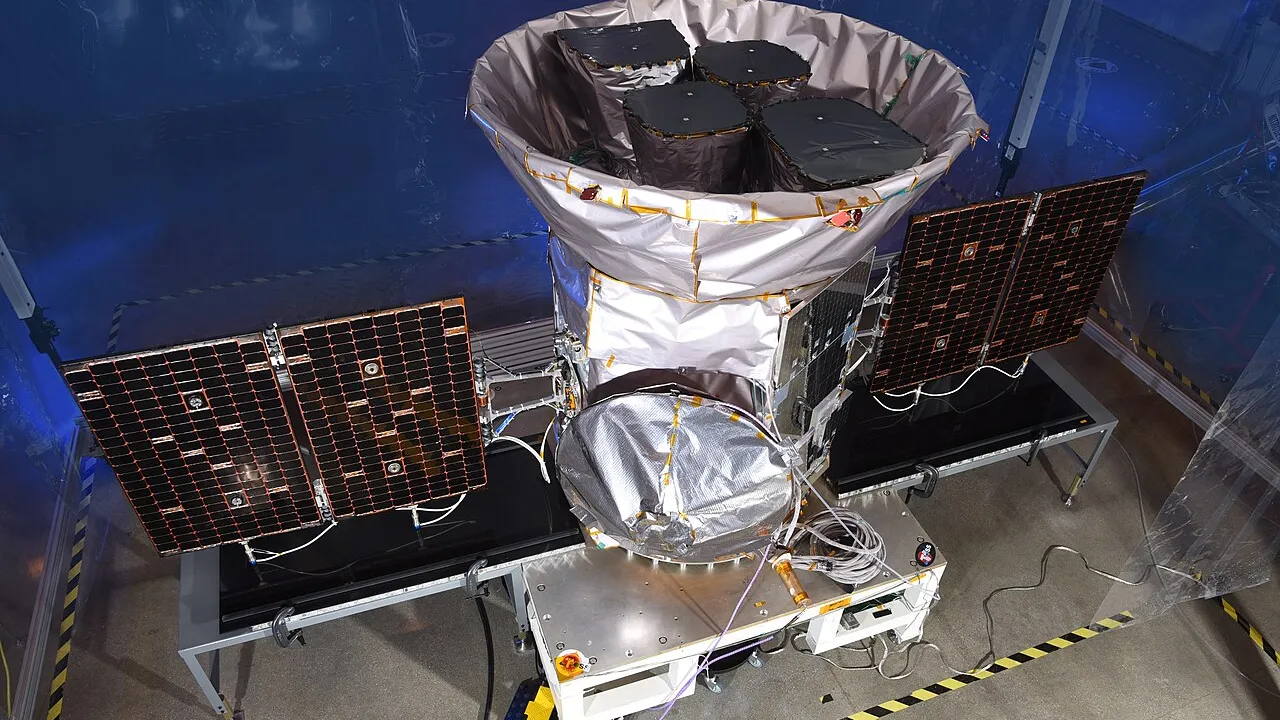
1. How many wide-angle cameras does TESS carry to watch the stars?
2. Which stars does TESS love to watch the most?
🤯 Mind-Blowing Fact • Grade 2
TESS loops around Earth in a special stretched-out orbit that stays perfectly balanced with the Moon's gravity!
✨ Word Sparks (Grade 2 Glossary)
Tap 🔊 to hear
sector
one measured slice of the sky
survey
a careful look across a wide area
atmosphere
the blanket of gases around a planet
🪝
How do you map planets across almost the entire night sky using a spacecraft the size of a refrigerator?
1
Slicing Up the Starry Sky
Imagine peeling an orange in neat long strips from top to bottom! Launched in 2018, NASA's TESS Exoplanet Hunter divides the sky into giant strips called . Its four wide cameras stare at each sector for twenty-seven days before turning to the next.
2
Bright Stars Close to Home
Earlier planet hunters stared deep into one narrow patch of space. Instead, TESS scans eighty-five percent of the whole sky! It watches bright stars that are thirty to three hundred light-years from Earth.
3
Teamwork with Giant Telescopes
When TESS spots a planet dimming a nearby star, it alerts bigger observatories like the James Webb Space Telescope to check that planet's air for water and gases.
1. How long does TESS stare at one sky sector before rotating to the next strip?
2. Why is it helpful that TESS finds planets around bright, nearby stars?
🤯 Mind-Blowing Fact • Grade 3
In 2020, TESS discovered TOI 700 d, its very first Earth-sized planet orbiting inside a nearby star's habitable zone just 100 light-years away!
✨ Word Sparks (Grade 3 Glossary)
Tap 🔊 to hear
elliptical
shaped like a stretched-out oval loop
resonance
a matching rhythm between two orbits
wide-field
able to view a huge area
🪝
Why did NASA build an all-sky scout after Kepler had already discovered thousands of exoplanets?
1
Passing the Planet-Hunting Torch
Picture standing in a dark field and sweeping a wide lantern across every treetop instead of shining a narrow beam at one branch. While the older Kepler telescope stared deep into one small patch of distant stars, the Transiting Exoplanet Survey Satellite—nicknamed TESS—was built to scan nearly the entire sky.
2
Four Cameras, Huge View
Launched aboard a Falcon 9 rocket in April 2018, TESS carries four custom cameras. Stacked together, their lenses capture a ribbon of sky stretching from the celestial pole all the way to the ecliptic plane. Over two years, TESS stitched twenty-six sectors into a breathtaking all-sky map.
3
Dancing with the Moon
Engineers placed TESS into a clever 13.7-day orbit. Every time the Moon circles Earth once, TESS circles Earth exactly twice! This lunar keeps the satellite stable for decades using almost no rocket fuel.
4
Targets for Atmosphere Detectives
Because TESS targets stars thirty to one hundred times brighter than Kepler's stars, follow-up telescopes can measure the mass and atmospheric gases of the rocky worlds TESS uncovers.
1. How does TESS's orbit match up with the Moon's orbit around Earth?
2. How do the stars TESS studies compare with the stars Kepler studied?
🤯 Mind-Blowing Fact • Grade 4
Besides exoplanets, TESS's continuous wide-angle movies accidentally catch exploding supernovae, flaring stars, and even comets outbursting in our own solar system!
✨ Word Sparks (Grade 4 Glossary)
Tap 🔊 to hear
red dwarf
a small, cool, long-lived reddish star
perigee
the closest point in an Earth orbit
spectroscopy
splitting starlight to identify chemical gases
🪝
How does an 800-pound spacecraft use the Moon's gravity to beam home gigabytes of planet-hunting data every two weeks?
1
An All-Sky Cosmic Scout
Imagine trying to read the license plates of cars parked three miles away versus cars parked right down your street. Distant exoplanets are thrilling to count, yet nearby exoplanets are bright enough to dissect in detail! Designed by MIT and NASA, the TESS Exoplanet Hunter launched in 2018 to catalog transiting worlds orbiting the nearest, brightest stars—especially cool stars known as M-dwarfs.
2
The Ingenious P/2 Orbit
Never before had a science spacecraft flown in a 2:1 lunar-resonant High Earth Orbit, called P/2. At its farthest point (apogee), TESS swings 233,000 miles away—nearly to the Moon's distance—keeping clear of Earth's damaging radiation belts and blinding glare. Every 13.7 days, it swoops inward to 67,000 miles (), beaming three hours of crisp starlight recordings straight down to NASA's Deep Space Network antennas.
3
Catching Fast-Orbiting Worlds
Each of TESS's four f/1.4 lenses projects a 24-by-24-degree patch onto a 16.8-megapixel detector, creating a combined 24-by-96-degree strip. Because cool are smaller and dimmer than our Sun, their habitable zones hug close to the star, meaning potentially temperate rocky planets complete a full year in just a few weeks—short enough for TESS to catch multiple transits within a single 27-day sector!
4
Feeding Webb and Ground Giants
With hundreds of confirmed worlds and over 7,000 TESS Objects of Interest cataloged, TESS serves as the premier finder-scope for missions searching alien skies for water vapor, carbon dioxide, and methane.
1. What happens every 13.7 days when TESS swings down to perigee (its closest point to Earth)?
2. Why can TESS easily spot habitable-zone planets around cool red dwarf stars during a 27-day watch?
🤯 Mind-Blowing Fact • Grade 5
TESS caught the exact moment a distant supermassive black hole shredded a wandering star in a 'tidal disruption event' 375 million light-years away!
✨ Word Sparks (Grade 5 Glossary)
Tap 🔊 to hear
radial velocity
a star's slight wobble from planet gravity
bulk density
mass divided by volume showing planet composition
ecliptic pole
sky point perpendicular to Earth's orbit
🪝
Why did astrophysicists design four tiny 10.5-centimeter lenses to succeed space telescopes ten times wider?
1
Wide-Angle Optics over Raw Aperture
At first glance, the optical apertures aboard the Transiting Exoplanet Survey Satellite look astonishingly modest—each of its four custom seven-element lenses measures just 10.5 centimeters (4.1 inches) across! Yet in survey astronomy, field of view matters just as much as mirror diameter. Engineered at MIT's Lincoln Laboratory, TESS's four red-optical CCD cameras image a sweeping 2,300-square-degree swath simultaneously—more than twenty times the sky area monitored by the Kepler Space Telescope.
2
Celestial Mechanics of the P/2 Resonance
Following its April 2018 Falcon 9 launch and a precision lunar gravity-assist flyby, TESS settled into an unprecedented 13.7-day High Earth Orbit tilted roughly 40 degrees from the lunar plane. Because the Moon's gravitational tugs average out symmetrically across this 2:1 orbital resonance, TESS maintains thermal stability near minus 75 degrees Celsius for its low-noise detectors without expending thruster propellant, while orbiting safely above the Van Allen radiation belts.
3
Bridging Transits and Radial Velocity
By concentrating on G, K, and M-type stars brighter than apparent magnitude 12 within 300 light-years, TESS enables two essential follow-up techniques. First, ground-based spectrographs measure the star's subtle gravitational wobble—its —yielding the planet's true mass to pair with TESS's transit radius and calculate : solid iron-rock versus puffy hydrogen envelope. Second, space observatories like JWST perform transmission spectroscopy as starlight filters through the planet's upper atmosphere.
4
Polar Overlap and Extended Missions
Where TESS's 24-by-96-degree sectors converge at the north and south , observation windows overlap for up to 351 continuous days—right inside JWST's own continuous viewing zones.
5
An Expanding Neighborhood Atlas
Now thriving in extended missions with faster frame rates down to twenty seconds, TESS has uncovered multi-planet gems like the nearby rocky pair around HD 260655, mapping humanity's cosmic doorstep for generations to come.
1. When astronomers combine a planet's transit radius from TESS with its radial-velocity mass from ground telescopes, what key property do they calculate?
2. Why are the north and south ecliptic poles extra-valuable patches of sky in TESS's survey design?