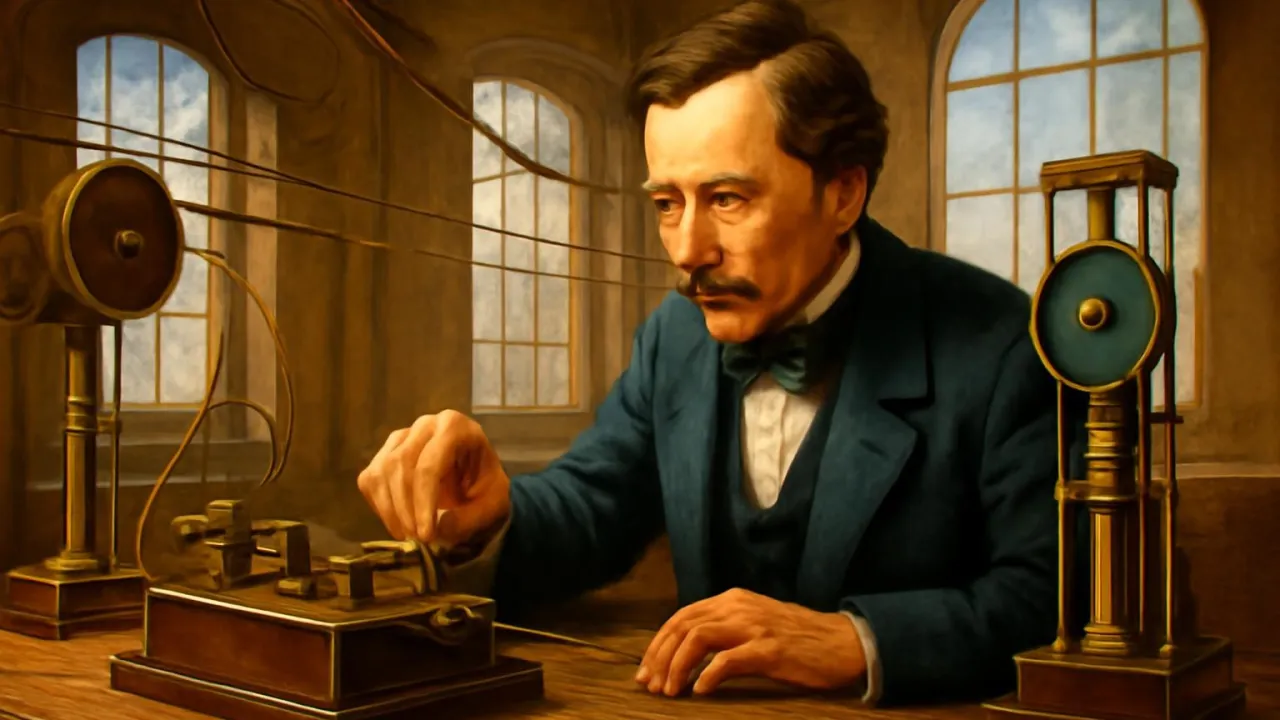
Some telegraph wires stretched all the way across the ocean!
✨ Word Sparks (Grade 2 Glossary)
Tap 🔊 to hear
message
A note sent to someone
code
A secret way to write words
electric
Using power from electricity
🪝
What if you could send a secret message across the country?
1
Tapping Out a Message
A person pushes a small metal key up and down. Each push makes a click or a clack sound. The sounds travel along wires to another city.
2
How Morse Code Works
Short clicks are called dots, and long clicks are called dashes. People use dots and dashes to spell out words. This special is called Morse code.
3
Changing the World
Before the telegraph, took days to travel. With the telegraph, people could talk to each other in seconds. It helped families and businesses stay connected.
The first telegraph line in the U.S. ran from Washington, D.C. to Baltimore, Maryland.
✨ Word Sparks (Grade 3 Glossary)
Tap 🔊 to hear
vibration
A fast shake or movement
pulse
A quick burst of energy
operator
A person who runs a machine
🪝
Can you imagine hearing a message travel through a wire, faster than any horse?
1
The Magic of Tapping Wires
In the 1800s, people tapped a telegraph key to send electric signals. Each tap made the wire vibrate with energy. The signals traveled quickly, carrying information far away. It was like magic compared to slow mail.
2
Cracking the Morse Code
Samuel Morse invented a code using dots and dashes for each letter. The code used short for dots and longer ones for dashes. listened to the clicks and wrote down the message. This system was called Morse code.
3
How the Telegraph Worked
The telegraph used a battery to create electric . When the key was pressed, the circuit closed and sent a pulse down the wire. At the other end, a sounder clicked for each pulse, making the message audible. This allowed people to communicate across great distances.
4
Changing Communication Forever
Before the telegraph, news traveled by horse or train, taking days or weeks. The telegraph sent news in minutes, connecting cities and countries. It helped businesses, newspapers, and even presidents share information quickly. The world felt smaller and more connected than ever before.
1. What did operators listen for in the telegraph?
2. Why was the telegraph faster than mail?
🤯 Mind-Blowing Fact • Grade 4
In 1912, Morse code helped save lives during the Titanic disaster by sending SOS signals.
✨ Word Sparks (Grade 4 Glossary)
Tap 🔊 to hear
prototype
A first try at a new invention
circuit
A path for electricity to flow
transatlantic
Across the Atlantic Ocean
🪝
What would it feel like to send a message that races across continents in a flash?
1
The Birth of Electric Communication
In the 1830s, inventors like Samuel Morse and Alfred Vail experimented with sending signals through wires using electricity. They built a telegraph that could transmit electric pulses over long distances. Each press of the telegraph key completed an electric , sending a current through the wire. The faraway sounder would then click, turning electrical energy into sound.
2
The Language of Dots and Dashes
Morse code assigned every letter and number a unique pattern of dots (short signals) and dashes (long signals). Operators learned to translate spoken words into these patterns, tapping them out on the key. At the receiving end, another operator wrote down the message by listening to the rhythm of clicks. This system made it possible to send complex messages quickly and accurately.
3
How the Telegraph Changed the World
Before the telegraph, messages could only travel as fast as a horse or ship. The telegraph allowed information to cross countries and oceans in mere minutes. It revolutionized news reporting, business deals, and even emergency rescue efforts. The first cable in 1858 connected North America and Europe, shrinking the world for everyone.
4
A Lasting Impact on Communication
The telegraph was the first invention to use electricity for instant long-distance communication. It inspired later inventions like the telephone and the internet. Even today, Morse code is still used by radio operators and in emergencies. The telegraph showed humanity how to connect through science and technology.
2. Why was Morse code important for the telegraph?
🤯 Mind-Blowing Fact • Grade 5
The 1866 transatlantic telegraph cable could send eight words per minute—faster than any ship could travel!
✨ Word Sparks (Grade 5 Glossary)
Tap 🔊 to hear
resonance
A sound that vibrates and gets louder
relay
A station that boosts a signal farther
insulation
A layer that keeps electricity inside wires
🪝
What if a simple tap on a metal key could send your words across an entire ocean in seconds?
1
Inventing the Age of Instant Communication
In 1837, Samuel Morse and Alfred Vail developed the first practical electric telegraph system, forever changing how people shared information. Their invention used a battery-powered circuit and a mechanical key to send electric pulses along insulated copper wires. Each pulse traveled at nearly the speed of light, making it possible to transmit messages much faster than any previous method. By 1844, the first public telegraph line connected Washington, D.C. and Baltimore, launching a communication revolution. Within decades, telegraph networks spanned entire continents and oceans.
2
Engineering Morse Code: The Language of Electricity
Morse code, invented by Morse and Vail, assigned every letter and number a unique sequence of dots (short pulses) and dashes (long pulses). Operators converted spoken language into these patterns by pressing the telegraph key for different lengths of time. The receiving sounder clicked for each pulse, and trained operators decoded the rhythm into words and sentences. This system relied on acoustic , as the metal sounder amplified the clicks for clear listening even in noisy telegraph offices. Morse code's simplicity and efficiency made it ideal for global communication.
3
Telegraphy’s Physics: Circuits, Conductors, and Signal Loss
The telegraph system worked by completing an electrical circuit whenever the key was pressed, allowing current to flow through long copper wires. The metal wires acted as conductors, efficiently carrying the electric signal over great distances, but signal strength weakened with length due to resistance and electromagnetic interference. Engineers solved this by adding stations, which amplified the signal and extended the network’s reach. Undersea cables, insulated with gutta-percha rubber, allowed messages to cross oceans without short-circuiting or eroding in saltwater.
4
The Global Impact of Telegraphy
The telegraph transformed business, government, and journalism by enabling real-time communication across continents and oceans. Stock markets, railroads, and newspapers relied on telegraphy to share information instantly, making economies more efficient and societies more connected. The first successful transatlantic cable in 1866 made it possible to send messages between North America and Europe in minutes instead of weeks. The telegraph also played a critical role in emergencies, such as sending the Titanic’s SOS in Morse code, saving many lives.
5
Legacy: From Telegraph to Digital Networks
Although the telegraph was eventually replaced by the telephone, radio, and the internet, its legacy endures in modern digital communication. Morse code is still used in aviation, maritime navigation, and by amateur radio operators for its simplicity and reliability. The telegraph’s principles of encoding, transmitting, and decoding information laid the groundwork for all electronic communication systems. By shrinking the world with wires and code, the telegraph showed how innovation could connect humanity in ways never imagined before.