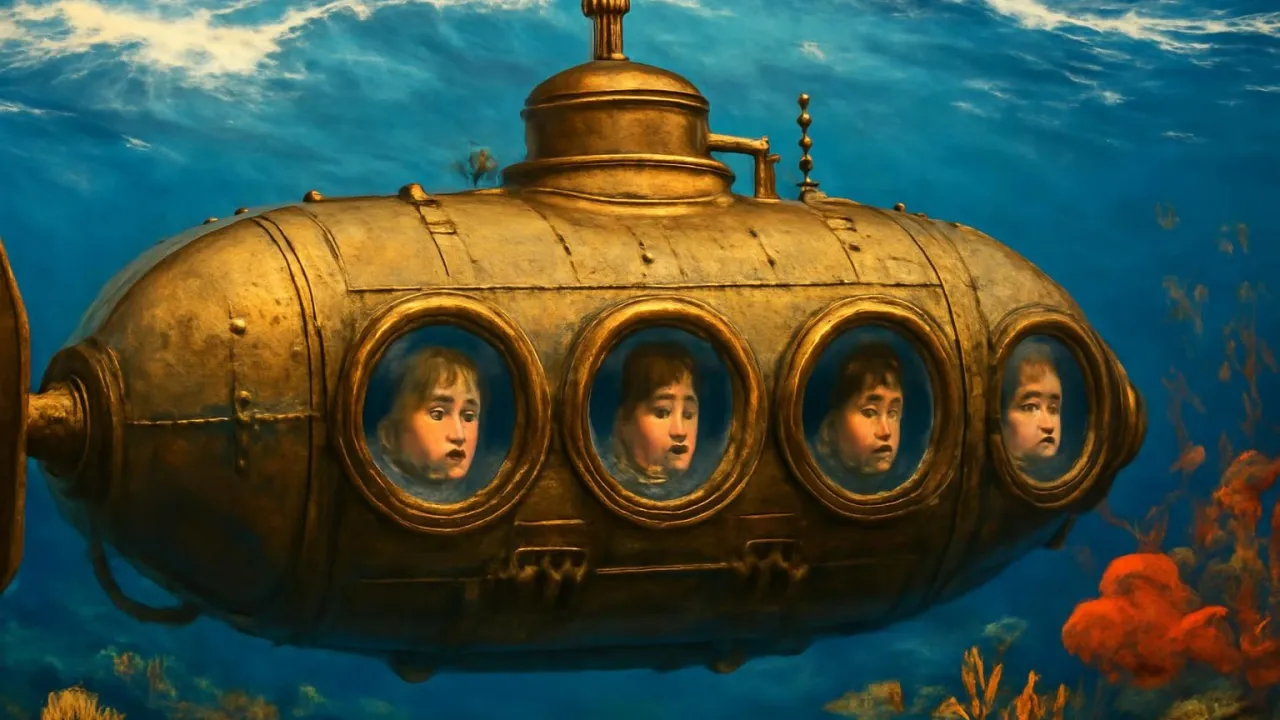
Have you ever wondered what it’s like under the sea?
1
Underwater Adventure
Submarines let people travel deep underwater, like secret ocean . They have strong metal shells and windows to look out. Passengers can see fish and sea plants swimming by.
2
How Does It Work?
Submarines sink by filling tanks with water, then rise by letting water out. They move quietly so they do not scare sea animals. Some submarines even have robotic arms to grab things.
3
Why Are Submarines Special?
Submarines help scientists study the ocean and find new creatures. They can stay underwater for many days without coming up. People use them for research, rescue, and fun trips.
Some submarines can dive deeper than Mount Everest is tall!
✨ Word Sparks (Grade 3 Glossary)
Tap 🔊 to hear
ballast tanks
Tanks that help subs sink or float
pressure
The push from water all around
sonar
Sound waves used to find things underwater
🪝
Can you imagine hearing only bubbles as you travel deep below the waves?
1
A Secret World Below
Submarines glide through the ocean, letting people explore places sunlight cannot reach. Their strong hulls protect everyone from the crushing water . Inside, passengers can watch strange fish and glowing creatures through thick windows. The silence is broken only by the soft hum of engines and the sound of bubbles.
2
How Submarines Dive and Surface
Submarines use to control their depth in the water. When the tanks fill with water, the submarine becomes heavier and sinks. To rise, the water is pushed out and replaced with air, making the vessel lighter. This clever design lets submarines move up and down smoothly.
3
Inventors and Early Designs
The first working submarine was built by Cornelis Drebbel in the early 1600s. His invention used oars and a leather-covered wooden frame for underwater travel. Later inventors improved submarines with stronger materials, engines, and periscopes. Each prototype brought new ways to explore the ocean’s mysteries.
4
Submarines in Science and Discovery
Modern submarines help scientists study deep-sea life and underwater volcanoes. They use , which sends out sound vibrations to map the ocean floor. Submarines also rescue lost objects and help researchers learn about shipwrecks. Their acoustic technology is important for ocean exploration.
1. What protects people from water pressure in a submarine?
2. What does sonar help submarines do?
🤯 Mind-Blowing Fact • Grade 4
The deepest-diving submarine, the Trieste, reached nearly 36,000 feet below the surface!
✨ Word Sparks (Grade 4 Glossary)
Tap 🔊 to hear
buoyancy
The force that helps things float
navigation
Finding your way from place to place
prototype
The very first model of something
🪝
What secrets might you discover if you could travel silently beneath the waves?
1
Exploring the Deepest Oceans
Submarines open up a hidden world, allowing people to travel where sunlight cannot reach and water pressure is enormous. Their hulls are engineered from thick metal to withstand the crushing forces found deep underwater. Inside, scientists and explorers use bright lights and observation windows to study rare sea creatures and undersea landscapes. The experience is both mysterious and thrilling, surrounded by darkness and the gentle hum of machinery.
2
The Science of Sinking and Floating
A submarine’s ability to dive and surface relies on the physics of and ballast. Ballast tanks are filled with water to make the vessel heavier and sink, or emptied and filled with air to help it rise. The precise control of these tanks allows submarines to hover at any depth, making them perfect for scientific research or rescue missions. This process uses valves, pumps, and careful engineering to keep everyone safe.
3
From Drebbel to Deep-Sea Titans
Cornelis Drebbel’s early 17th-century was powered by oars and covered in greased leather, but it inspired centuries of innovation. Later designs added steam engines, electric motors, and periscopes for . Today’s submarines use advanced sonar and navigation systems, allowing them to travel thousands of feet below the surface. Each new invention has helped humans understand more about the mysterious ocean world.
4
Submarines’ Global Impact
Submarines have revolutionized ocean science, enabling discoveries of new species, underwater mountains, and shipwrecks. They play a vital role in protecting marine environments by monitoring pollution and tracking sea life. Submarines are also used for rescue operations and to repair underwater cables that connect the world’s internet. Their global impact continues to grow as technology advances.
Nuclear-powered submarines can travel over 80,000 kilometers underwater without resurfacing for months at a time!
✨ Word Sparks (Grade 5 Glossary)
Tap 🔊 to hear
Archimedes’ principle
A science rule about floating in water
sonar
A system that uses sound to find things underwater
autonomous
Able to work or move by itself
🪝
Imagine the silence as you descend into the inky blackness, surrounded by crushing pressure—what would you discover?
1
Engineering Marvels Below the Surface
Submarines are extraordinary vessels engineered to travel deep beneath the ocean, where sunlight fades and water pressure becomes extreme. Their pressure-resistant hulls are typically constructed from high-strength steel or titanium, designed to withstand forces exceeding 1,000 times atmospheric pressure. These hulls are shaped in a cylindrical form to distribute stress evenly, preventing collapse as the submarine descends to great depths. Inside, life-support systems recycle air and remove carbon dioxide, allowing crews to remain submerged for months. The experience is both awe-inspiring and scientifically vital, as these vessels reveal the ocean’s hidden wonders.
2
The Physics of Buoyancy and Ballast Control
A submarine’s ability to sink, rise, and maintain a specific depth depends on precise manipulation of buoyancy using ballast tanks. By filling these tanks with seawater, the submarine increases its density and sinks; by pumping the water out and replacing it with compressed air, it becomes lighter and rises. This process is governed by of buoyancy, which states that an object immersed in a fluid is buoyed up by a force equal to the weight of the fluid displaced. Sophisticated valves, pumps, and sensors allow modern submarines to hover at any depth with remarkable stability. This engineering enables scientific missions, stealth operations, and underwater rescue.
3
A History of Innovation and Exploration
The concept of underwater travel began with Cornelis Drebbel’s wooden and leather-covered submersible in the early 1600s, which used oars for propulsion. In the 19th and 20th centuries, inventors introduced steam engines, electric batteries, and diesel-electric propulsion, dramatically increasing range and reliability. The introduction of the periscope allowed submariners to see above the surface while remaining hidden. By the mid-20th century, nuclear-powered submarines could travel around the world underwater without surfacing, transforming naval exploration and scientific research. Each technological leap made the ocean’s depths more accessible.
4
Modern Submarines: Science, Safety, and Global Impact
Today’s submarines are equipped with advanced systems, robotic arms, and high-definition cameras, enabling detailed exploration of the ocean floor. Research submarines have discovered hydrothermal vents, new species, and sunken ships, expanding our understanding of Earth’s last frontier. Submarines also play a crucial role in environmental monitoring, tracking pollution, and maintaining global communications by repairing undersea cables. Their ability to operate in hazardous environments makes them essential for rescue missions and disaster response. The global impact of submarines extends from scientific discovery to international security.
5
The Future of Submarine Technology
Engineers are developing new materials like carbon composites and ceramics to create lighter, stronger submarine hulls for even deeper dives. underwater vehicles (AUVs) and remotely operated vehicles (ROVs) are revolutionizing deep-sea exploration, allowing scientists to reach places too dangerous for humans. Future submarines may use renewable energy sources or advanced battery technology to reduce environmental impact. As technology advances, submarines will continue to unlock the mysteries of the deep ocean, revealing new knowledge about our planet and its hidden ecosystems. The journey beneath the waves is only just beginning.