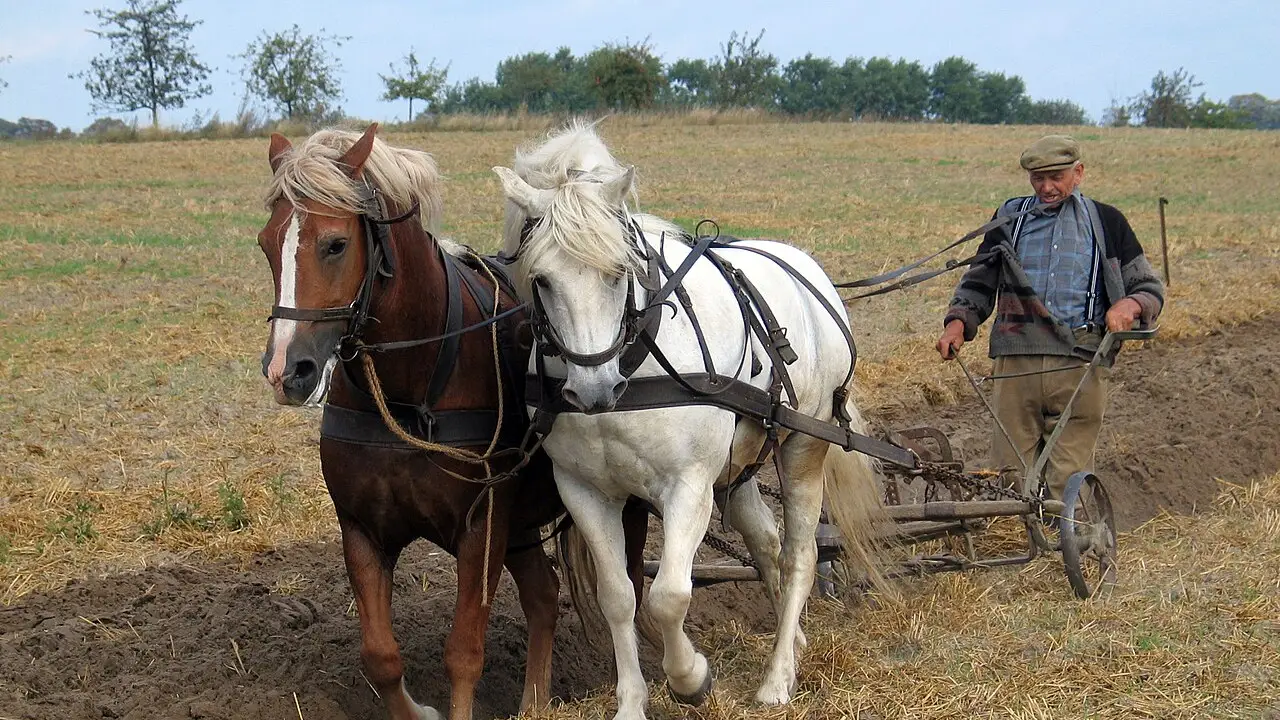
John Deere made the first steel plow from a broken saw blade!
✨ Word Sparks (Grade 2 Glossary)
Tap 🔊 to hear
soil
The dirt plants grow in
invent
To make something new
prairie
A flat, grassy land
🪝
Have you ever heard metal slice deep into the ground?
1
A New Way to Dig
The steel plow had a shiny, sharp blade that did not break. Farmers used it to dig up tough dirt, and it made their work much faster.
2
Why Steel Was Special
Before steel, plows were made of wood or iron, which often stuck in the . The steel blade slid smoothly, so it did not get clogged or slow farmers down.
3
Changing the Land
The steel plow helped farmers plant more seeds and grow more food. Soon, many people moved west to farm new land with this amazing tool.
John Deere's first steel plow sold for only $10 in 1837.
✨ Word Sparks (Grade 3 Glossary)
Tap 🔊 to hear
sod
Thick grass and roots in soil
blade
The sharp part that cuts dirt
inventor
A person who creates something new
🪝
Can you imagine a tool that could slice through the toughest earth like a knife through butter?
1
A Prairie Problem
Long ago, farmers struggled to plow the thick, grassy soil of the American Midwest. Their wooden or iron plows would get stuck or break in the tough prairie . The land needed a new kind of tool to help farmers grow crops.
2
A Shiny Solution
In 1837, blacksmith John Deere invented a plow with a smooth, curved steel . Steel was much stronger and slicker than iron, so the blade could cut through soil without clogging. The blade's design let it glide through dirt, turning it over easily.
3
How It Works
The steel plow uses a sharp, polished to slice into the ground. As the plow moves, the blade lifts and flips the soil, making rows for seeds. This process is called turning the soil, and it helps air and water reach plant roots.
4
Changing Farming Forever
The steel plow made it possible to farm huge areas of prairie land. Farmers could grow more crops and feed more people than ever before. This invention helped many families move west and start new farms on the open plains.
By 1855, John Deere's factory was making over 10,000 steel plows each year.
✨ Word Sparks (Grade 4 Glossary)
Tap 🔊 to hear
prototype
A first test version of an invention
sod
Thick grass and roots in the ground
turnover
Flipping soil to make it better
🪝
What if a single invention could unlock millions of acres of wild land for farming?
1
The Prairie Challenge
Before 1837, American farmers struggled to plow the thick, root-filled prairie soil of the Midwest. Wooden and cast iron plows would break or get clogged with sticky , making farming slow and exhausting. Settlers needed a new tool that could handle the tough ground and help them plant crops efficiently.
2
John Deere's Brilliant Idea
John Deere, a blacksmith in Illinois, noticed that polished steel tools slid easily through sticky soil. He designed a plow with a curved, highly polished steel blade that could slice through prairie without collecting dirt. Deere's was a breakthrough, and soon, farmers across the region wanted his strong, efficient plow.
3
Engineering the Steel Plow
The steel plow works by using a sharp, smooth blade to cut and lift the soil in one motion. As the plow is pulled, usually by horses or oxen, the blade's shape rolls the dirt over, burying weeds and old plants. This process, called soil , improves soil health and makes planting easier.
4
A Tool That Changed America
The steel plow made it possible to farm the vast prairies of the Midwest, leading to a boom in agriculture and westward expansion. This invention helped turn the United States into one of the world's top food producers. Today, modern plows still use steel blades, showing how one idea can change history.
1. Why did polished steel work better than iron for plows?
2. How did the steel plow help the United States grow?
🤯 Mind-Blowing Fact • Grade 5
The steel plow’s design helped the United States become the world’s leading grain producer by the late 1800s.
✨ Word Sparks (Grade 5 Glossary)
Tap 🔊 to hear
moldboard
The curved part that flips soil over
friction
How much things rub and slow down
innovation
A new idea that changes things
🪝
Imagine standing on a vast, grassy prairie—how would you break the earth to plant life-giving crops?
1
A Land of Untamed Sod
In the early 1800s, the American Midwest was covered with thick prairie sod, a dense mat of grass roots and tough soil. Traditional wooden and cast-iron plows would stick, break, or require constant cleaning, making large-scale farming nearly impossible. This challenging landscape demanded a new engineering solution to unlock its agricultural potential.
2
John Deere’s Revolutionary Design
In 1837, John Deere, a skilled blacksmith, observed that polished steel tools slid through sticky earth without collecting soil. He crafted a prototype plow from a broken steel saw blade, shaping it into a curved, highly polished . This allowed the blade to cut, lift, and turn over prairie sod in one continuous motion, preventing clogging and reducing the need for constant cleaning.
3
Engineering Principles of the Steel Plow
The steel plow’s efficiency comes from the physical properties of steel and the aerodynamic curvature of the blade. The smooth, hard steel surface reduces , allowing soil to slide off easily, while the curved creates a lifting force that turns the soil over. This process, known as soil turnover or inversion, buries weeds and crop residues, aerates the earth, and prepares ideal seedbeds for planting.
4
Transforming Agriculture and Society
The steel plow’s impact extended far beyond individual farms, transforming the American Midwest into the nation’s breadbasket. By enabling efficient cultivation of millions of acres, it fueled westward migration, increased food production, and supported rapid population growth. The steel plow also inspired further in agricultural machinery, leading to the mechanized farming systems we see today.
5
Legacy and Global Influence
By the 1850s, John Deere’s factory was producing thousands of steel plows annually, and the design quickly spread worldwide. Modern plows still rely on the essential principles of Deere’s invention, using advanced steel alloys and tractor power for even greater efficiency. The steel plow remains a symbol of human ingenuity—demonstrating how a single breakthrough can reshape landscapes, societies, and the future of food.