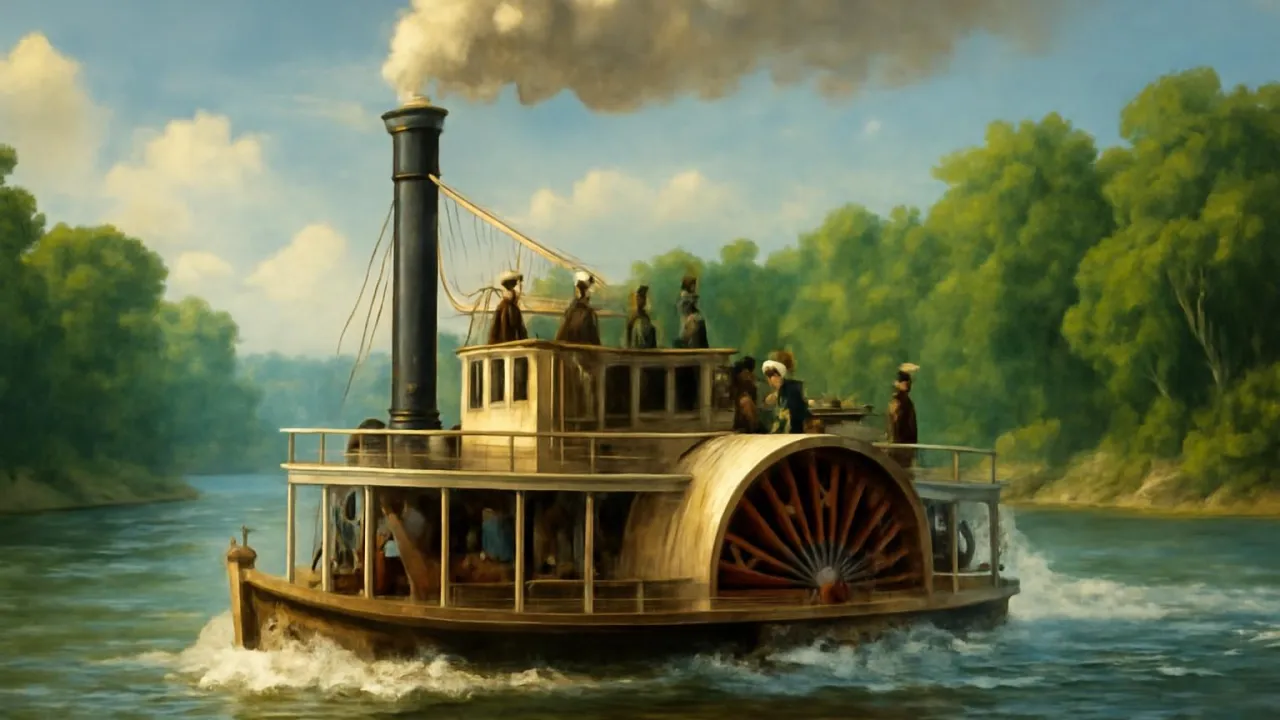
Some steamboats even carried circus animals and whole marching bands!
✨ Word Sparks (Grade 2 Glossary)
Tap 🔊 to hear
engine
Machine that makes things move
current
Water moving in one direction
goods
Things people buy or sell
🪝
What if you could ride a boat powered by hot steam?
1
Puffing Up the River
Steamboats made loud chugging sounds as they moved. Their big paddle wheels splashed water everywhere. People watched white clouds of steam rise high.
2
How Steam Moved the Boat
Hot water turned into steam inside a metal . The steam pushed the paddle wheel to spin and move the boat. Steamboats could travel up rivers, even against strong .
3
Riding and Working on Steamboats
People rode steamboats to visit new places or ship . Some worked on deck, loading and unloading things. Everyone listened for the loud whistle as the boat came close.
The Clermont’s first trip was 150 miles and took only 32 hours—much faster than rowboats or rafts!
✨ Word Sparks (Grade 3 Glossary)
Tap 🔊 to hear
boiler
A tank that heats water into steam
pressure
A force that pushes things forward
cargo
Goods carried by ships or trucks
🪝
Imagine hearing a steamboat’s whistle echo across the wide river—how did it work?
1
Chug, Splash, and Whistle
Steamboats made rivers come alive with chugging engines and splashing paddle wheels. Their tall smokestacks sent white steam clouds into the sky. People gathered on decks to watch the busy river traffic. The loud whistle signaled the boat’s arrival from far away.
2
The Power of Steam
Inside the boat, a fire heated water in a strong . The hot steam created that spun the paddle wheel or turned a propeller. This process is called a steam engine, and it changed how people traveled. Steamboats could go upstream, even against strong river currents.
3
Inventors and Early Journeys
Many inventors tried to build steam-powered boats, but Robert Fulton made the first successful one in 1807. His boat, the Clermont, traveled up the Hudson River in New York. People were amazed it could move without wind or horses. Soon, steamboats carried passengers and all over America’s rivers.
4
Changing Life Along the River
Steamboats helped towns grow along rivers by speeding up trade and travel. Farmers shipped crops faster, and families visited new places. The invention of the steamboat made rivers busy highways for people and goods. Today, you can still see old steamboats in museums or on special river tours.
1. What did the steam engine do inside the steamboat?
2. Why did towns grow along rivers after steamboats?
🤯 Mind-Blowing Fact • Grade 4
Some luxurious steamboats were over 300 feet long and had grand ballrooms with sparkling chandeliers!
✨ Word Sparks (Grade 4 Glossary)
Tap 🔊 to hear
piston
A moving part pushed by steam
merchant
A person who buys and sells goods
innovation
A new idea or invention
🪝
What would it feel like to stand on a 1800s riverbank as a steamboat’s whistle echoed and steam billowed overhead?
1
Steam and Engineering on the Water
A steamboat’s journey began with a roaring fire heating water inside a heavy iron boiler. As the water boiled, it produced high-pressure steam that powered connected to a giant paddle wheel or a propeller. This mechanical energy turned the wheel, pushing the boat forward against the river’s current. The tall smokestack vented steam and smoke, creating the steamboat’s signature look and sound.
2
From Dream to River Highway
While inventors in Europe and America experimented with steam engines, Robert Fulton’s Clermont made history in 1807. Fulton's design proved that steam-powered vessels could carry passengers and cargo reliably up and down rivers. The Clermont’s 150-mile trip up the Hudson River amazed people and inspired new steamboat designs. Soon, hundreds of steamboats crisscrossed American rivers, changing travel forever.
3
Life on Board and Along the Banks
Steamboats became floating towns, with cabins, dining rooms, and even entertainment for travelers. Deckhands, engineers, and pilots worked together to keep the engines running and steer through tricky bends. Towns along the riverbanks grew quickly, as farmers and could ship goods farther and faster than ever before. Steamboats also helped people explore new places and meet others from distant towns.
4
A Lasting Impact on America
Steamboats transformed the United States by making rivers the main highways for people and products. They sped up trade, helped settlers move west, and connected faraway communities. Even after trains and cars became popular, steamboats remained symbols of adventure and progress. Today, preserved steamboats remind us of the power of steam and the inventors who changed history.
1. How did the paddle wheel move the steamboat forward?
2. Why were steamboats important for American towns?
🤯 Mind-Blowing Fact • Grade 5
In the 1800s, the Mississippi River saw over 1,200 steamboats operating at once—making it the busiest waterway in America!
✨ Word Sparks (Grade 5 Glossary)
Tap 🔊 to hear
thermodynamics
The science of heat, energy, and motion
cylinder
A tube where steam pushes a piston
thrust
The force that moves something forward
🪝
What if you could step onto a 19th-century steamboat and watch the mechanics as steam, metal, and water worked together to conquer the river’s current?
1
The Science Behind Steamboat Power
Steamboats operated using the principles of and mechanical engineering. A coal or wood fire heated water inside a robust iron boiler, converting it into high-pressure steam. This steam was channeled into , where it pushed pistons back and forth, converting thermal energy into mechanical motion. The pistons turned a massive paddle wheel or, in later models, a screw propeller, generating to propel the boat forward. The entire process relied on careful control of pressure and temperature to prevent dangerous explosions and maximize efficiency.
2
Fulton’s Clermont and the Age of Steam Navigation
Although steam engines had been experimented with earlier, Robert Fulton’s Clermont was the first commercially successful steamboat. Launched in 1807, it traveled 150 miles up the Hudson River from New York City to Albany in just 32 hours, averaging nearly 5 miles per hour. This achievement demonstrated that steam-powered vessels could reliably travel upstream, overcoming river currents that limited traditional boats. Fulton’s design inspired a wave of innovation, leading to hundreds of steamboats operating on American rivers by the 1830s.
3
Engineering Marvels and Daily Life Aboard
Steamboats were floating engineering marvels, often measuring over 200 feet long and featuring multiple decks for passengers, cargo, and crew. The main deck housed the boiler and engine room, where engineers monitored gauges and maintained the delicate balance of heat and pressure. Passengers enjoyed comfortable cabins, dining halls, and sometimes even live music or ballroom dances. Crew members, such as pilots and deckhands, navigated tricky river bends and kept the vessel running smoothly.
4
Economic and Cultural Impact
The arrival of steamboats revolutionized transportation and commerce in the United States during the 19th century. River towns flourished as farmers and manufacturers could ship goods quickly and reliably to distant markets. Steamboats also played a key role in westward expansion, carrying settlers and supplies deep into the frontier. The technology spread globally, influencing river travel in Europe, Asia, and South America, and helping to shape the modern world’s interconnected economies.
5
Legacy and Modern Reflections
Although railroads and diesel engines eventually replaced most steamboats, their legacy endures in engineering history and popular imagination. Today, restored steamboats operate as museum attractions and river cruise vessels, allowing visitors to experience the sights, sounds, and mechanics of early steam travel. The steamboat’s story highlights the power of innovation, teamwork, and scientific understanding to transform societies and connect people across great distances.