1. How many Merlin engines sit at the bottom of a Falcon 9 booster—matching the number in its name?
2. What happens to the tall first-stage booster after pushing the top stage toward space?
🤯 Mind-Blowing Fact • Grade 2
SpaceX named its ocean landing droneships whimsical titles from science-fiction books, like 'Of Course I Still Love You' and 'Just Read the Instructions'!
✨ Word Sparks (Grade 2 Glossary)
Tap 🔊 to hear
grid fin
Waffle-shaped metal paddle steering falling rocket boosters
touchscreen
Glass computer display controlled by finger taps
stage
Section of a rocket with its own engines
🪝
How do waffle-shaped metal fins steer a fourteen-story rocket falling faster than a speeding bullet?
1
History Made in 2015
For decades, every orbital rocket booster crashed into the ocean after a single three-minute burn. Then on December 21, 2015, SpaceX stunned the world when a fourteen-story Falcon 9 booster roared down out of the night sky and stood upright at Cape Canaveral!
2
Waffle Fins and Hover-Slam
Near the top of the booster, four titanium '' shaped like giant waffle irons tilt against rushing air to steer toward a floating robot ship. Seconds before splashing, the center engine fires hard while four carbon-fiber legs snap open!
3
Crew Dragon Taxis
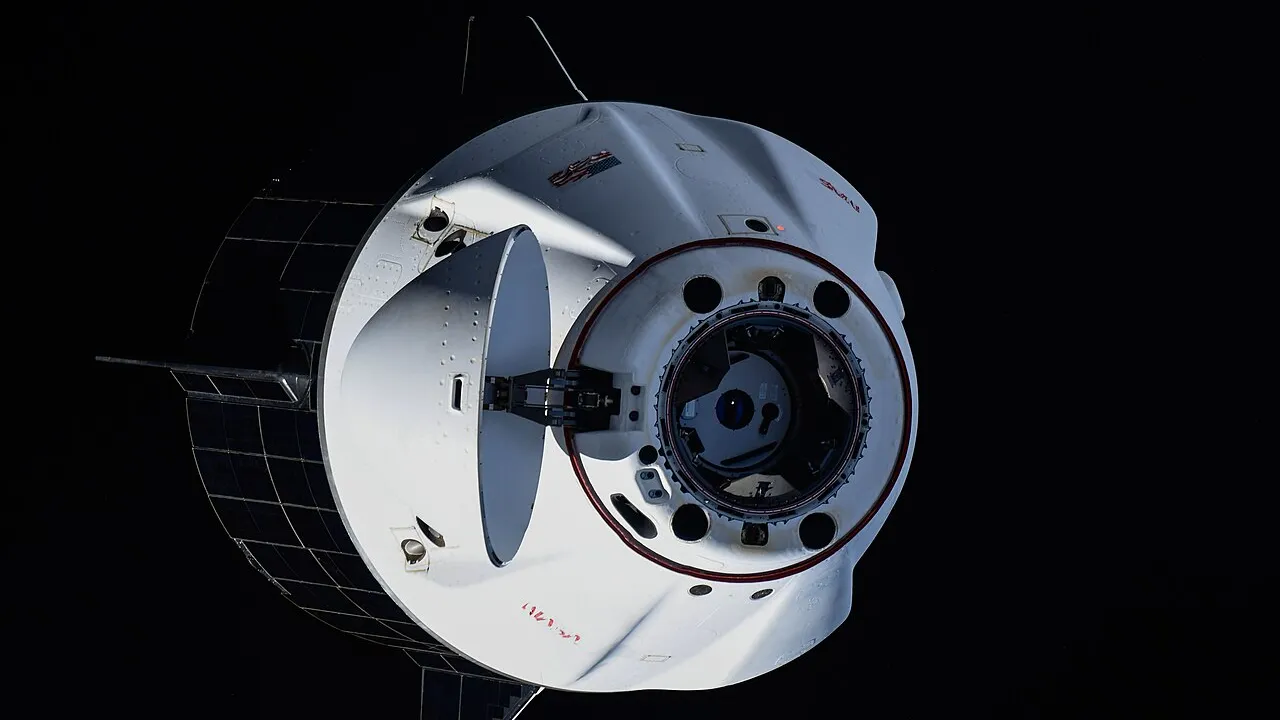
Meanwhile, -equipped Crew Dragon capsules ferry astronauts smoothly to and from the International Space Station.
1. What steers the falling Falcon 9 booster through the atmosphere toward its landing pad?
2. What do astronauts use inside Crew Dragon instead of hundreds of old-fashioned switches?
🤯 Mind-Blowing Fact • Grade 3
Falcon 9's center engine is actually TOO powerful to hover even at its lowest throttle—so the falling rocket must time its landing burn to hit zero speed at the exact split-second its legs touch the deck!
✨ Word Sparks (Grade 3 Glossary)
Tap 🔊 to hear
fairing
Protective two-piece nose cone shielding cargo during launch
kerosene
Refined liquid hydrocarbon fuel burned in jet and rocket engines
throttle
Control adjusting how much thrust an engine produces
🪝
Why is landing an empty fourteen-story rocket like balancing a broomstick upright on your fingertip in a windstorm?
1
Octaweb of Nine Engines
At the base of Falcon 9 sits the 'Octaweb'—eight Merlin engines arranged in a circle around one center engine, burning super-chilled rocket and liquid oxygen. If one engine ever hiccups during climb, onboard computers shut it off cleanly and burn the remaining eight slightly longer to still reach orbit!
2
Three Burns Back to Earth
About two and a half minutes after liftoff, fifty miles up, the stages separate. While the single-engine second stage carries satellites or Dragon into orbit at 17,500 miles per hour, the first stage puffs cold nitrogen gas to flip around, fires an entry burn to survive fiery heat, and nails a pinpoint landing burn!
3
Dragon Opens Private Spaceflight
In 2012, Cargo Dragon became the first commercial spacecraft to deliver supplies to the International Space Station—and in May 2020, Crew Dragon flew NASA astronauts Bob Behnken and Doug Hurley on historic Demo-2.
4
Twenty Flights and Counting
Even the nose-cone halves that shield satellites parachute down to be fished out and reused, while veteran boosters have topped twenty launches apiece!
1. Why can't a returning Falcon 9 booster simply hover slowly in midair above the droneship before setting down?
2. What milestone did Cargo Dragon achieve in 2012?
🤯 Mind-Blowing Fact • Grade 4
Why is Falcon 9 exactly 12 feet (3.7 meters) wide? Because that is the maximum width allowed to haul rocket stages under highway bridges across the United States!
✨ Word Sparks (Grade 4 Glossary)
Tap 🔊 to hear
retropropulsion
Firing rocket engines forward against motion to brake
abort system
Emergency rockets pulling a crew capsule away from danger
cadence
Regular pace or frequency of repeated rocket launches
🪝
Why did cooling liquid oxygen nearly to freezing turn Falcon 9 into a much stronger rocket without making it wider?
1
Super-Chilled Propellant Physics
At 12 feet (3.7 meters) wide, Falcon 9 is deliberately narrow enough to travel across American highways on a truck from SpaceX's factory in Hawthorne, California! How did engineers squeeze far more lifting muscle into the same tank size for the Block 5 version? By chilling liquid oxygen down to minus 340 degrees Fahrenheit—well below its normal boiling point—making the liquid much denser so tons of extra propellant pack inside the aluminum-lithium tanks!
2
Surviving Supersonic Retropropulsion
Plunging tail-first back into the thick atmosphere at Mach 7 creates blistering shockwaves. Firing three Merlin engines directly forward into that supersonic airstream—a technique called supersonic —wraps the rocket's base in a protective plume of exhaust that shields the Octaweb from melting, exactly the physics NASA also studies for landing heavy human ships on Mars!
3
SuperDraco Escape and Autonomous Docking
Riding atop Falcon 9, Crew Dragon protects astronauts from launchpad to orbit with eight built-in SuperDraco abort thrusters integrated seamlessly into its side walls, capable of rocketing the capsule half a mile clear in two seconds if an emergency strikes. In orbit, laser rangefinders guide Dragon straight into the Space Station's docking port automatically.
4
Launching Science and Worlds Beyond
With launch costs slashed by rapid booster reuse, Falcon 9 became history's highest- orbital rocket—launching everything from NASA's DART asteroid impactor and TESS planet hunter to crewed missions and global satellite constellations.
1. How did super-chilling Falcon 9's liquid oxygen boost its lifting power without widening its tanks?
2. What keeps Crew Dragon astronauts safe if a rocket problem ever happens right on the launchpad?
🤯 Mind-Blowing Fact • Grade 5
Falcon 9's four titanium grid fins are the largest single-piece titanium castings ever forged—tough enough to glow cherry-red during hypersonic reentry and fly dozens of missions without repainting!
✨ Word Sparks (Grade 5 Glossary)
Tap 🔊 to hear
gimbal
Pivoting mount letting a rocket engine tilt to steer
hypersonic
Traveling at five or more times the speed of sound
turbopump
High-speed spinning pump forcing tons of propellant into engines
🪝
How did turning expendable aerospace hardware into rapidly reusable fleet vehicles shatter a sixty-year economic barrier to space?
1
Challenging the Expendable Paradigm
Since Sputnik in 1957, nearly every orbital launch vehicle discarded millions of dollars of precision , avionics, and airframes into the ocean minutes after liftoff; even the Space Shuttle required months of costly tile and solid-booster refurbishment between flights. SpaceX engineered Falcon 9 Block 5 specifically for airline-style turnaround—pairing bolted-rather-than-welded Octaweb heat shields, forged single-piece titanium grid fins that never burn away, PICA-X thermal protection, and retractable carbon-fiber landing legs.
2
Convex Optimization Guidance at Hypersonic Speeds
Bringing a 41-meter empty aluminum-lithium tube down from 80 kilometers altitude onto a pitching nine-by-fifty-meter droneship deck 600 kilometers downrange requires real-time mathematical wizardry. Rather than following a fixed pre-programmed rail, onboard flight computers solve convex-optimization trajectory equations continuously—blending GPS, inertial sensors, cold-gas nitrogen RCS puffs, aerodynamic grid-fin lift, and gimbaled Merlin 1D thrust vectoring to null lateral drift and vertical speed simultaneously at touchdown.
3
Dragon 2: Pressurized Return and Life Support
Atop the stack, Dragon 2 (Crew and Cargo variants) remains the world's main western pressurized downmass vehicle capable of returning delicate biological samples, spacesuits, and up to four NASA Commercial Crew astronauts from the International Space Station. Its cylindrical unpressurized trunk carries solar arrays, thermal radiators, and external station hardware before detaching prior to fiery PICA-X heat-shield reentry and four-parachute ocean recovery.
4
Reliability Through Flight Heritage
Surpassing three hundred consecutive successful missions and certifying individual boosters past twenty-five flights, Falcon 9 transformed reuse from an experimental gamble into the gold standard of reliability—entrusted with flagship science payloads from IXPE and Euclid to Psyche (via triple-core Falcon Heavy) and DART.
5
Stepping Stone to Full Reusability
Every supersonic retropropulsion burn and autonomous landing mastered by Falcon 9 and Dragon laid the computational and propulsion foundation for fully reusable super-heavy spacecraft aimed at the Moon and Mars.