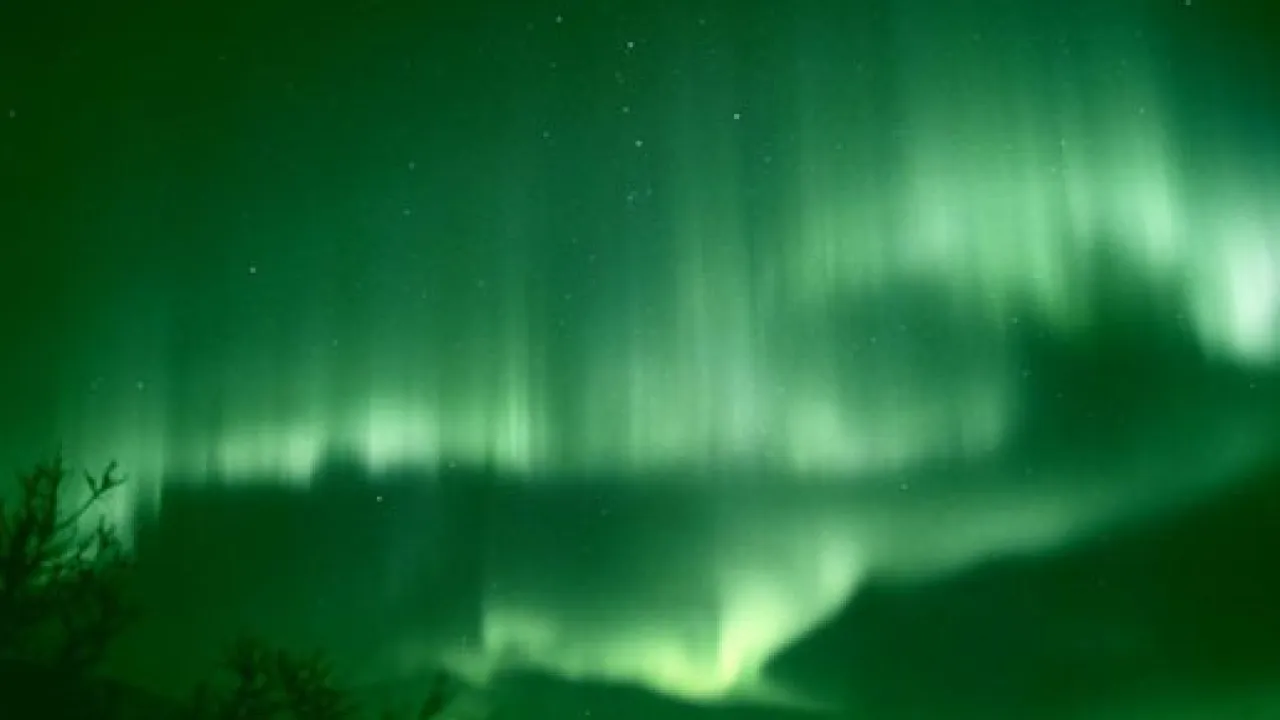
1. What does the solar wind push straight away from the Sun?
2. When does the Sun blow out the solar wind?
🤯 Mind-Blowing Fact • Grade 2
Apollo astronauts unrolled a sheet of shiny aluminum foil on the Moon like a sail to catch real solar wind particles and bring them home!
✨ Word Sparks (Grade 2 Glossary)
Tap 🔊 to hear
proton
Tiny particle with a positive electric charge
electron
Tiny negatively charged particle zooming in atoms
heliosphere
Giant space bubble blown by solar wind
🪝
Why does a comet's tail sometimes point AHEAD of the comet as it flies away from the Sun?
1
Too Hot to Stay Put
Up in the Sun's outer crown, gas heats past two million degrees Fahrenheit! Even the Sun's huge gravity cannot hold onto particles jiggling that fast. Streams of tiny and escape into space as the solar wind, racing outward at nearly one million miles per hour.
2
Nature's Space Windsock
Long before satellites launched, comets gave away the secret. Whether a comet flies toward the Sun or heads back out into deep space, its blue gas tail always points away from the Sun—pushed by this invisible breeze!
3
A Giant Cosmic Bubble
Far past Pluto, the solar wind inflates a huge protective bubble called the that shields planets from deep-space rays.
1. Why do particles in the Sun's outer crown escape to form the solar wind?
2. How did Apollo astronauts collect a sample of the solar wind on the Moon?
🤯 Mind-Blowing Fact • Grade 3
In 2018, Eugene Parker became the first living person in history to watch NASA launch a spacecraft named in his honor—the Parker Solar Probe!
✨ Word Sparks (Grade 3 Glossary)
Tap 🔊 to hear
supersonic
Traveling faster than the speed of sound
coronal hole
Cooler magnetic opening shooting fast solar wind
Mariner 2
Early NASA probe that measured solar wind
🪝
Why did editors laugh at the scientist who predicted the solar wind—right before spacecraft proved him 100% right?
1
Eugene Parker's Bold Idea
In 1958, a young astrophysicist named Eugene Parker calculated that the Sun's super-hot corona could not sit still. His math showed it must expand outward faster than sound! Reviewers doubted him at first, yet four years later NASA's spacecraft flew toward Venus and measured the nonstop solar wind firsthand.
2
Slow Streams and Fast Highways
Spacecraft soon found the solar wind blows at two main speeds. Slow solar wind drifts from the Sun's belt at about 250 miles per second, while fast solar wind blasts out of dark openings called at nearly 500 miles per second!
3
Planetary Shields Matter
Earth's liquid iron core generates a strong magnetic shield that parts the solar wind like water around a boat bow. Mars lost its global magnet billions of years ago, allowing solar wind to slowly strip away most of its ancient air.
4
Crossing the Heliopause
More than eleven billion miles away, NASA's twin Voyager probes finally crossed the edge where the solar wind stops and starry space begins!
1. Who calculated in 1958 that a supersonic wind must stream continuously from the Sun?
2. Why did ancient Mars lose most of its thick atmosphere to the solar wind while Earth kept ours?
🤯 Mind-Blowing Fact • Grade 4
Solar wind protons hitting oxygen inside Moon rocks actually forge tiny amounts of water molecules right on the dusty lunar surface!
✨ Word Sparks (Grade 4 Glossary)
Tap 🔊 to hear
Parker spiral
Pinwheel shape of the Sun's magnetic field
bow shock
Shockwave formed ahead of a planet's shield
astronomical unit
Average distance between Earth and the Sun
🪝
How does our spinning Sun twist a straight-line plasma wind into a giant cosmic garden sprinkler?
1
Comet Tails and Parker's Equations
In 1951, German astronomer Ludwig Biermann studied why a comet's ionized gas tail always points rigidly away from the Sun, even faster than sunlight pressure alone could push it. Seven years later, Eugene Parker solved hydrodynamic equations showing how a million-kelvin corona inevitably accelerates protons, electrons, and alpha particles to supersonic speeds.
2
The Parker Spiral
Because solar wind plasma conducts electricity, it drags the Sun's magnetic field lines outward as it flies straight into space. Meanwhile, the Sun rotates once every 27 days underneath! Just like water droplets flying straight out of a spinning lawn sprinkler trace curved arcs, solar wind winds the interplanetary magnetic field into a pinwheel called the .
3
Bow Shocks and Space Weathering
Where supersonic solar wind slams into Earth's magnetosphere at 400 to 800 kilometers per second, it forms a standing '' upstream of our planet. Airless worlds without global magnets—like Earth's Moon and Mercury—take the full blast directly on their rocks, darkening lunar soil through space weathering.
4
Cosmic Ray Armor
Out near 120 , the solar wind's heliosphere blocks roughly 70 percent of dangerous galactic cosmic rays launched by distant supernovae!
1. Why does the Sun's magnetic field curl into the 'Parker spiral' across the Solar System?
2. How does the solar wind's giant heliosphere bubble protect everything in our Solar System?
🤯 Mind-Blowing Fact • Grade 5
Electric-sail spacecraft concepts aim to unfurl miles-long charged wires to catch the pushing force of solar wind protons for fuel-free travel across the Solar System!
✨ Word Sparks (Grade 5 Glossary)
Tap 🔊 to hear
switchbacks
Sharp S-shaped magnetic zigzags in solar wind
heliopause
Outer boundary where solar wind meets interstellar space
Alfvén waves
Magnetic waves rippling through electrically charged plasma
🪝
What bizarre magnetic zigzags did NASA's Parker Solar Probe discover when it dove straight into the birthplace of the solar wind?
1
Transonic Escape From the Corona
Published in 1958 in The Astrophysical Journal after overcoming fierce skepticism, Eugene Parker's solar wind theory demonstrated that hydrostatic equilibrium fails inside an ultrahot, thermally conductive solar corona. Driven by steep thermal pressure gradients and , coronal plasma accelerates past both sound speed and magnetic Alfvén speed, continuously shedding roughly $1.3 \times 10^9$ kilograms of ionized hydrogen and helium every second.
2
Bimodal Wind and Magnetic Switchbacks
Ulysses, a joint ESA-NASA probe that looped over the Sun's poles in the 1990s, mapped two distinct regimes: dense, variable slow wind (~400 km/s) near the equatorial streamer belt, and tenuous, steady fast wind (~750 km/s) pouring from polar coronal holes. Diving within 8 million kilometers of the photosphere behind a carbon-composite heat shield, NASA's Parker Solar Probe uncovered whip-like magnetic zigzags—''—forged by interchange reconnection at supergranule boundaries that turbocharge the wind.
3
Planetary Atmospheric Erosion
Orbiting Mars since 2014, NASA's MAVEN spacecraft quantified how solar wind motional electric fields accelerate upper-atmosphere oxygen and carbon dioxide ions into deep space via ion pickup and sputtering. Without a global core-driven magnetic dynamo to stand off the supersonic plasma flow, ancient river-carved Mars lost the vast majority of its thick greenhouse atmosphere over billions of years, drying into today's arid polar desert.
4
Termination Shock and Heliopause
Near 85 to 95 astronomical units from the Sun, the expanding solar wind abruptly slows from supersonic to subsonic speeds at a standing wave called the termination shock, piling into the turbulent heliosheath before pressing against cold interstellar gas and magnetic fields at the (~120 AU)—the historic frontier crossed in situ by Voyager 1 in 2012 and Voyager 2 in 2018.
5
Astrospheres Around Other Stars
Infrared and ultraviolet space telescopes now image glowing bow shocks around fast-moving stars across the Milky Way, revealing vast 'astrospheres' sculpted by alien stellar winds and testing how stellar outflows shape exoplanet habitability.