🌌 COSMOS
🔭 Solar Magnetic Reconnection Flash • Heliospheric Physics
VA Science SOL 1.6, 4.5, 4.6 (Solar System, Stars & Space Exploration)
Solar Flare
Lightning-Fast Magnetic Flashes Erupting From Our Sun
Grade 5 • Advanced • 296 words
🌌 Cosmic Location & DistanceSolar Corona & Sunspot Regions • ~93 million miles (150 million km) away
🪐 Scale / DiameterLoops towering 10x Earth's width • Up to 10^25 joules of energy
☄️ Composition & OrbitX-rays, ultraviolet & radio waves • Reaches Earth in ~8.3 minutes
⚡ Cosmic SparkSnaps twisted magnetic rubber bands to unleash a billion-megaton flash at light speed
🤯 Mind-Blowing Fact • Grade 1
One big solar flare can unleash as much energy in minutes as billions of lightning bolts all striking at once!
✨ Word Sparks (Grade 1 Glossary)
Tap 🔊 to hear
burst
A sudden, strong pop of energy
magnetic
Having an invisible pulling and pushing force
static
Crackling noise on a radio signal
🪝
What happens when giant magnetic loops on the Sun suddenly snap and flash?
1
Flash on the Sun!
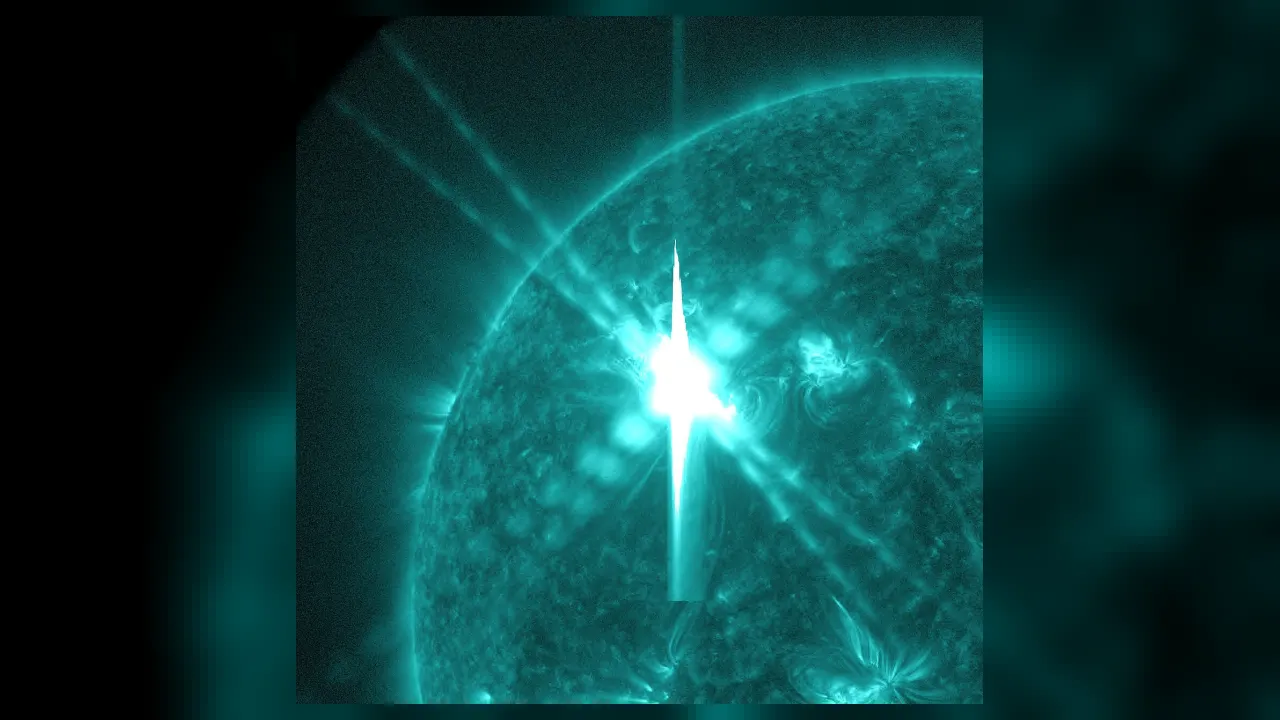
BOOM—without a sound in space, a blinding flash off the Sun! Energy shoots out in every direction. Scientists call this sudden burst of light a solar flare.
2
Racing at Light Speed
That bright flash races across space as fast as light can go. It reaches Earth in just over eight minutes! Our thick air keeps us completely safe on the ground.
3
Static on the Radio
Big flares can tickle the top of Earth's sky. Airplane and ship radios may buzz with for a little while.
1. How long does the light from a solar flare take to reach Earth?
2. What protects kids and animals on the ground from solar flare X-rays?
🤯 Mind-Blowing Fact • Grade 2
Scientists grade solar flares like spicy peppers from tiny A, B, and C flares up to strong M flares and monster X-class flares!
✨ Word Sparks (Grade 2 Glossary)
Tap 🔊 to hear
sunspot
A cooler, dark magnetic patch on the Sun
ultraviolet
High-energy light beyond purple our eyes miss
atmosphere
The protective layer of gases around a planet
🪝
How can twisting invisible magnets on the Sun create the biggest explosions in our Solar System?
1
Twisted Like Rubber Bands
Imagine twisting a giant bundle of rubber bands tighter and tighter until they suddenly snap! Our Sun spins faster at its middle than near its poles, tangling invisible magnetic lines above dark . When those tangled lines snap and reconnect, a dazzling solar flare erupts.
2
Invisible Light Waves
Most of a flare's power shines in X-rays and light that human eyes cannot see. Special space telescopes watch the Sun in extreme ultraviolet colors to catch every flash right away.
3
Space Weather Alert
Travelling at light speed, flare energy slams into Earth's upper in eight minutes. Astronauts in orbit duck into shielded rooms, while Earth's air keeps everyone below safe!
1. What causes a solar flare to suddenly erupt on the Sun?
2. Which letter marks the strongest class of solar flares?
🤯 Mind-Blowing Fact • Grade 3
In 1859, British astronomer Richard Carrington sketched a solar flare so intensely bright it shone like twin pearls even against the dazzling face of the Sun!
✨ Word Sparks (Grade 3 Glossary)
Tap 🔊 to hear
plasma
Super-heated electrically charged gas in stars
reconnection
Magnetic field lines snapping into a new shape
ionosphere
High sky layer filled with electrically charged air
🪝
Why do radio signals on only the sunny side of Earth suddenly go silent during a giant solar flare?
1
Magnetic Short-Circuits
Deep inside the Sun, churning hot generates powerful magnetic arches that loop high into the solar atmosphere. Above crowded sunspot groups, opposing magnetic loops twist and press together until they suddenly short-circuit in a process called magnetic . Instantly, stored magnetic tension converts into blazing heat and radiation!
2
Hotter Than the Sun's Core
Within seconds, a major solar flare heats nearby gas past 20 million degrees Fahrenheit—hotter than the very center of the Sun! It blasts electromagnetic energy across every wavelength, from radio waves and visible light to fierce ultraviolet rays and X-rays.
3
Daylight Radio Blackouts
Racing at 186,000 miles per second, those X-rays strike the sunlit side of Earth in 8 minutes and 20 seconds. They electrify the , soaking up high-frequency radio signals used by pilots and ships while leaving the nighttime half of Earth untouched.
4
Measuring Flare Power
Spacecraft rank flares on a tenfold scale—A, B, C, M, and X—where each step packs ten times more X-ray punch than the letter before it.
1. How much stronger is an X1 solar flare compared to an M1 solar flare?
2. Why does a solar flare radio blackout only hit half of Earth?
🤯 Mind-Blowing Fact • Grade 4
In November 2003, a monstrous Halloween solar flare burned so fiercely it overloaded NOAA's X-ray sensors, later estimated around a staggering X45!
✨ Word Sparks (Grade 4 Glossary)
Tap 🔊 to hear
differential rotation
Spinning at different speeds at equator and poles
chromosphere
Reddish middle layer of the Sun's atmosphere
photon
A tiny massless packet of light energy
🪝
What happens inside a twisted magnetic arch to heat solar plasma past thirty million degrees in seconds?
1
Differential Rotation and Tangled Loops
Because the Sun is a roaring sphere of plasma rather than solid rock, its equator completes a spin in about 25 days while its poles take roughly 35 days. This winds magnetic field lines tighter each week, forcing intense magnetic loops up through dark sunspot groups into the tenuous outer corona.
2
The Physics of Magnetic Reconnection
When oppositely directed magnetic field lines get squeezed together, they abruptly sever and snap into simpler shapes—an explosive event called magnetic reconnection. Like a colossal slingshot, reconnection accelerates electrons and protons to nearly half the speed of light, slamming them downward into the dense and superheating plasma past 30 million kelvins.
3
Flares Versus Particle Storms
People often confuse solar flares with coronal mass ejections (CMEs), though they often erupt side by side. A flare is pure electromagnetic radiation— of X-ray, extreme ultraviolet, and gamma light racing at light speed—whereas a CME hurls a slower cloud of heavy magnetized plasma across days.
4
Protecting Satellites and Astronauts
NASA's Solar Dynamics Observatory photographs the Sun every twelve seconds, watching X-class flares swell Earth's upper atmosphere, increase drag on low-orbiting satellites, and scramble GPS navigation timing.
1. How is a solar flare different from a coronal mass ejection (CME)?
2. How can an intense solar flare slow down satellites orbiting close to Earth?
🤯 Mind-Blowing Fact • Grade 5
Gamma-ray telescopes have detected solar flares smashing heavy nuclei together hard enough to create short-lived antimatter positrons right on the Sun's surface!
✨ Word Sparks (Grade 5 Glossary)
Tap 🔊 to hear
heliophysics
Science of the Sun and its space environment
logarithmic scale
Measurement scale where each step multiplies by ten
exoplanet
A planet orbiting a star outside our system
🪝
How can a single solar magnetic snap unleash ten million times the energy of a volcanic eruption—and warn us about distant alien worlds?
1
Carrington's White-Light Discovery
On September 1, 1859, amateur astronomers Richard Carrington and Richard Hodgson independently witnessed two blinding crescents of white light flare across a sprawling sunspot complex. Within five minutes the patches faded, marking humanity's first recorded solar flare. Today we know that flare released roughly 10^25 joules of energy—equivalent to tens of billions of megatons—forging the modern science of .
2
Magnetohydrodynamics and Particle Acceleration
Driven by the Sun's 11-year magnetic dynamo, buoyant flux tubes pierce the photosphere within complex delta-spot regions where opposite magnetic polarities collide. Inside thin current sheets high in the corona, magnetic reconnection converts non-potential magnetic energy into kinetic and thermal energy. Relativistic electron beams plunge down magnetic footpoints, producing hard X-ray bremsstrahlung radiation and evaporating chromospheric plasma up into glowing coronal arcades.
3
Logarithmic Classification and Ionospheric Impact
Geostationary GOES satellites continuously monitor solar X-ray flux between 1 and 8 angstroms, sorting eruptions along a base-10 (A, B, C, M, X). When an X-class burst strikes Earth's dayside D-region ionosphere 500 seconds after eruption, sudden ionospheric disturbances absorb high-frequency (3–30 MHz) radio transmissions across entire continents.
4
Superflares on Red Dwarf Stars
Kepler and TESS space telescopes revealed that cool, fully convective M-dwarf stars—the most common stars in our Milky Way—routinely unleash 'superflares' up to ten thousand times more energetic than the 1859 Carrington Event! Because habitable-zone around dim red dwarfs must orbit closer than Mercury orbits our Sun, repeated ultraviolet and X-ray superflares can photodissociate water molecules and strip entire planetary atmospheres away unless protected by fierce planetary magnetospheres.
5
Forecasting Space Weather
Modern observatories like NASA's Solar Dynamics Observatory, the IRIS ultraviolet spectrometer, and ESA's Solar Orbiter map photospheric magnetic twist and vertical current density hours before reconnection strikes. Machine-learning flare forecasts and real-time GOES X-ray alerts safeguard astronauts aboard the International Space Station and future Artemis lunar missions, while helping aviation dispatchers reroute polar transcontinental flights away from high-latitude radio blackouts.