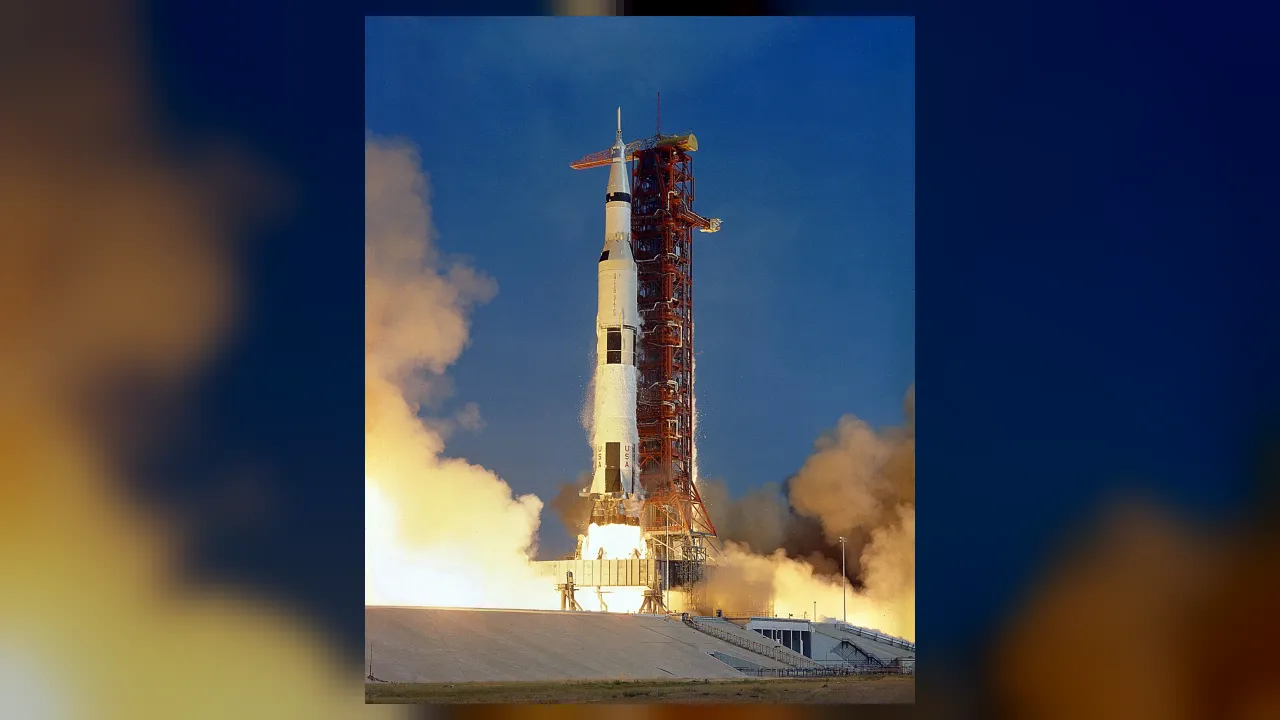
1. Why did Saturn V drop off sections as it climbed into space?
2. Where did the three Apollo astronauts sit during launch?
🤯 Mind-Blowing Fact • Grade 2
Saturn V's liftoff roar was so thunderous that spectators three miles away felt their clothes and chests vibrate with sound waves!
✨ Word Sparks (Grade 2 Glossary)
Tap 🔊 to hear
ignite
To catch fire and start burning fiercely
hydrogen
Lightest gas in the universe, used as rocket fuel
vibrate
To shake rapidly back and forth
🪝
How much fuel did the mighty Moon rocket gulp down every single second at liftoff?
1
Gulp Goes Twenty Tons!
Picture twenty elephants disappearing every second! When the five colossal F-1 engines at the base of this 363-foot giant ignited, pumps gulped twenty tons of kerosene and liquid oxygen every single second to lift 6.5 million pounds off the pad.
2
Three Stages Working Together
Stage one boosted the stack forty-two miles high in under three minutes. Next, five engines on stage two pushed almost to orbit, before stage three's single engine fired twice—first to circle Earth, then to slingshot toward the Moon!
3
Thirteen Flights, Thirteen Wins
Between 1967 and 1973, Saturn V launched thirteen times without ever losing a single astronaut or spacecraft!
1. How many elephants' worth of propellant did Saturn V's bottom stage burn every single second?
2. How many times did Saturn V launch successfully between 1967 and 1973?
🤯 Mind-Blowing Fact • Grade 3
Three real retired Saturn V rockets lie sideways inside museums in Florida, Alabama, and Texas today—letting visitors walk the entire length of a football-field-plus Moon machine!
✨ Word Sparks (Grade 3 Glossary)
Tap 🔊 to hear
crawler
Giant tracked vehicle carrying rockets to the launchpad
gyroscope
Spinning wheel sensor detecting any tilt or turn
acoustic
Related to sound waves and vibrations
🪝
Why did engineers spray hundreds of thousands of gallons of water underneath a blazing rocket at liftoff?
1
Taming Sound Waves With Water
Eight seconds before liftoff, giant pipes flooded the concrete trench below Pad 39A with water—not just to cool flames, but to muffle sound! Without that water cushion, echoes from 7.6 million pounds of F-1 engine thrust would bounce upward hard enough to shake the rocket's metal skin apart!
2
Hauling a Skyscraper on Tank Treads
Workers stacked all three stages indoors inside NASA's cavernous Vehicle Assembly Building. Then a monster -Transporter crept along a gravel road at just one mile per hour, keeping the 36-story rocket perfectly level all three miles to the pad.
3
A Ring-Shaped Computer Brain
Above the third stage sat a three-foot-tall ring built by IBM containing and a computer with less memory than a musical greeting card—yet smart enough to steer to the Moon!
4
One Final Gift: Skylab
On its thirteenth and final launch in 1973, a two-stage Saturn V lofted America's first space station, Skylab, into orbit.
1. What was the main job of the giant flood of water sprayed under Saturn V at ignition?
2. How fast did the giant Crawler-Transporter carry the stacked Saturn V to the launchpad?
🤯 Mind-Blowing Fact • Grade 4
Just thirty-six seconds after liftoff, lightning struck the Apollo 12 Saturn V rocket TWICE—and while cabin warning lights lit up like a holiday tree, the rocket's guidance ring kept flying straight to orbit!
✨ Word Sparks (Grade 4 Glossary)
Tap 🔊 to hear
regenerative cooling
Circulating cold fuel through engine walls to prevent melting
specific impulse
Measure of how efficiently a rocket uses propellant
combustion
Rapid chemical burning producing intense heat and gas
🪝
How do you keep a rocket engine bell from melting when the flames roaring inside it burn twice as hot as steel's melting point?
1
Regenerative Cooling Inside the F-1
Developed in Huntsville, Alabama under Wernher von Braun's team, Saturn V owed its liftoff muscle to Rocketdyne's F-1—still the most powerful single-chamber liquid-fueled rocket engine ever flown, producing 1.5 million pounds of thrust apiece! Flames inside each F-1 chamber raged near 6,000 degrees Fahrenheit, hot enough to liquefy steel in seconds. Engineers solved this with : before cold RP-1 kerosene even entered the fire, pumps routed it through hundreds of thin metal tubes lining the nozzle wall, chilling the metal while preheating the fuel!
2
Switching Gears to Cryogenic Hydrogen
Once the bulky first stage lifted the stack above thick lower air, efficiency mattered more than brute push. Stages two (S-II) and three (S-IVB) switched to liquid hydrogen chilled to minus 423 degrees Fahrenheit—delivering roughly forty percent more 'miles per gallon' () through six J-2 engines.
3
Apollo 6, Apollo 12, and Bulletproof Resilience
Saturn V proved astonishingly tough. Even when lightning struck Apollo 12 twice shortly after liftoff in 1969, scrambling spacecraft displays, the Saturn V's independent Instrument Unit ring kept steering calmly onto orbit! On Apollo 13, when a second-stage center engine shut down early from 'pogo' vibrations, the computer burned the outer four engines longer and saved the mission's path.
4
Benchmark of Deep-Space Flight
Accelerating forty-eight-ton Moon payloads to 24,200 miles per hour, Saturn V remains the only vehicle to send human beings to another celestial world—so far!
1. How did engineers stop the 6,000-degree flames inside each F-1 engine from melting its metal walls?
2. Why did Saturn V use dense kerosene in its bottom stage but switch to super-cold liquid hydrogen in its upper stages?
🤯 Mind-Blowing Fact • Grade 5
NASA purposefully crashed spent Saturn V third stages into the Moon so Apollo seismometers could hear the Moon 'ring like a bell' for hours and map its deep interior!
Rocket propellant pairing liquid hydrogen with liquid oxygen
redundancy
Backup systems ensuring one failure never stops a mission
🪝
How did 1960s engineers—calculating with slide rules and sewing core memory by hand—tame combustion instabilities that blew early Moon engines apart on test stands?
1
Taming Combustion Instability in the F-1
Answering President Kennedy's 1961 lunar challenge demanded a launch vehicle ten times more powerful than the Redstone that lofted Alan Shepard. Yet during early California desert firings, Rocketdyne's mammoth F-1 engine suffered violent combustion instability: acoustic pressure waves sloshed across its three-foot injector plate, ripping thick steel chambers to shreds in milliseconds! Across more than two thousand test-stand firings—even detonating small explosive charges inside running engines to test recovery—engineers perfected copper-baffled injector plates that damped pressure waves within a tenth of a second.
2
Lunar Orbit Rendezvous and Three-Stage Synergy
Standing 110.6 meters tall and massing 2,950 metric tons fueled, Saturn V embodied John Houbolt's Lunar Orbit Rendezvous architecture, enabling a single launch rather than multiple orbital dockings. Five F-1s propelled the Boeing-built S-IC stage to 68 kilometers; five North American J-2 engines carried the common-bulkhead S-II stage to 175 kilometers; and the Douglas S-IVB third stage parked Apollo in low orbit before reigniting its J-2 engine in zero gravity for Translunar Injection at 10.8 kilometers per second.
3
Triple-Modular Redundancy in the Instrument Unit
Nested beneath the Lunar Module adapter panels sat the 91-centimeter-tall IBM Launch Vehicle Digital Computer. Built with triple-modular-redundant logic circuits—where three parallel pathways voted on every calculation so a single cosmic ray or transistor fault couldn't veer the rocket—it steered smoothly using just 70 kilobytes of magnetic-core memory!
4
Seismic Science From Spent Stages
Nothing went to waste: starting with Apollo 13, controllers deliberately aimed empty S-IVB third stages to crash onto the Moon so seismometers left by earlier astronauts could listen to deep lunar echoes and map the Moon's internal crust and core!
5
Immortal Titan of Aerospace
Across ten crewed Apollo missions (Apollo 8 through 17), two uncrewed tests, and the Skylab orbital workshop launch, Saturn V delivered 140 metric tons to Low Earth Orbit and 48.6 metric tons to the Moon—cementing an unbroken legacy of engineering audacity.