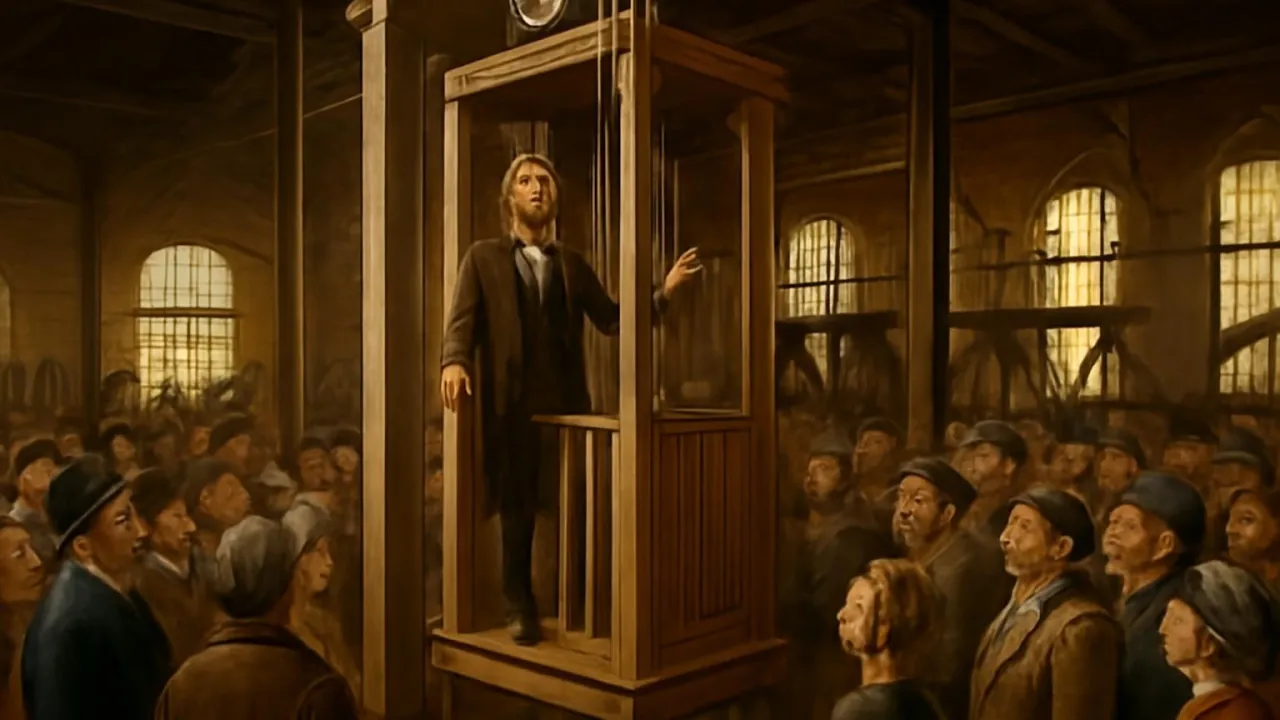
Elisha Otis once cut the elevator rope at a fair to prove his safety brake worked!
✨ Word Sparks (Grade 2 Glossary)
Tap 🔊 to hear
invent
To make something new
brake
A part that stops things moving
rails
Long bars that guide elevators
🪝
Have you ever wondered how elevators keep you safe as you rise?
1
Riding Up High
When you step into an elevator, you hear a gentle whirring sound. The doors close, and you feel the floor move. Elevators lift people to the tops of tall buildings every day.
2
A Clever Safety Trick
Elisha Otis invented a special for elevators in 1852. If the rope ever snaps, the brake grabs the tightly. This clever idea keeps everyone inside safe and sound.
3
Changing the City
Elevators made it possible to build skyscrapers that touch the clouds. Now, people can live and work high above the busy city streets. Cities grew up, not just out, thanks to this invention.
Elisha Otis amazed a crowd in 1854 by cutting the elevator rope and showing his brake in action!
✨ Word Sparks (Grade 3 Glossary)
Tap 🔊 to hear
mechanism
A group of working parts
friction
Rubbing that slows or stops things
skylines
Shapes of tall buildings in a city
🪝
Can you imagine standing in a box that rises safely above the ground?
1
The Magic of Moving Rooms
When you enter an elevator, you might hear a gentle hum and feel a tiny shake. The doors close tightly, and the elevator begins to rise smoothly. People use elevators every day to reach high places in buildings. Without elevators, climbing many stairs would be very tiring and slow.
2
The Invention of Safety
In 1852, Elisha Otis invented a safety brake for elevators. His device used a spring-loaded that grabbed the guide rails if the lifting rope broke. This important invention stopped the elevator from falling quickly. The safety brake made people feel much safer riding to higher floors.
3
How Elevators Work
Elevators move using a strong rope and a motor that pulls the car up and down. The safety brake is a mechanical device that uses force and to grip the rails. If the rope snaps, the brake’s spring pushes metal arms into the rails, stopping the elevator. This engineering breakthrough made tall buildings possible.
4
Changing Cities Forever
Before elevators, most buildings were only a few stories tall. After Otis’s invention, architects could design skyscrapers with many floors. Elevators changed city and made it easier for people to live and work in tall buildings. Today, elevators help millions of people move safely every day.
2. Why are elevators important for tall buildings?
🤯 Mind-Blowing Fact • Grade 4
The world’s fastest elevators today can travel over 45 miles per hour in super-tall skyscrapers!
✨ Word Sparks (Grade 4 Glossary)
Tap 🔊 to hear
plummet
To fall very quickly
mechanical engineering
Designing and building moving machines
demonstration
Showing how something works to others
🪝
What would you do if you had to climb fifty flights of stairs every day?
1
A Leap in Lifting
Imagine the clanging of gears and the soft whoosh as an elevator rises. Before elevators, most people could only live or work on low floors because stairs were exhausting. The invention of the safety elevator changed all that, making it possible for buildings to reach for the clouds. Suddenly, cities could grow upward instead of just outward.
2
Otis’s Ingenious Brake
Elisha Otis invented the first practical safety brake for elevators in 1852. His device used a spring-loaded mechanism that would instantly clamp onto the guide rails if the lifting rope broke. This mechanical breakthrough relied on friction and force to stop the elevator car from plummeting. Otis’s public at the 1854 New York World’s Fair convinced people elevators could be safe.
3
Engineering the Elevator
Elevators use a strong steel cable wound by a motor to lift and lower the car. The safety brake, hidden beneath the floor, is always ready to spring into action if needed. When the cable snaps, a spring triggers metal arms to grip the rails tightly, using friction to halt the car. This system is a great example of and safety working together.
4
Changing the World’s Skyline
The safety elevator made skyscrapers and high-rise living possible for millions of people. Architects could now design buildings with dozens of floors, forever changing city skylines around the world. Elevators also made life easier for people with disabilities or heavy loads. Today, Otis’s invention helps billions of safe elevator rides happen every year.
1. What did Otis’s safety brake use to stop the elevator?
2. How did elevators change city buildings?
🤯 Mind-Blowing Fact • Grade 5
The world’s tallest building, the Burj Khalifa, has 57 elevators—including double-decker cars that travel over 1,600 feet!
✨ Word Sparks (Grade 5 Glossary)
Tap 🔊 to hear
potential energy
Stored energy that can be used
redundant
Extra systems for extra safety
regenerative braking
Brakes that turn motion into electricity
🪝
What if a single invention could turn a city’s dreams skyward—and keep every rider safe?
1
The Dawn of Vertical Cities
Picture the echoing clang of iron and the excited murmurs of a 19th-century crowd as Elisha Otis stands atop an open elevator platform. Before his invention, most buildings were limited to five or six stories, since climbing higher by stairs was impractical for most people. The invention of the safety elevator in 1852 marked a turning point in urban architecture, enabling cities to expand vertically instead of sprawling outward. Otis’s dramatic demonstration at the 1854 New York World’s Fair, where he cut the elevator’s hoisting rope and the car stopped safely, stunned onlookers and proved that elevators could be trusted.
2
Engineering a Revolution in Safety
Otis’s safety elevator relied on a simple yet brilliant mechanical principle: a spring-loaded safety brake. This brake was designed to engage automatically if the hoisting cable broke, forcing two metal arms outward to grip the elevator’s guide rails with tremendous friction. The physics behind this system involves the conversion of into frictional force, rapidly halting the elevator’s descent. This breakthrough not only saved lives but also made the construction of taller buildings both practical and popular.
3
How Elevators Work: Mechanics and Modern Innovations
Traditional traction elevators use a steel cable looped around a motorized pulley, with a counterweight balancing the car’s load. The safety brake mechanism, hidden beneath the car’s platform, is always ready to activate if the cable fails. Modern elevators feature advanced electronic sensors, emergency brakes, and even double or triple safety systems. Today’s fastest elevators, like those in Shanghai Tower, can travel at speeds exceeding 45 miles per hour and use aerodynamic design to reduce vibration and noise.
4
Transforming Skylines and Societies
The safety elevator’s impact on society is enormous, enabling the rise of skyscrapers, high-rise apartments, and accessible public buildings. Cities like New York, Chicago, and Dubai owe their iconic skylines to this invention, which allowed architects to design structures over 100 stories tall. Elevators also play a crucial role in accessibility, making upper floors available to people with mobility challenges and enabling efficient vertical transportation for millions every day. The global elevator industry now supports over 18 million elevators worldwide, carrying billions of passengers safely each year.
5
From Otis to the Future: Evolving Upward
Since Otis’s time, elevator technology has continued to advance, with magnetic levitation (maglev) elevators and smart digital controls now being developed. Engineers are exploring energy-efficient designs, systems that feed power back into the grid, and even cable-free elevators that move both vertically and horizontally. The safety elevator not only transformed the way we build and live but also continues to inspire new innovations in urban transportation and engineering.